NORMAL SERVICE IS RESUMED
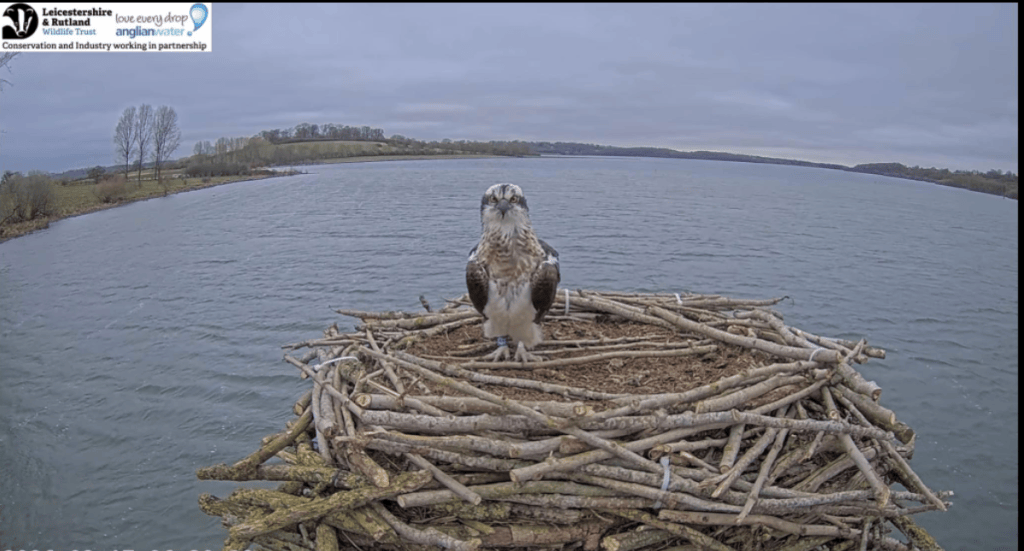
BLUE 25(10) started the season by landing on the Manton Bay nest on the 15/03/26 at 12:29, she is usually the first to return and this year was no exception. She was joined at Rutland by her long term partner Blue 11(10) 4 days later making them the first pair known to have returned this season. They have been the resident pair at Rutland Water Site C since 2013, This year they went on to produce one female chick.
The season also started with news of new Cameras Friends of the Osprey PC Nest in the Glaslyn Valley, Rutland Water Lagoon 4, Border Ospreys and on the Bassenthwaite Nest in collaboration with the Lake District Wildlife Park. Camera upgrades were also reported at Manton Bay, Dyfi, and Glaslyn. A little later in the season Forestry England and Kielder Osprey Project had cameras on nests 1A, 7 and 12 at Kielder Forest.
The amount of cameras available to watch live this year has grown once again, with well over 30 cameras available to view UK nests. See below.
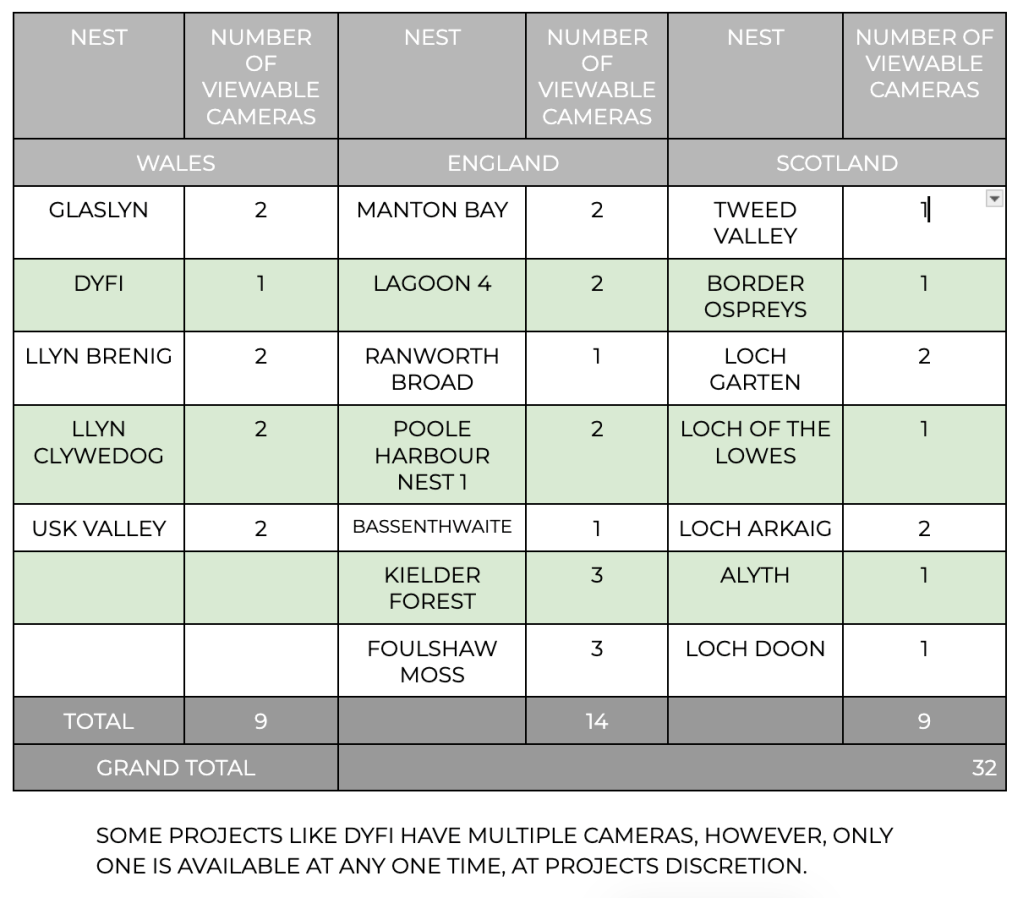
There also appears to have been a significant shift in another area this season.
Access to Information.
The stand out projects, Dyfi, Kielder, Glaslyn, Tweed Valley and Loch Arkaig have continued their excellent work, However, Rutland Osprey Project have shared considerably more information this season, including a full list of ring numbers. Friends of the Osprey in collaboration with Glaslyn have live streamed the Pont Croesor Nest in the Glaslyn Valley, which has been a real treat to watch. Then there is Bassenthwaite, For the first time since at least 2019 the chicks were ringed and the information shared, there was also a camera which allowed some live watching of the nest, thanks to the Barnes family and the Lake District Wildlife Park for this. Other projects Birds of Poole Harbour, Llyn Brenig, Usk Valley Ospreys have continued their good work. A project that also deserves a mention for how to handle sensitive information in a timely manner is Llyn Clywedog, John Williams and the team had the task of managing and sharing a very difficult situation, when all 3 chicks were lost at Llyn Clywedog nest 1, despite the personal hurt felt by the team, they shared the information in a very professional and sensitive manner.
MORVEN WHITE PE(03)
We started last year’s Season summary talking about White PE (Morven) well she turned up again this year at the DYFI OSPREY PRJECT on 24/04/26. Is she currently the oldest ringed bird in th UK?
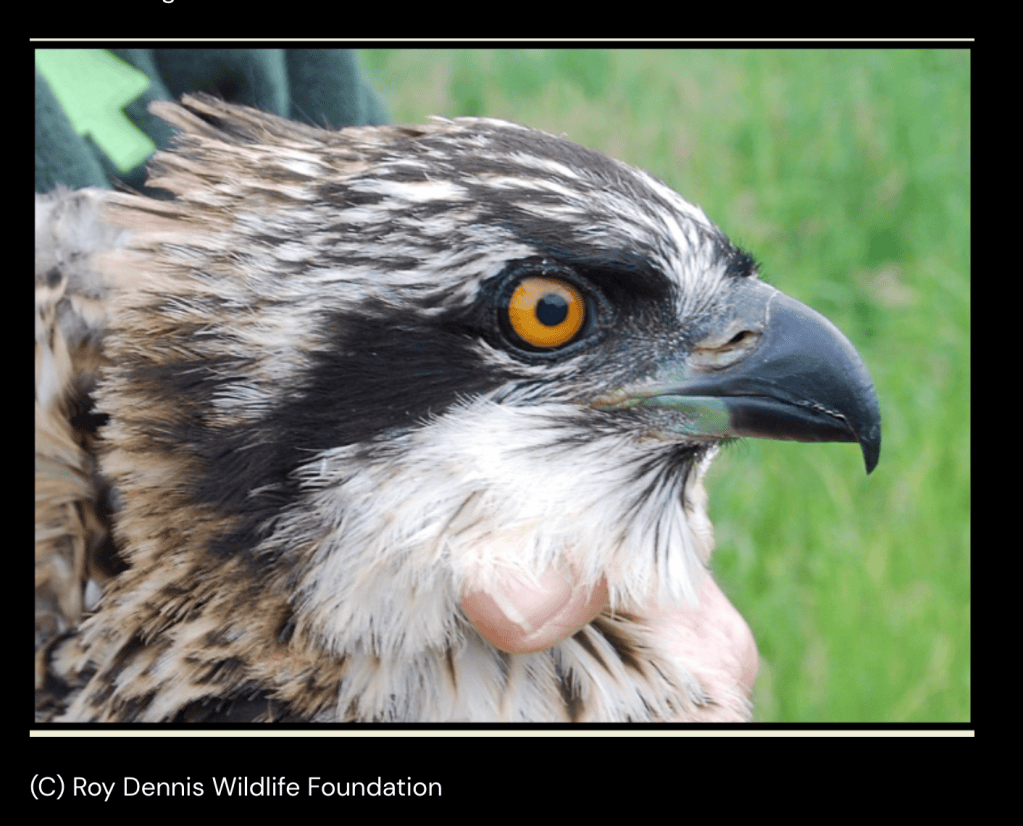
Her story can also be found at.
https://www.dyfiospreyproject.com/blog/emyr-mwt/morven-osprey-royalty-visit-today
CONTENT
The accuracy of reports credited to individuals is their responsibility, UKOI has not fact checked those reports. We have asked that all information is gained from public sources and that any media used is used with permission of the owner. All reports are intended to promote Projects, conservation and inform through sharing information.
INDIVIDUAL NESTS
SCOTTISH NESTS

ALYTH SUBSTATION
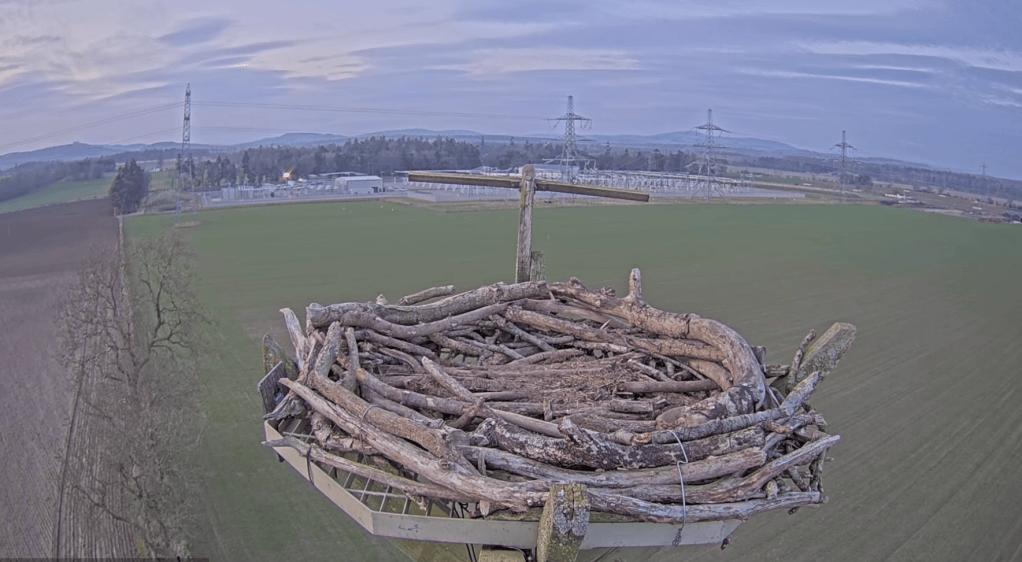
Alyth 2026 Season Summary.
On the 14th of March 2026 the camera went live. This was earlier than usual for Alyth and followed the sighting of an Osprey in the area on reported Bird Guides.
However the nest remained empty until the 22nd of March when an Osprey (thought to be NC0) landed. The Osprey had a BTO ring but no Darvic ring and NC0 is a known early returner who has previously nested at Loch of the Lowes. She was positively identified by followers.
Following NC0’s visit there was no further activity on the nest until Blue 726 landed at 12.09 on 2nd April. He had been ringed in the Tweed Valley in 2022.
Later that day Flora (Blue HK0) returned home to Alyth. It was wonderful to see her. She busied herself bringing sticks and improving the nest. On the 6th of April at 11.30 Harry landed on the nest. He had a large whole fish in his talons.
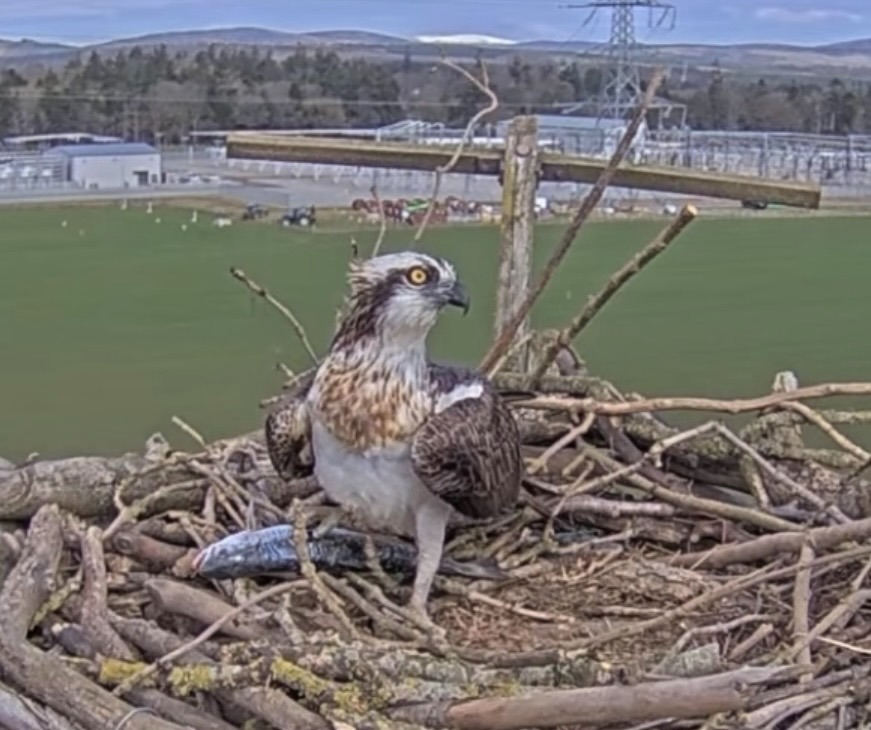
Unfortunately Flora wasn’t there to receive it. So Harry departed. An unringed female then landed, but was evicted by Flora. Harry landed again at 14.37 and was chased by Flora. Harry departed and later returned with a partial fish for Flora. Life at Alyth continued as expected, with nest building mating and regular fish deliveries.
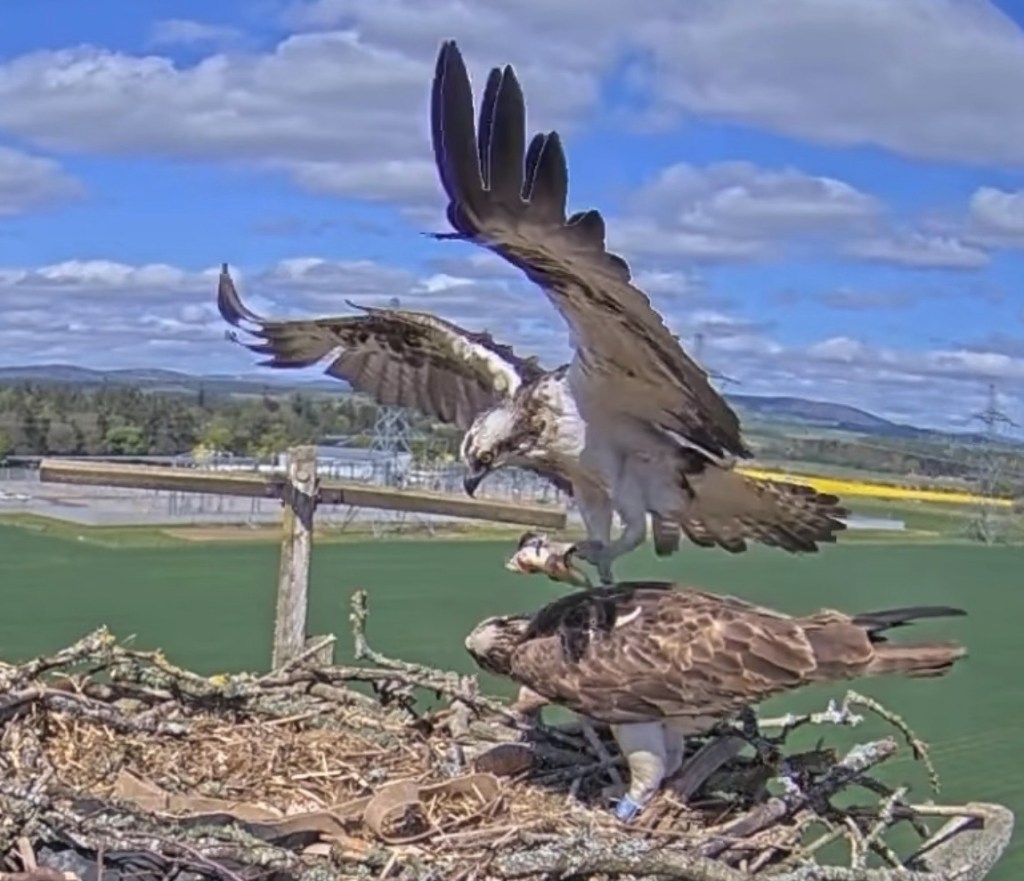
On Saturday the 18th of April Flora laid the first egg of the season and settled to incubate. Two further eggs were laid on the 21st and 23rd of April.
This season the Corvid activity at Alyth was unusually aggressive – far more so than in previous years. Harry, who used to be very active in chasing them, didn’t seem to be doing as much this year. Flora on the other hand was chasing them more.
On the 23rd of April an Unringed Male attempted to land on the nest. Flora angrily flapped him away and this turned out to be Clyde. He seemed to be showing interest in the nest and always seemed to be about when Harry was away fishing. Clyde had previously raised chicks with Darden Blue 210 at the Bridge of Cally and after their nest was cut down, Darden moved to Loch of the Lowes. Clyde was prospecting for an alternative nest.
On the 17th of May at 11.01 Harry delivered a large headless flounder to Flora. She took it and flew. Harry took over incubation duties and Flora returned with the fish at 11.40. Harry then flew and sadly this was the last time he was seen at Alyth.
On the 18th May, an Unringed male (possibly Clyde) flew over a couple of times. There was no sign of Harry. On the 19th the weather at Alyth was atrocious and Flora remained incubating the eggs. She called loudly, but there was no sign of Harry. On the 20th of May at 17.23 Flora left the nest to fish. Within moments of her leaving the Corvids moved in and destroyed all 3 eggs. Sadly Flora returned to an empty nest. Something catastrophic must have happened to Harry. There is no way he would have abandoned Flora and the eggs. He would have done everything possible to raise chicks. Being unringed we have no way of knowing how old Harry was. With hindsight, it seems he was slower this season. He has raised many chicks here over a number of years with Flora. Alyth chicks are unringed due to the height of the nesting platform. However last year, when dangerous items were removed from the nest the opportunity was taken to ring the chicks. They had been named by the Meigle school children. They were:
Forest Blue 7L0 Marlow Blue 7L1 and Oakley Blue 7L2.
Sadly Oakley perished on the nest. However Forest and Marlow went on to safely fledge. Hopefully we will see them return next year and Harry and Flora’s legacy will be seen to continue.
After the sad loss of Harry it seemed like the season was over at Alyth. Whilst there were no chicks to follow, there was a lot of Osprey activity. After the loss of Harry and the eggs, Flora wasn’t seen much at Alyth. She left, but did make fleeting visits back. Flora was last seen at Alyth on the 10th of July.
Throughout the year, Clyde took an interest in the nest and worked extremely hard building and improving it. An Unringed female has appeared on a number of occasions (referred to as Isla) and Clyde attempted to mate with her on several occasions. However she did not remain at Alyth.
There were also a number of ringed intruders at the nest.
Blue AV6 landed on 10th of June (ringed in 2018 near Inverness). She had previously intruded at Alyth in 2023
Blue 718 landed 7th July (ringed at Balgavies July 2023)
Blue 1L1 (also ringed at Balgavies in July 2024) visited on a couple of occasions.
Blue 6K0 ( no information Available )
Blue 578 ringed by Justin Grant near Bonar Bridge on 09/07/2020. This is thought to be the first sighting since its first migration.
Blue KU5 (a female ringed at Balgavies).
From the 11th of August NC0 and Clyde were spending a lot of time at Alyth. Clyde continued to build up the nest and to deliver fish to NC0 and there were mating attempts (mostly rebuffed by NC0) but she was pleased to receive the fish.
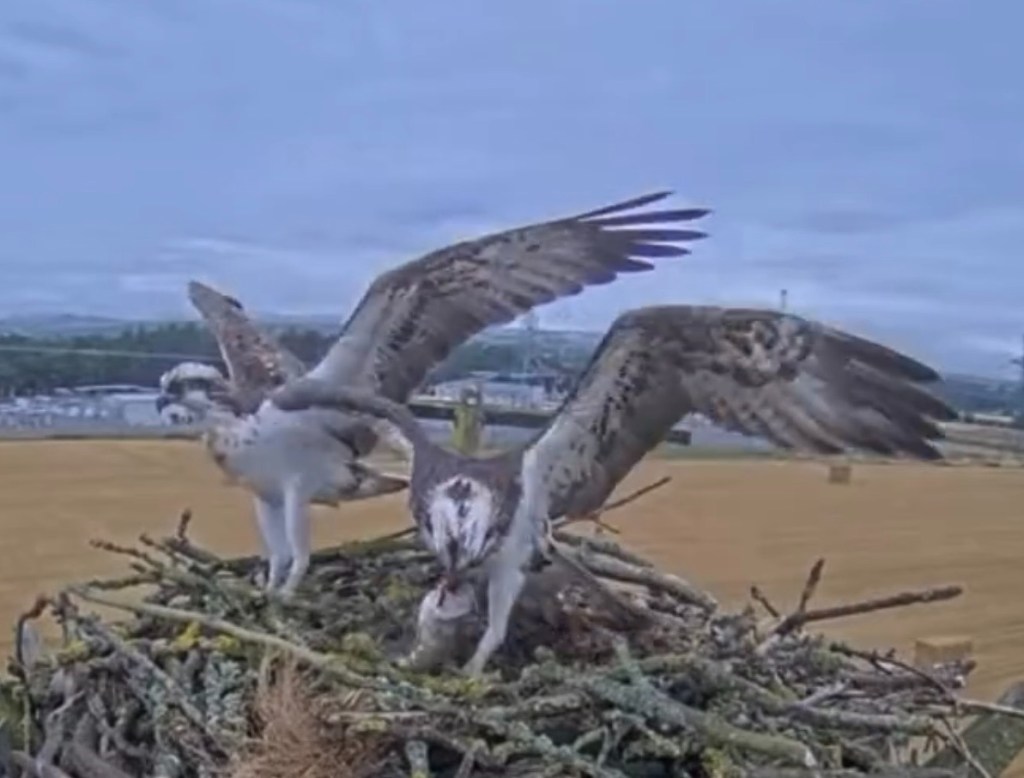
NC0 and Clyde were last seen on the 23rd and 27th August respectively.
Hopefully all the Ospreys will return safely.
Sadly this won’t include Harry, however he will be remembered with great warmth and fondness. He was an awesome Osprey.
Fly high Harry, you always will be in our hearts.
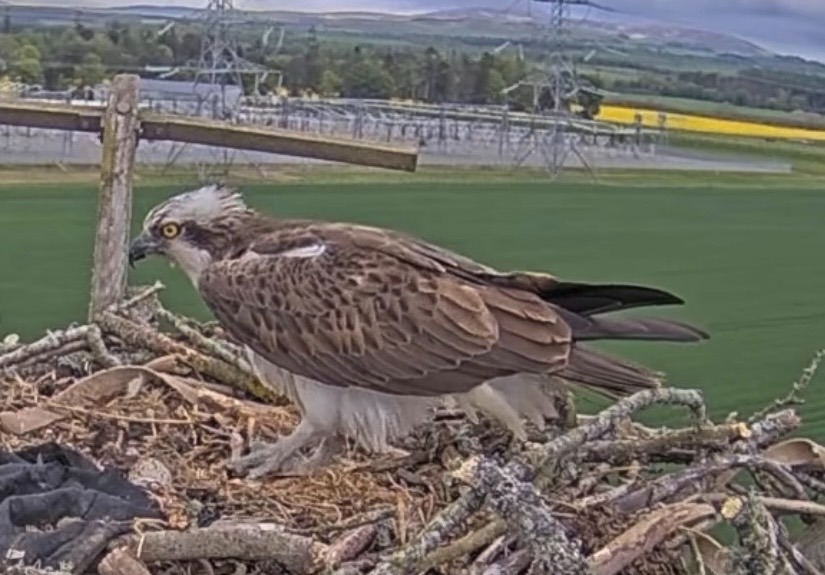
Many thanks to SSEN, Wildlife Windows, to all the contributors of The Alyth Document, to those that contributed to Friends of Alyth Ospreys and to the watchers who watched the live stream and left valuable time slots on You Tube and Discord.
(C) RUTH BOUGHTON and LIVIA ARMSTRONG
ALYTH NEST WATCH
ARGATY
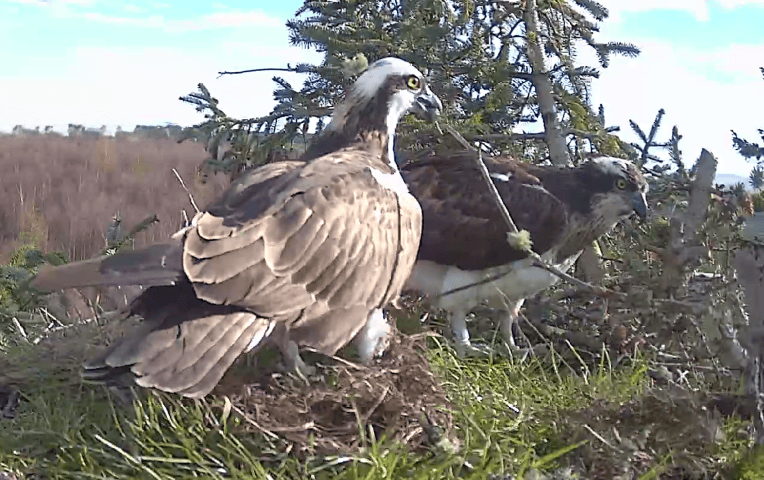
Argaty Osprey 2026
The web cam had not been working properly but it would seem the birds arrived early April. Both adults had lost their Darvic rings but by looking at photos from earlier years it was determined that they were the resident pair. They set about getting the nest ready and chasing off intruders. The cam worked on and off for a short time but on the 24th April it failed. The very last frame appeared to show NF3 incubating.
The nest was observed as well as it could be under the circumstances and on 10th July 2 very healthy male chicks were ringed 7S0 and 7S1
(C) MARION MOORE
BALGAVIES LOCH
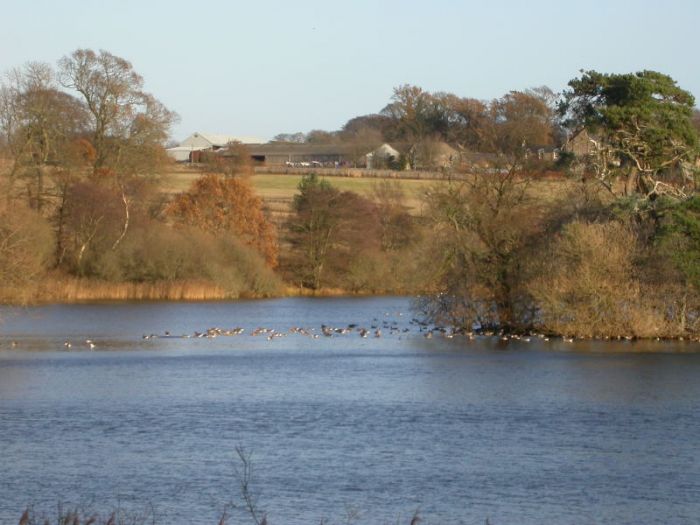
Male:- KR3(16), Returned 06/04/26, Last seen Guardbridge 06/09/26
Female:- Unringed Mrs BF, Arrived 07/04/26
Interestingly Unringed Mrs BF bred at this nest up to 2024, she was evicted in 2025 but returned to the nest once again this year.
Although at least one chick hatched, the nest failed, it is unclear whether this was due to bad weather or predation.
KNOWN BALGAVIES RETURNERS 2026
BLUE 718(23)
BLUE 1L1(24)
Both birds intruded Alyth substation Nest.
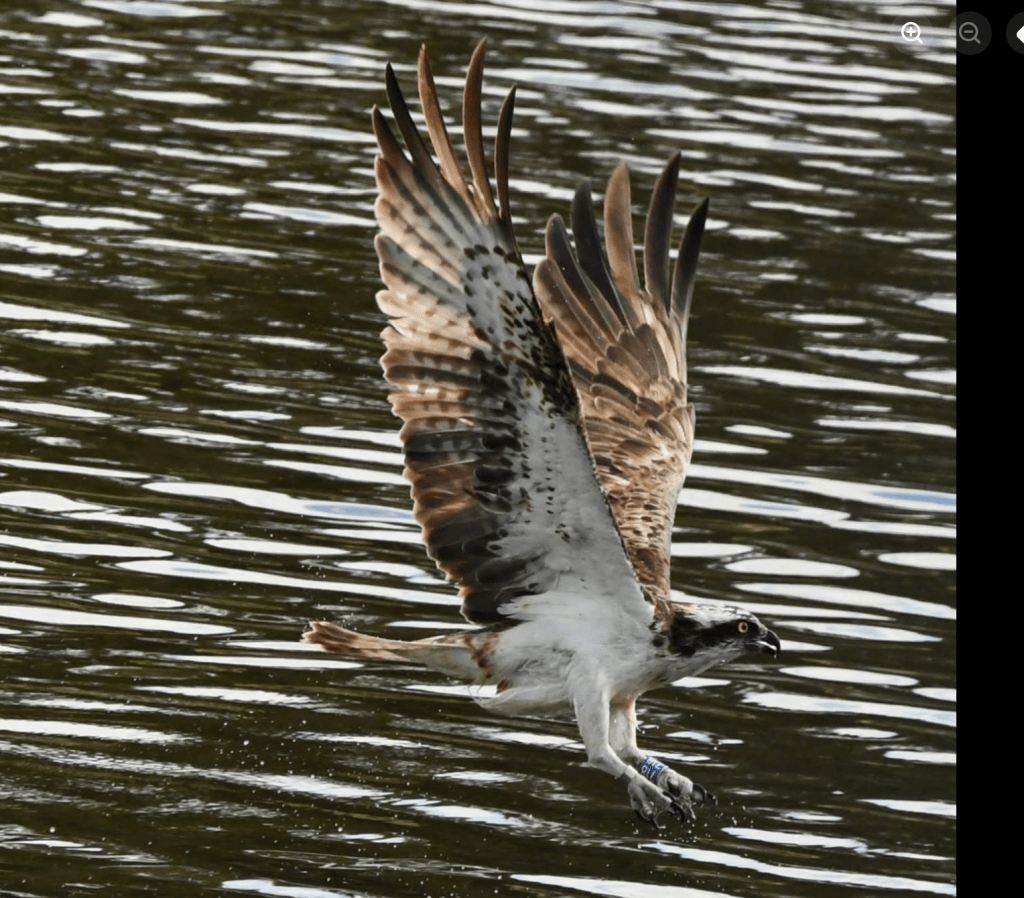
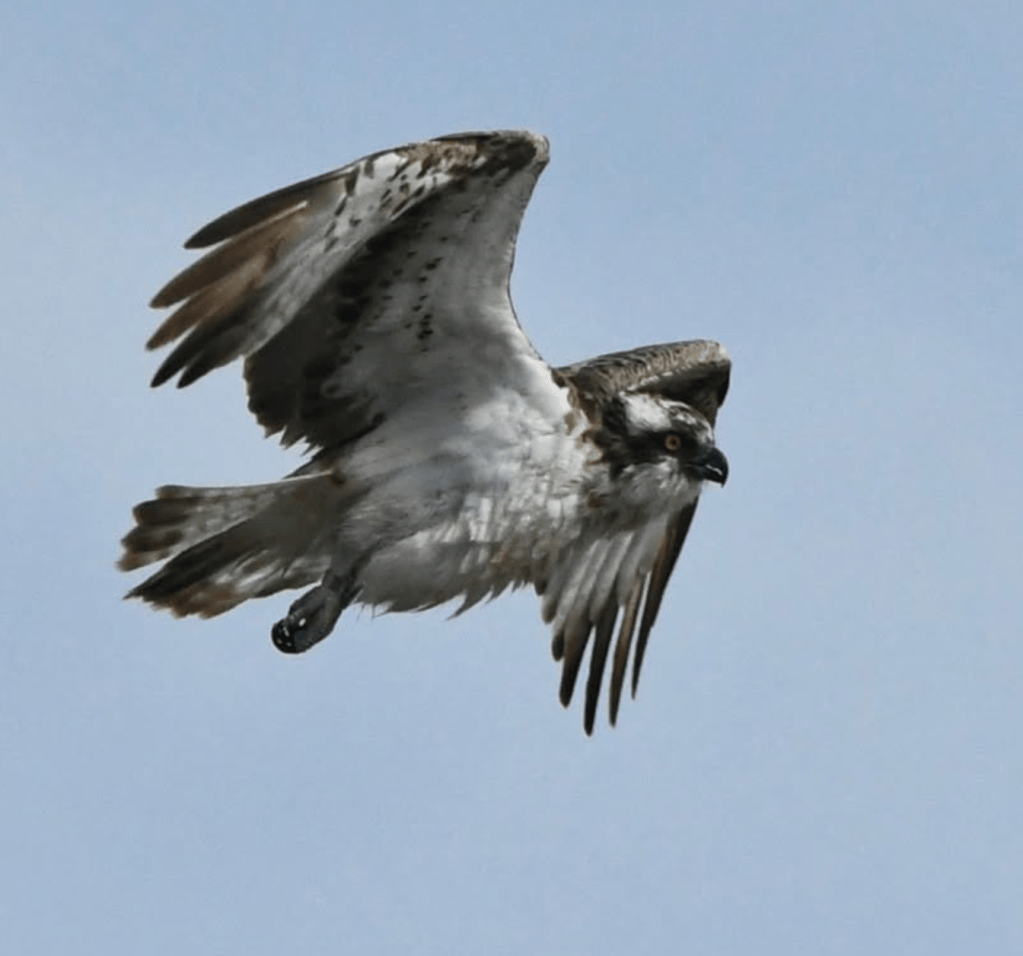
PHOTOGRAPHED AT THE EDEN ESTUARY BY CAROL BONE 31/08/26
BORDER OSPREYS
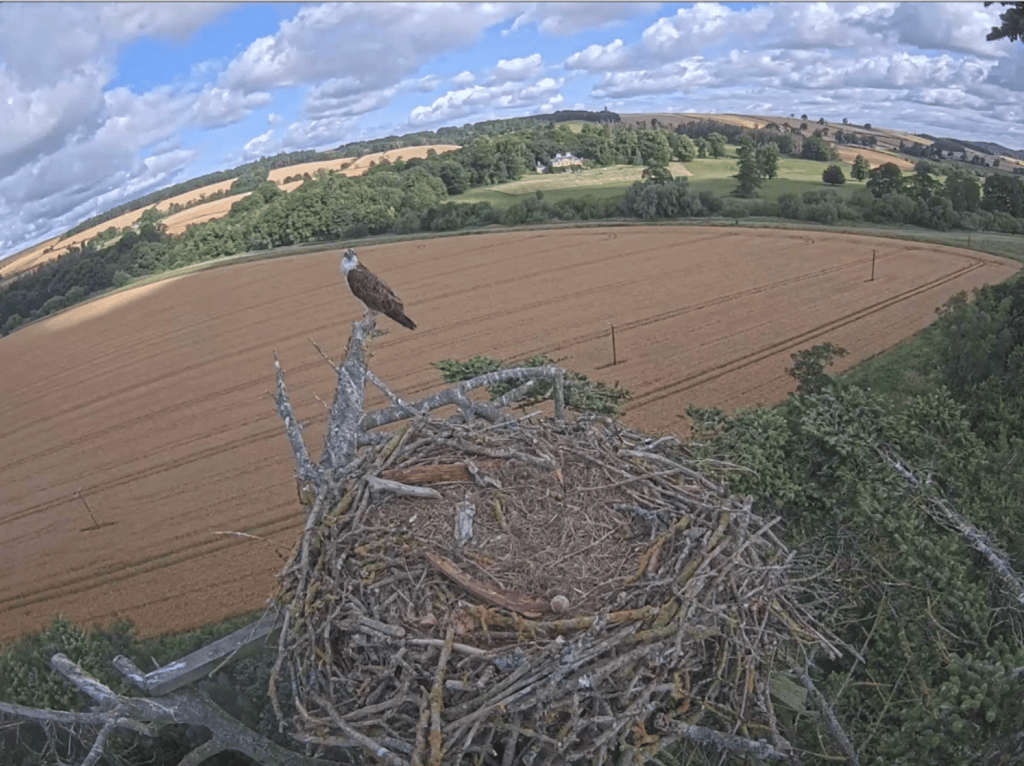
(C) Border Ospreys/Rosie Shields
Male:- Unringed Samson, Returned 28/03/26
Female:- Blue 500(20) Augusta, Returned 06/04/26
NEST HISTORY
Border Ospreys :_ Live Camera, for the first time it is now possible to follow the nest live, Link:-
https://www.youtube.com/watch?v=O7gM-tkGIXY
It is not possible to summarise this nest anywhere near as well as Rosie Shields does in her regular blogs, her intimate knowledge of this nest gives an interesting and personal insight into the Osprey World. We recommend to sign up to recieve Border Osprey’s regular blogs throughout the season.
LOCH GARTEN
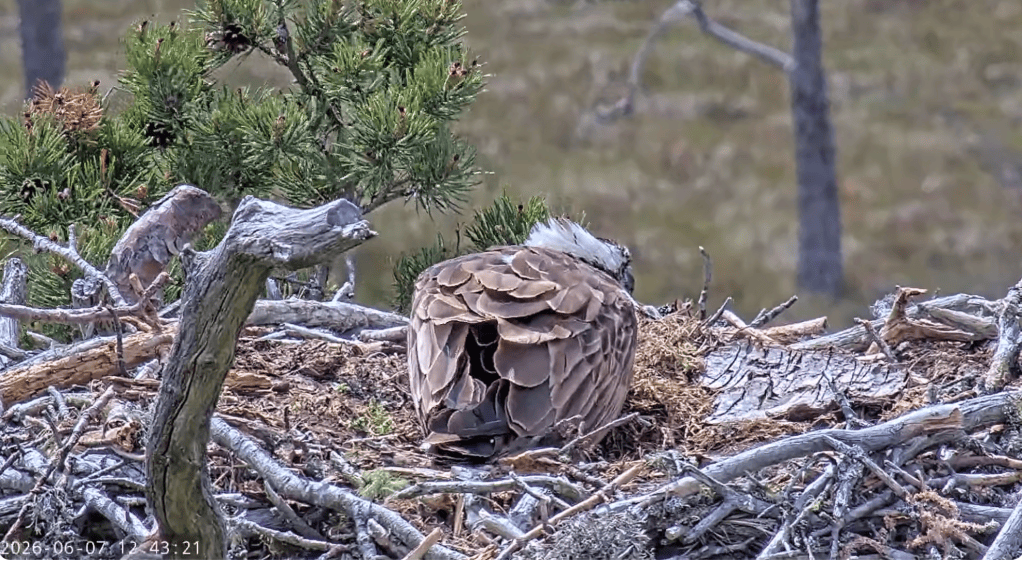
(C) RSPB/Loch Garten Abernethy
Male:- Blue KL5 (Darvic ring lost) arrived, 13/04/26, Last seen 14/05/26
Female:- Unringed Myrtle, arrived 10/04/26 (see nest/Chick details) Last seen 17/08/26
The season appeared to have a positive start, however things soon changed, events are best read on the official updates below.
Loch Garten was the original starting point of Ospreys returning to the UK after many barren years, albeit not the original nest site. In the last few years it appears to be suffering from the population growth in the region, as the area moves to a maximum carrying capacity, there is more competion for nest sites, partners. It also follows that there will be more nest disturbance, the last few seasons at this nest have been unsettled and fraught with disturbance, this year being no exception. KL5 going missing early possibly due to intruder battles, which certainly didn’t help with stability.
RSPB LOCH GARTEN UPDATES
NEST/CHICK DETAILS
LOCH GARTEN SYNOPSIS
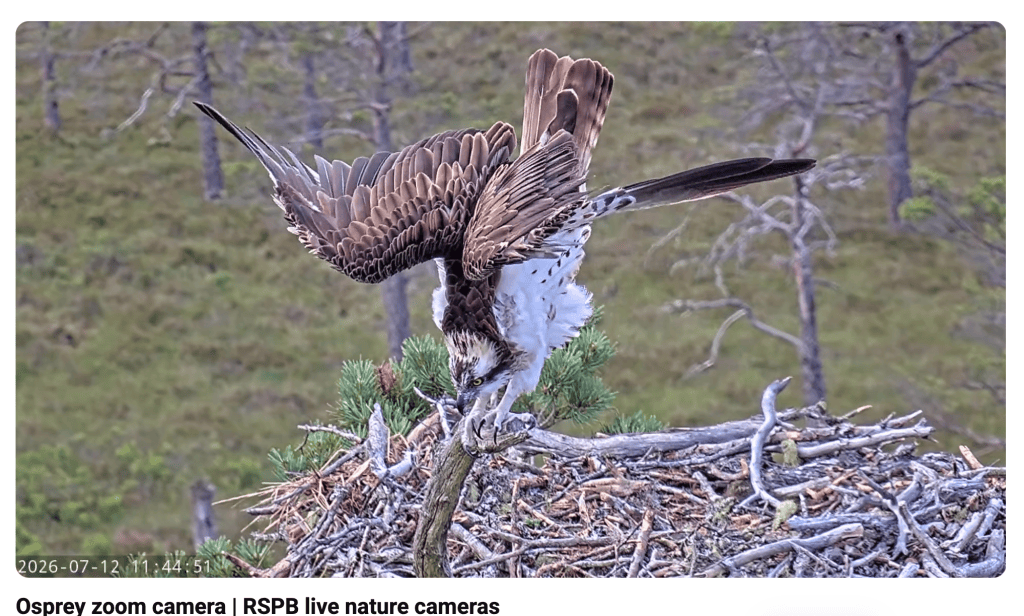
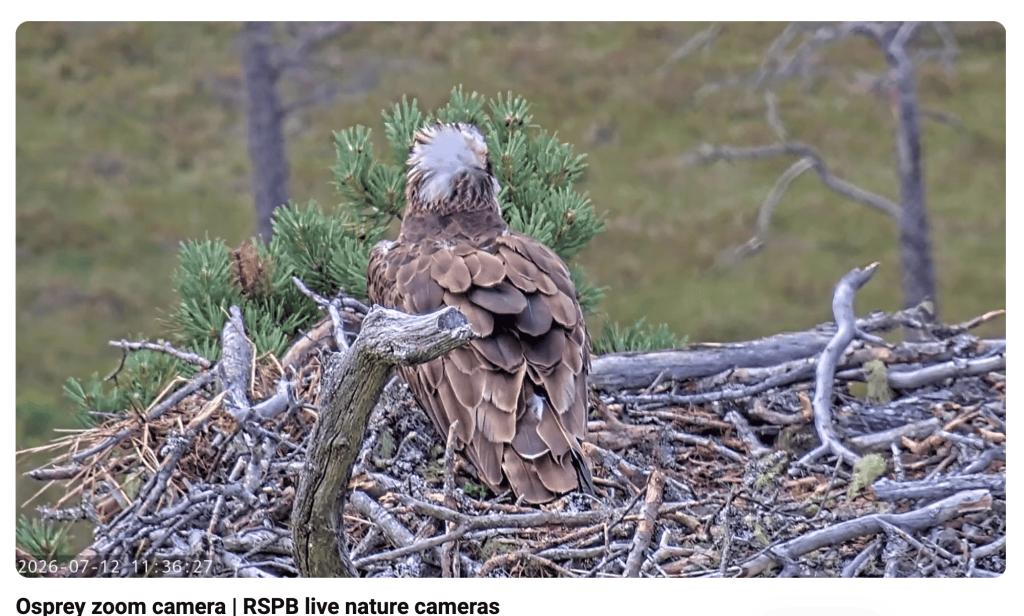
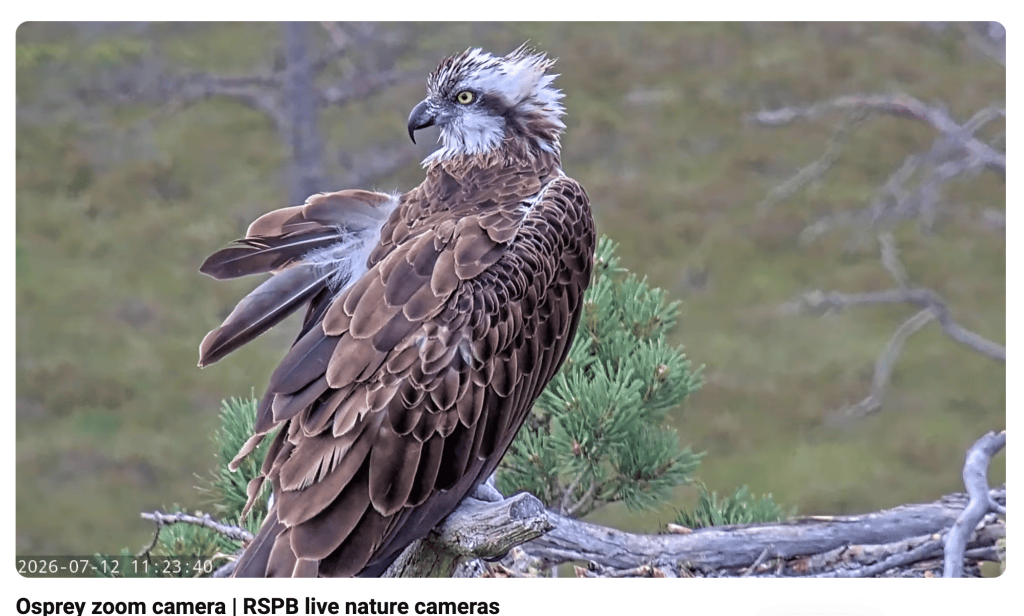
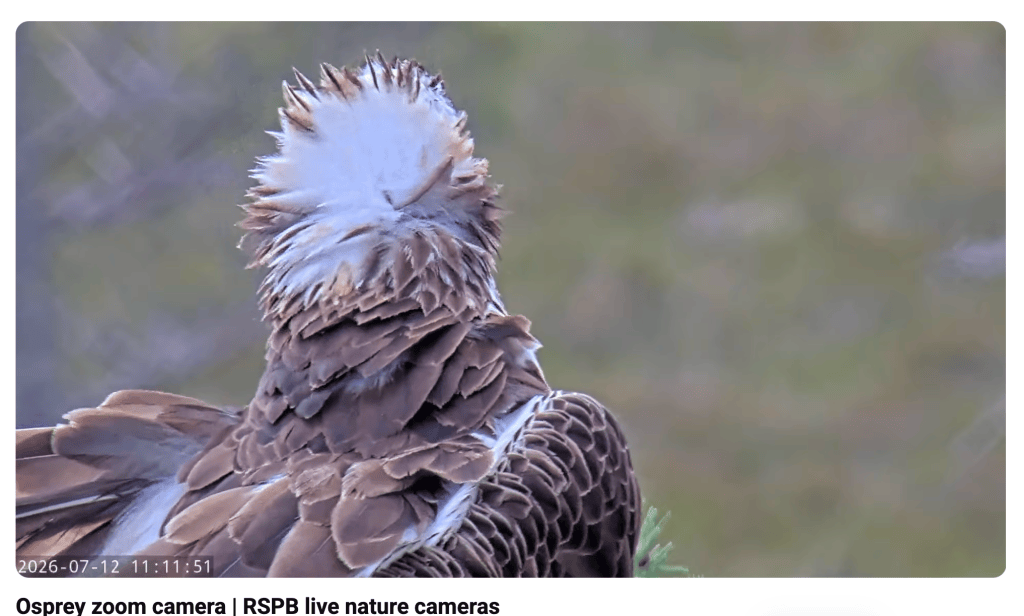
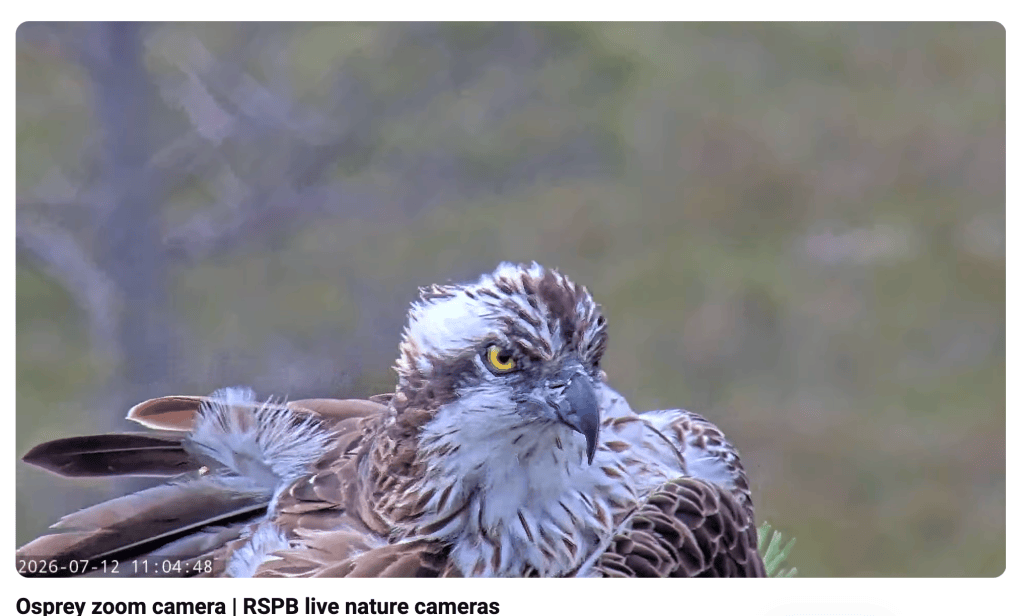
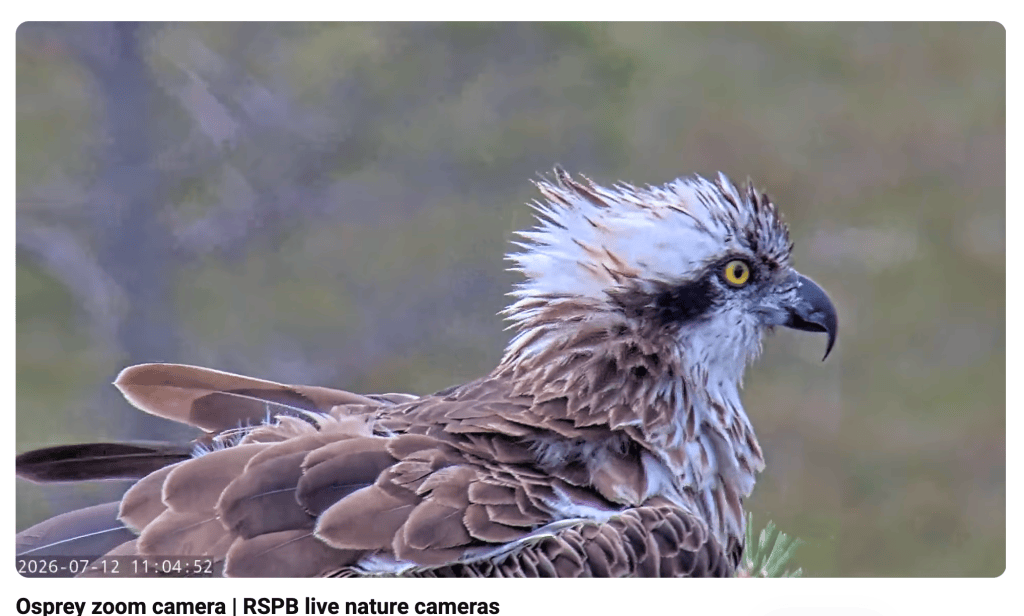
A few Screen Captures of Myrtle
LOCH of the LOWES
Loch of the Lowes Visitor Centre and Wildlife Reserve
The last few seasons at Loch of the Lowes have not been the easiest and this year has proven to be no different, one of the most visually stunning nests by appearence appears equally desireable to Ospreys, once again a season plagued with intruders, which has kept the male busy. A pair of birds settled on the Nest an unringed Male known as LM24 and Blue 210(Darden), 3 eggs were laid of which one failed to hatch, one chick died after two days and the third was ringed 2J8 on 10/07/26, this chick fledged on 25th July and was subsequently last seen on 25th. August.
Blue 210 had in previous years bred with an unringed male named Clyde, with something of a twist, Clyde appears to have bonded with Loch of the Lowes previous female Blue NC0 at the Alyth Substation site this happened too late to breed this year, after the Alyth nest had failed after the Male (Harry) went missing in early May.
Read, Loch of the Lowes Visitor Centre and Wildlife Reserve’s posts below.
23/07/26
It’s been a dramatic few days at the reserve, with a very persistent female intruder upsetting the daily routine of the resident family of osprey.
The intruder first hovered above the nest on late Tuesday afternoon, but was quickly shouted at by Blue 210. She then came for a second pass, this time with more intent and landed on top of the camera, but was immediately chased off by 210. It was her third pass that drew a gasp at the sheer ferocity of the attack, flying at speed, before pulling up and stooping down on the nest, legs extended with full talons exposed.
What ensued was an aerial battle the likes of which we have not seen before! For the best part of five hours LM24, Blue 210 and the female intruder duked it out, sizing each other up, vying for the higher thermals, before suddenly dropping in height, twisting and turning with incredible agility, in a battle of speed and strength. At times it looked like the flight was a synchro display – however, this was anything but friendly.
Around 9:20pm another bird was spotted and all four osprey flew off out of sight, leaving youngster Blue 2J8 completely alone on the nest for several hours – a highly unusual occurrence osprey (and females in particular), are hard wired to never leave their unfledged young unprotected.
Finally, at 11:30pm, in full darkness, Blue 210 returned, landing on the camera, still chipping alarm calls. She settled down and spent the next four hours preening and napping, before suddenly flying off again at 3:30am!
LM24 dutifully appeared at first light on Wednesday to deliver a fish, but with 210 nowhere to be seen, he released it, still flapping. Fortunately, the youngster was up to the task of pinning it down and began his first full solo feed. It takes time to build up the strength and skills required to negotiate the skin of a fish, but in between some furious wingsercising sessions he managed to eat it up – another step on his flight to independence.
The morning was not without more drama, with a very pale unringed male landing briefly on the nest, however LM24 was attentive in his duties and was quickly up on the nest seeing it off. He then spent the rest of the day sitting on one of his favourite trees, and remained alert and on guard, before dropping off another perch for 2J8 to tackle.
Finally, after much baited breath, Blue 210 finally returned at 3:42pm, followed by an intruder. Thankfully some mantling and chipping seemed to send it on its way, and it wasn’t long before she was demanding a meal from LM24. Supper was duly served, with both mother and son squealing loudly with excitement.
For now at least, a sense of routine seems to have returned to the loch.
So the question is…….who was the dogged female intruder who refused to be seen off by LM24 and Blue 210’s defensive teamwork?
Whilst the views of her on the camera were brief, after spending extensive time scrutinising the playback frame by frame, examining photographs taken from the hides by one of the Seasonal Ranger team, and comparing the images with those in our database, we can confidently reveal that the intruding female was none other than…….Blue NC0 – our much loved resident breeding female from 2020 – 2024.
Although NC0 lost her colour Darvic ring some time ago, her silver BTO ring is clearly still visible on her right leg. That along with the tell-tale white gap behind her eye, the ‘rocket’ marking on the rear of her head and the unique feather patterning of her underwing have made a positive ID possible.
This of course explains why even with a large youngster on the nest, NC0 was so persistent and aggressive in her attacks. We can only assume that given the time of year she has had a failed breeding season, and despite having given up waiting last season for LM24, and only using the nest as a pit stop this season before moving on, NC0 must still view the nesting site as a territory worth fighting for.
Who knows what happens next?
Will we see NC0 attempt to usurp Blue 210 as the Queen of the Loch? Despite having spent a summer with NC0 in 2024, LM24 seemed in no mood to re-acquaint their bond, even pulling at her feathers during one of their mid-air duals.
For now it seems that Blue 210 has seen off NC0’s challenge. With her offspring ‘Blue 2J8’ days away from fledging, she will be needed to help supply fish to the youngster as he fuel loads for his first huge migration south. When do you think he will take to the skies?
One thing’s for sure – where there are ospreys, drama is never far away! 
Loch of the Lowes Update 14/08/26
Since young osprey Blue 2J8 fledged on the 25th July, his life on the nest has settled into a predictable routine of preening, eating, shouting at any passing birds and going for short flights around the loch.
More recently the youngster has been spotted plunging himself into the middle of the loch for a wash, which is not only vital for keeping his feathers in tip top condition, but a chance to learn the vital of skill of taking off the water, which he will need when he learns to fully hunt for himself during migration.
At 73 days old he is likely to be a good 2-3 weeks away from thinking about migrating yet, though some male osprey can be as old as 100 days and females 110 days old before heading on their epic journey south.
As we near the time when instinct will kick in and pull him along the ancient flyways, we are likely to see less of 2J8 around the loch, as he will spend more time exploring the land and skies around his natal nest site, mapping out the area for his return as a 2 year old.
Meanwhile, the call of migration is already influencing female Blue 210’s behaviour. After a huge delivery of trout from her mate LM24 on 5th August and a hearty feed, she stretched her wings for a few days, only visiting briefly, before heading off on Sat 8th for some extended R&R.
This is an important time for female osprey who need to build back their strength, power and body weight for migration, having spent a lot of the season inactive on the nest, often forgoing food for their offspring.
It is common for females to disappear for extensive periods, before dropping in on the nest again ahead of their final departure. True to form, at the time of writing (3:10pm Fri 14th), Blue 210 landed on the ‘Split Birch’ perch and then had a bath on the shore before flying off twenty minutes later in an easterly direction.
Will we see her again? Who knows, but it can’t be long before she begins to wind her way south, handing the full responsibility of caring for 2J8 to her mate, until he too follows her wingbeats for the very first time.
The hard work for all male adult osprey with young continues, juggling both defending the territory and providing for their offspring alone, typically only leaving to undertake their own migration when the rest of the family has fully departed.
There was substantial intruding pressure on the territory last weekend when 210 was away. Unsurprisingly the number of fish deliveries dropped off markedly. Once things calmed down normal service resumed with 6 fish (a mixture of perch and trout) coming in quick succession throughout Monday. The rest of the week has been more steady, with anywhere between 2-4 fish coming to the nest.
Finally, it wouldn’t be an osprey update without some drama afoot!!!
Following the sudden appearance and ensuing lengthy battle between our previous long term breeding female NC0 and this year’s matriarch Blue 210, we thought that NC0 had drifted off – however, we are delighted to see that since the 10th August she has been making herself at home at the SSEN nest near Alyth (also monitored and protected by a webcam).
This nest has also had it’s fair share of drama over the season, when the unringed male ‘Harry’ went missing and the eggs were inevitably predated after ‘Flora’ left to feed herself. Not long after another unringed male, known to local observers as ‘Clyde’ moved in, and after a string of females throughout the summer is currently wooing NC0 with his nest building skills and generous gifts of flounder and trout.
The final twist in the osprey tale……?
‘Clyde’ is Blue 210’s partner from 2024, when the pair fledged two young from another nest in Perthshire!
Who needs Eastenders and Netflix for drama eh!!?
SWT UPDATE 03/09/26
It’s September and the first tinges of autumn have arrived, and with them a quietening on the loch and in the skies.
It’s been two and a half weeks since female Blue 210 was last seen, departing the reserve on 17 August (one day earlier than last year). Blue 2J8 followed suit 8 days later, early in the morning of the 25 August, on his first monumental migration to West Africa.
Finally, after spending several days on the reserve resting and preening (and making sure the coast was clear), male LM24 has also departed, and was last seen flying from the familiar haunt of the Split Birch on the evening of the 28 August (the very same day of his departure last year).
It is always a strange feeling when a Lowes’ osprey family finally leaves. It can feel somewhat anti-climatic since it is always a waiting game to see if an absence is temporary or final, and always mixed with a feeling of trepidation about their respective journeys ahead.
However, this year the feeling is without doubt one of overwhelming joy and satisfaction.
After several years of trials and tribulations, everyone at the reserve has been delighted to once again watch a breeding season culminate in the successful fledging and departure of a strong, healthy youngster, heading off on their first migration south.
It is always a great privilege to be able to follow the lives of such wild creatures so closely. Our thanks go to the Wildlife Protection Team and all the volunteers who gave so much of their time to ensure a peaceful breeding season for all the species on the reserve.
Until next time… fly strong, fly high….and for now, our eyes (and ears) turn once more to the skies in anticipation of welcoming our next noisy, feathered visitors – though this time from the far north!
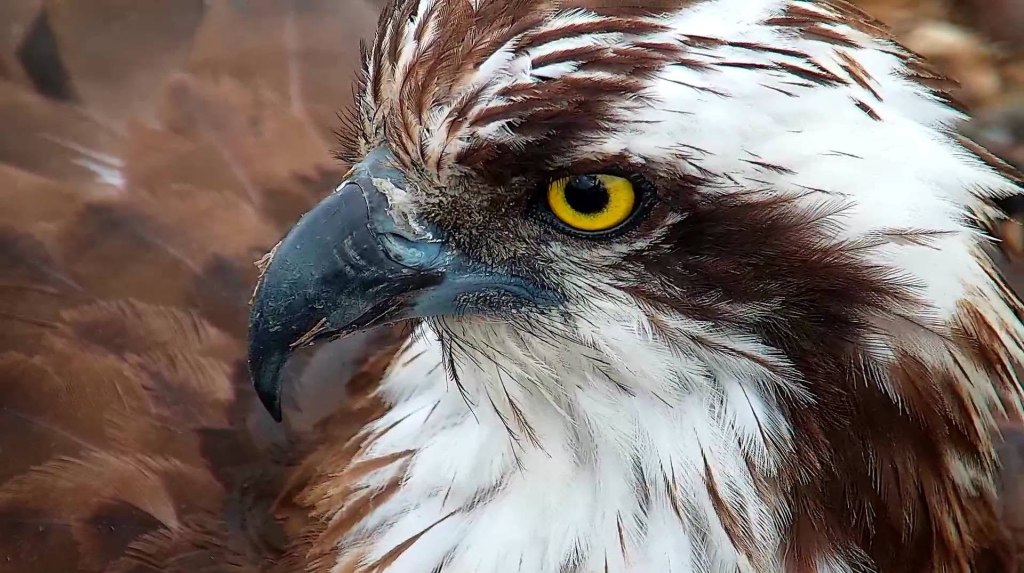
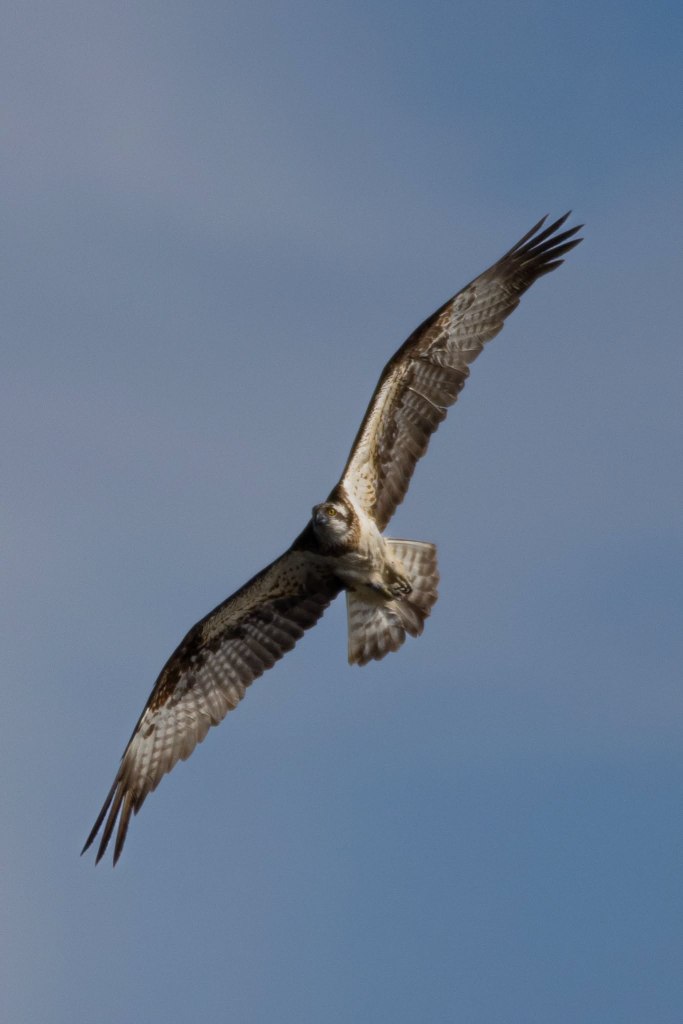
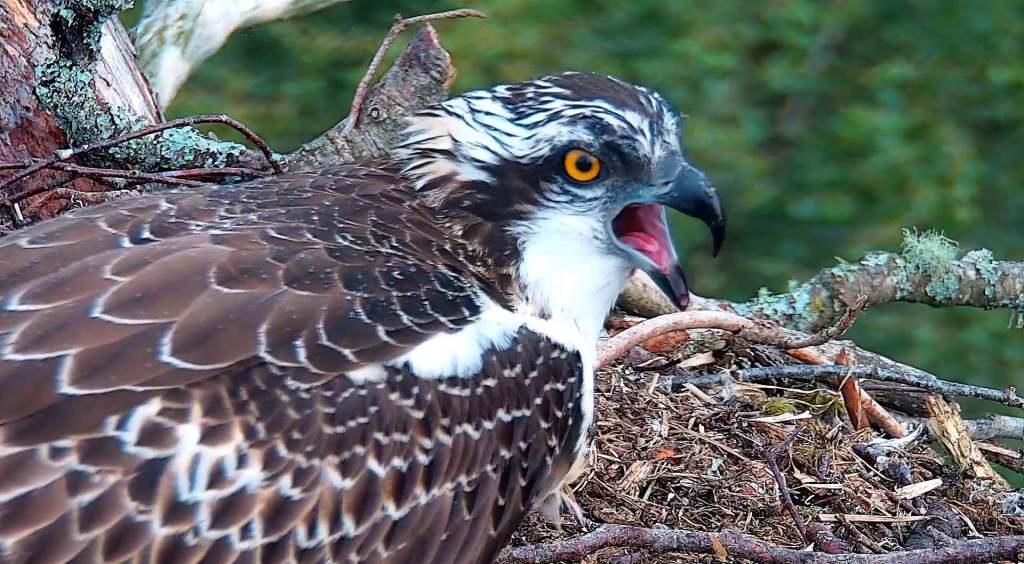
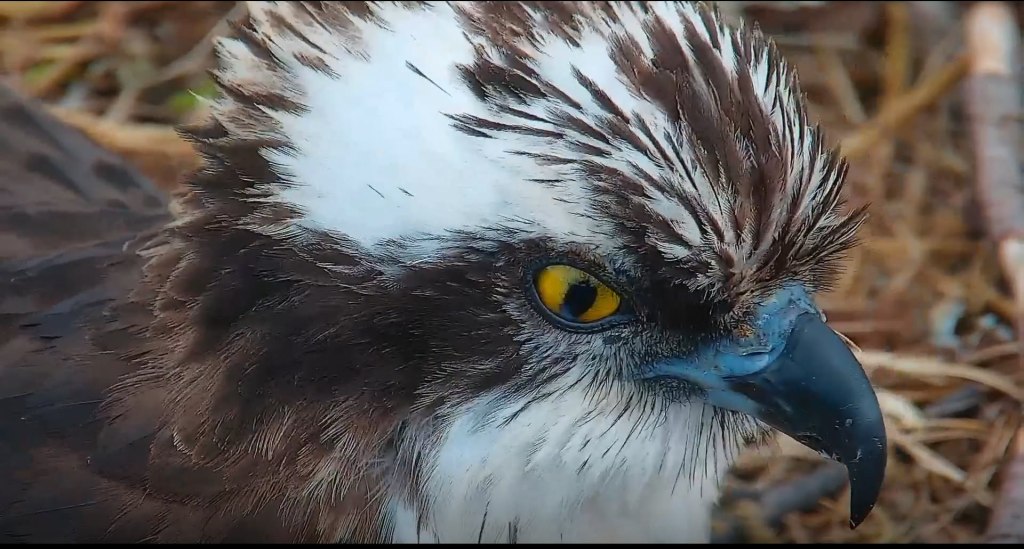
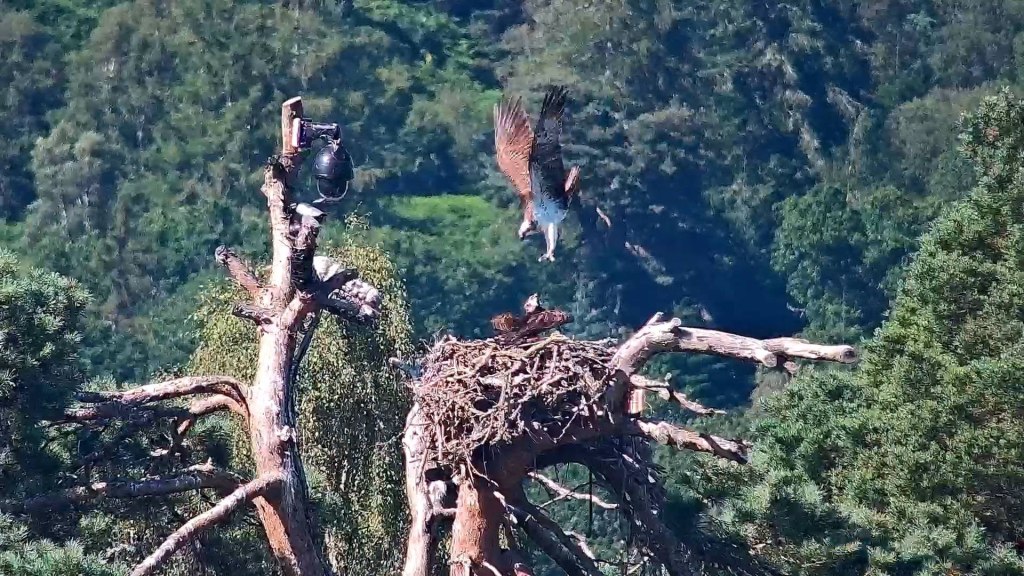
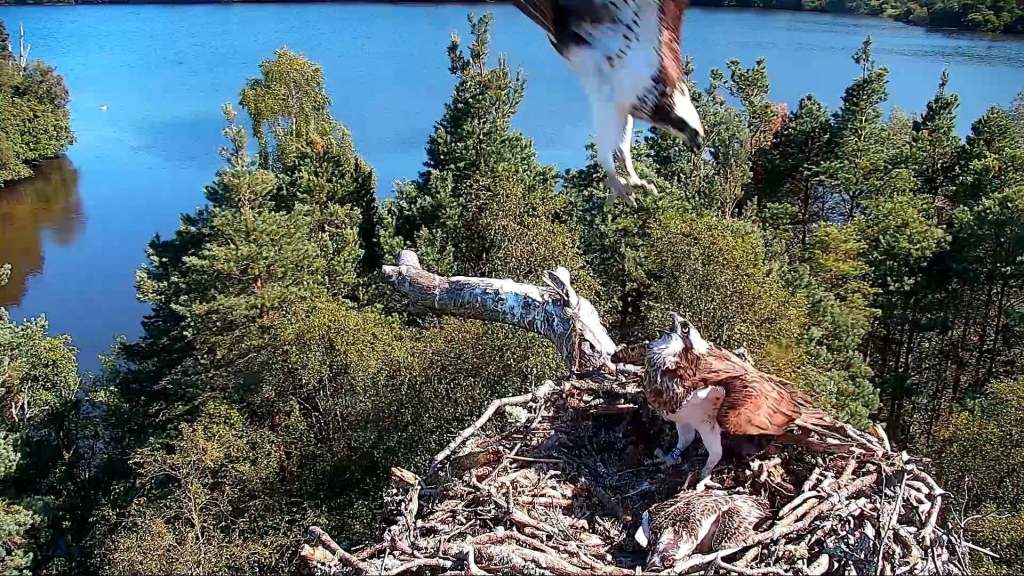
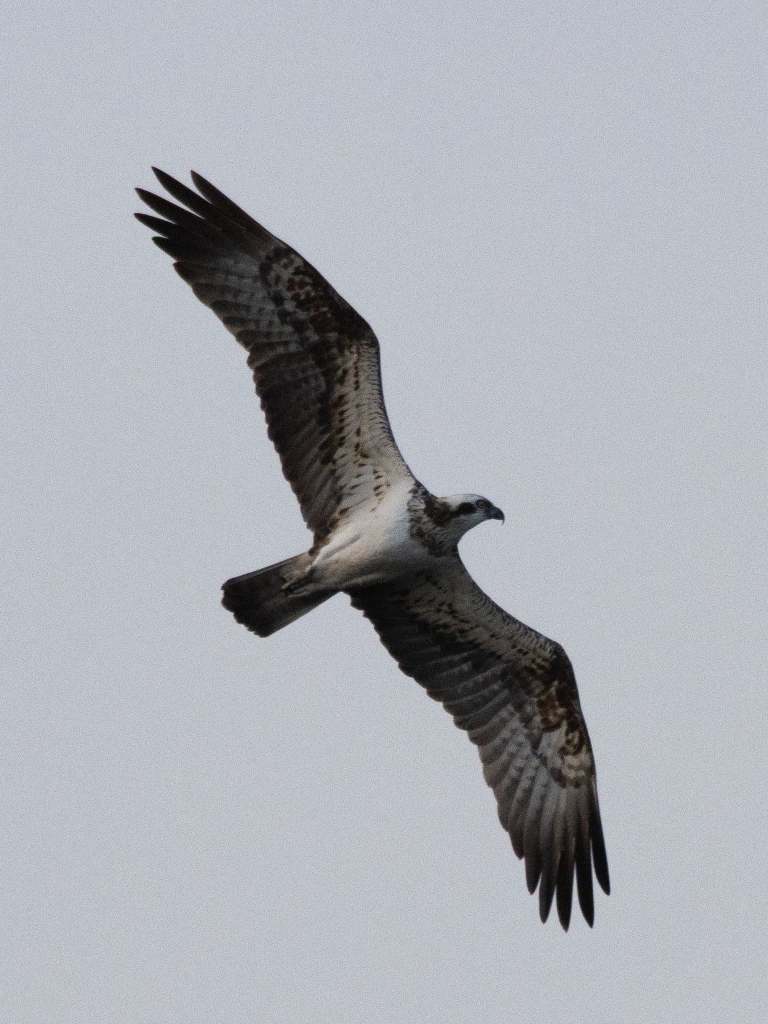
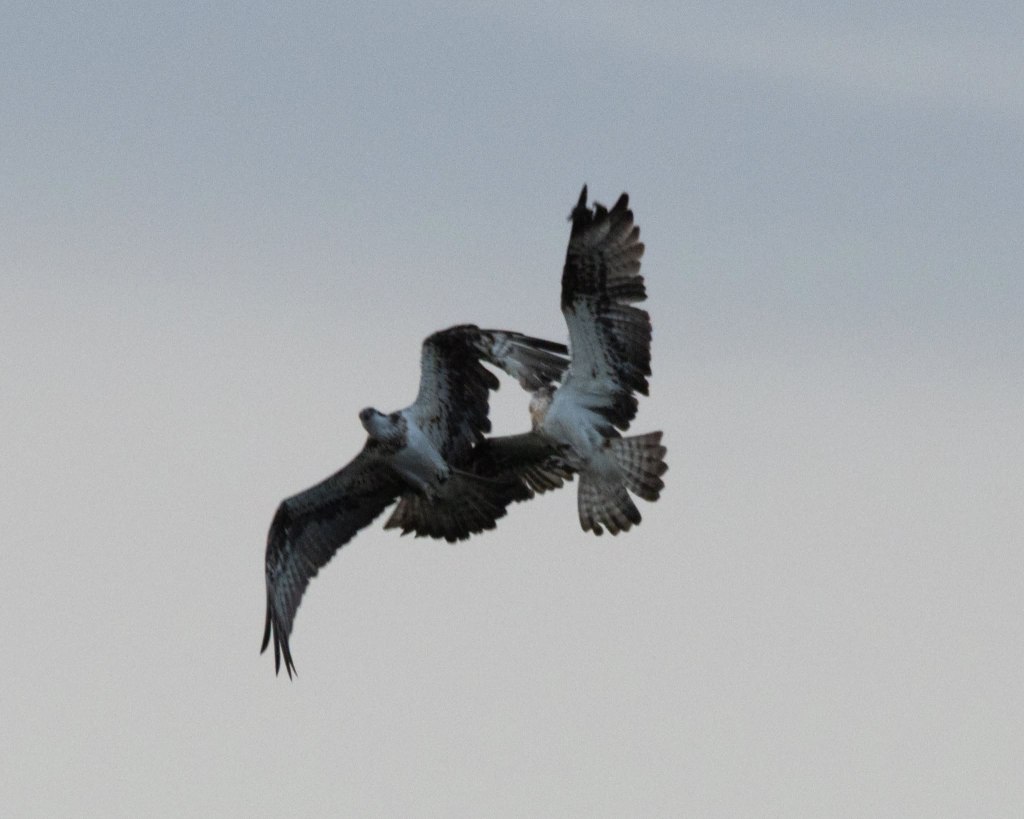
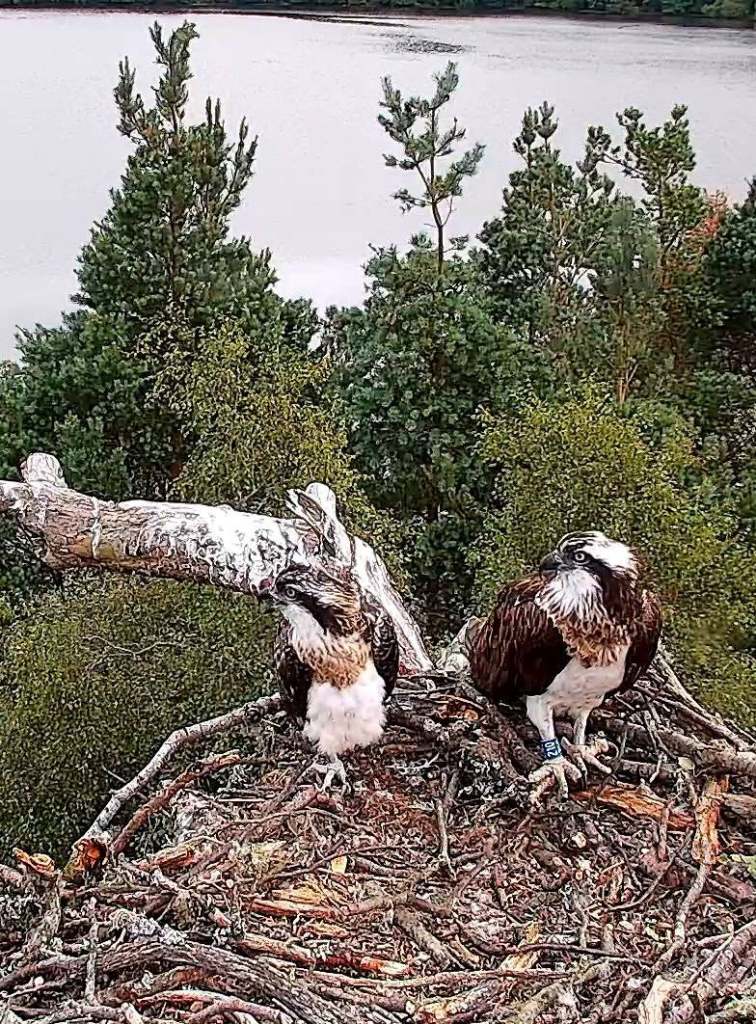
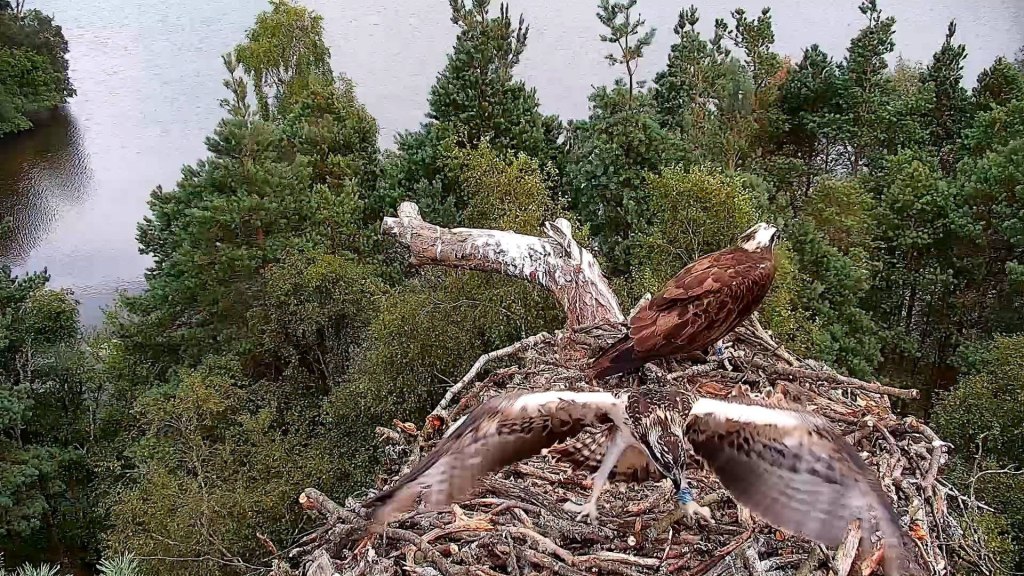
(C) SWT
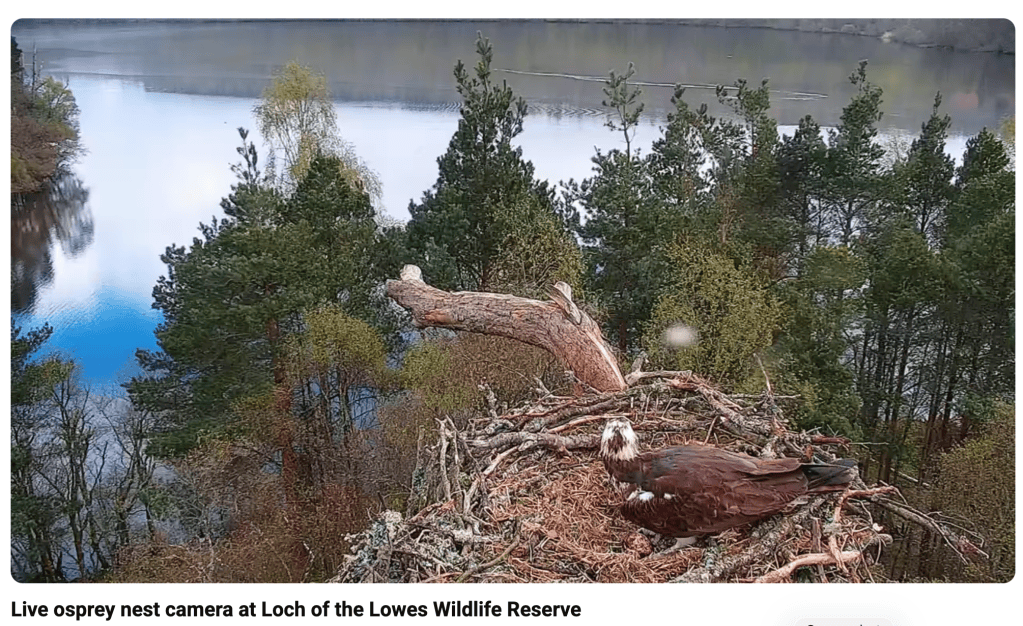
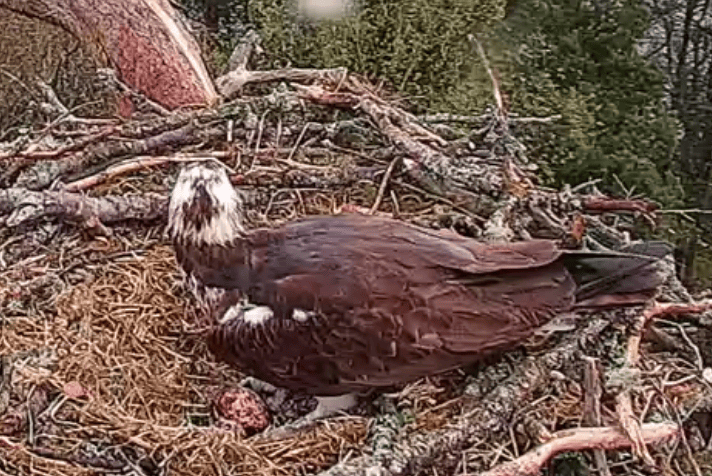
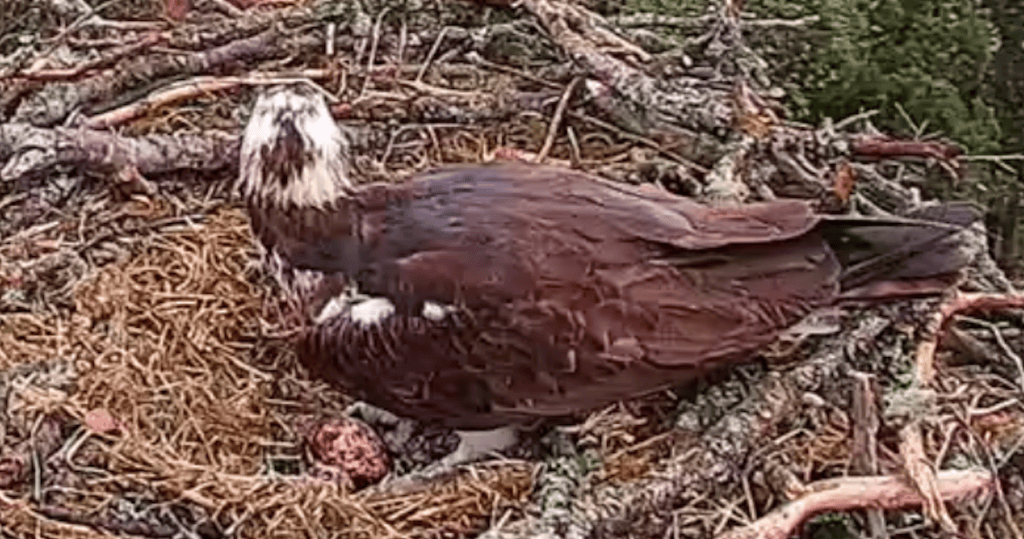
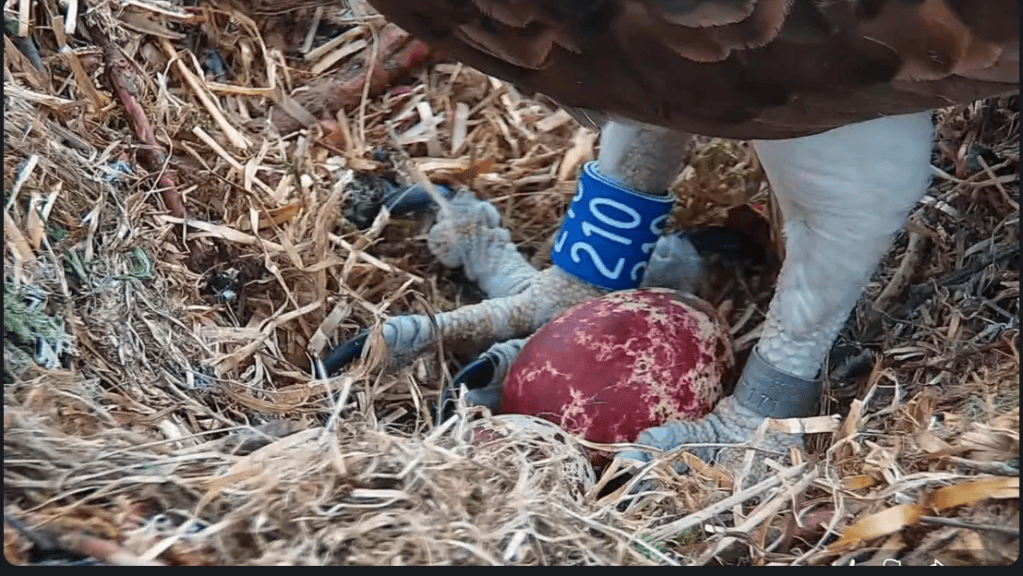
(C) SWT, Egg number 2 27/04/26
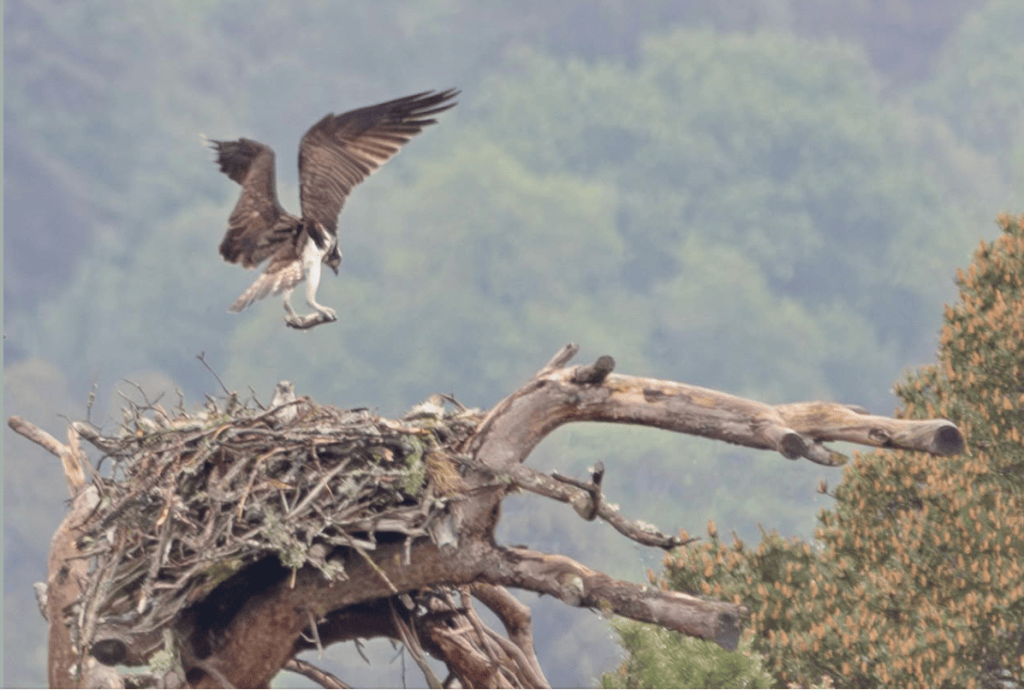
LM24 DELIVERING A FISH TO DARDEN AND THE CHICK (C) M. MOORE
LOCH ARKAIG
MARY
Loch Arkaig 2026
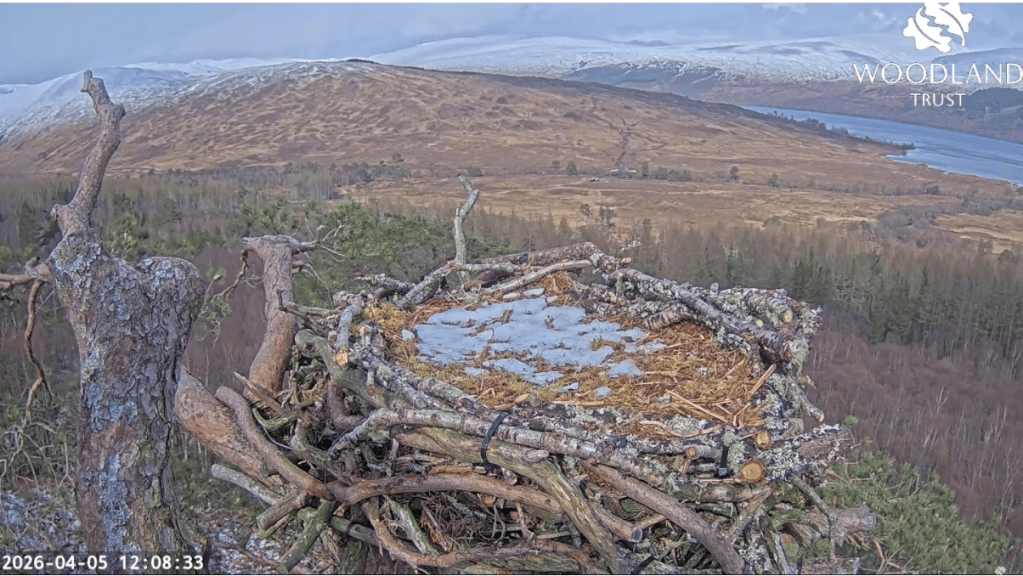
Pre-season 2026 was filled with anticipation as to whether for the first time in Loch Arkaig history there would be chicks on both nests 1 & 2.
The anticipation was based on the activities of 2025 when LV0 Garry & 536 Aurora appeared to bond well at nest 1 where there had been no chicks since Louis & Aila bred there for the last time in 2020.
The first bird to arrive at either nest was Dorcha who arrived at nest 2 on the 4th April, the followers were happy, 1 out of 4, a good start. Next were nest 2’s occupants, Garry & Aurora, both returning on the 7th April. Great, what the followers had been hoping for pre season looked as though it may come to fruition.
That left 1 still to return ……….
Dorcha waited, & waited, as did the followers, “where IS Louis?”
Dorcha visited the nest daily for varying amounts of time, generally bringing sticks, moss & other nesting material. April 7th was a busy day. Garry landed on nest 2, the first sighting of him for 2026, with a fish which Dorcha happily accepted. Garry returned soon after for a mating attempt, it was unsuccessful. Soon after a very dark unringed female landed, possibly the same bird who’d been seen in previous seasons, she only stayed for a few minutes. The afternoon gave the first sighting of Aurora when she too visited nest 2. She hung around the nest for a while, Dorcha wasn’t happy, an aerial disagreement followed. The “spat” continued at nest 1 for a short time when Dorcha briefly landed there. Peace eventually reigned with territories temporarily established.
The following day both Garry & Aurora were seen at nest 2 but Dorcha defended her nest well & the “intruders” returned to nest 1 where, in the following days, they began to reinforce their bond. Over the coming days Dorcha continued to wait.
A male, JJ4, who hatched at a nest at the west end of Loch Arkaig in 2020, landed on nest 2 on the 12th April & continued to visit over the coming days. He brought a fish, attempted to mate with Dorcha, & completed nest maintenance. Garry, who was providing & mating with Aurora at nest 1, continued to visit too. The 13th April saw all 4 birds at nest 2 at one point, needless to say it was a little frantic.
JJ4 on one of his visits to nest 2
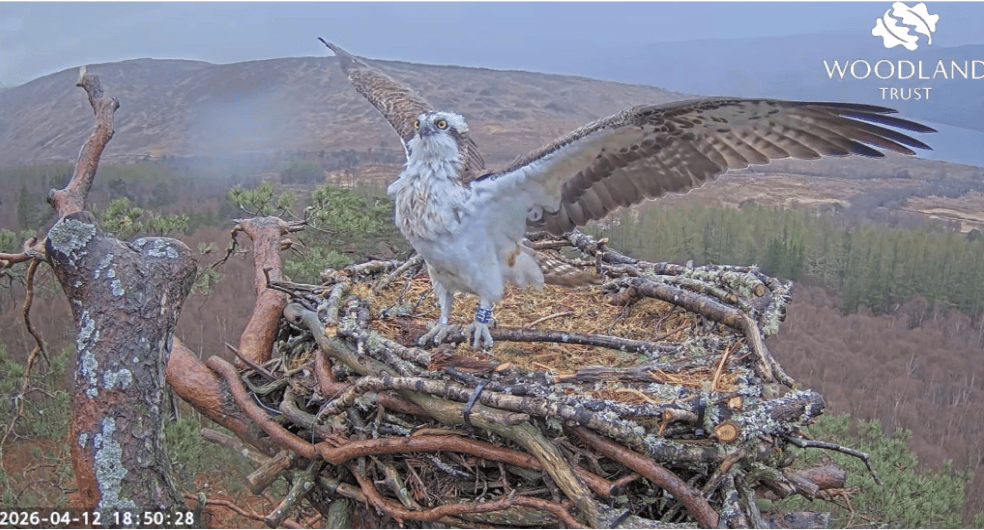
The weather conditions on the 17th April were poor, gusting winds & rain, but it didn’t deter Dorcha. She spent all morning at the nest, most of her time on the perch, waiting. It appeared that she wasn’t giving up on Louis even though many of the followers had. She eventually left at 15.19.
At 17.57.42 an unringed osprey landed on the nest. The Woodland Trust chat & the Friends of Loch Arkaig Ospreys group went wild, everyone full of disbelief & joy, it was Louis! His arrival was 15 days later than that in 2025.
Louis & Dorcha were first seen together on the nest the following morning. A Kielder bird 2B6 hatched 2023, also made the first of a couple of seasonal visits to the nest in Louis & Dorcha”s absence.
Louis & Dorcha reunited for 2026
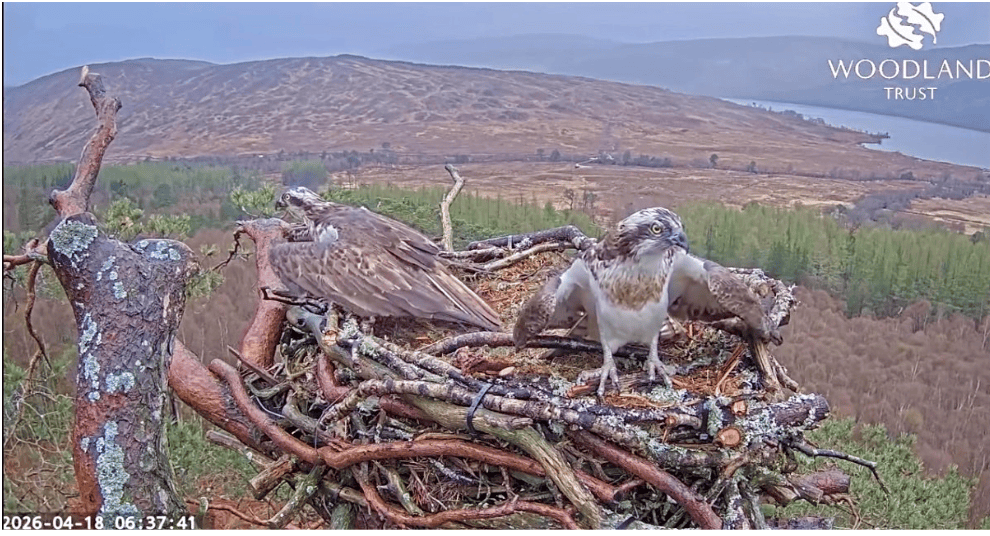
The following days saw a frenzy of mating at nest 2, there was a lot of time to make up. At nest 1 proceedings continued to be at more of a steady pace. Garry was reliable & consistent with his fish deliveries but mating appeared to be “hit & miss.” Aurora wasn’t always receptive & attempts weren’t regular.
The first egg was laid at nest 2 on the 26th April, with eggs 2 & 3 following on the 29th & 2nd May. Much to the followers delight an egg was laid on nest 1 at 19.18 on the 30th, the first egg on the nest since 2020. No further eggs were laid on nest 1.
During May the days at nest 2 passed without incident, Louis enjoying his time incubating, as he’s always done, & reluctantly giving up his place when Dorcha made it clear it was her turn. He delivered fish as expected, some days Dorcha waited longer between deliveries than others. At nest 1 incubation of the 1 egg was inconsistent, even taking into account the possibility that delayed incubation was being used, & the egg was left uncovered for long periods of time. Also livestream downtime meant that viewers couldn’t observe all activities.
June 1st marked the 36th day since the first egg was laid at nest 1. In the early hours of the morning cheeping could be heard.
At 12.23 Louis arrived eager to incubate, Dorcha left but returned soon after, Louis wasn’t interested in moving. At 12.40 Louis stood up quickly and & an empty shell could be seen but not the chick. Six minutes later he stood again & the livestream viewers had their first glimpse of the chick. It was more than 15 hours before the chick had its first feed, which was minimal, but a much more substantial feed followed a couple of hours later.
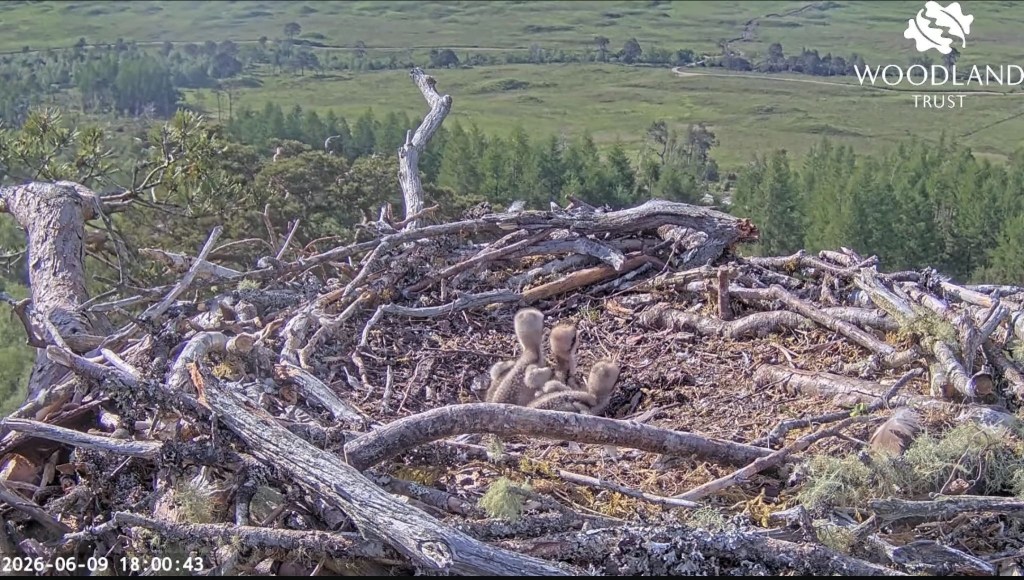
Eggs two & three hatched as expected on the 3rd & 6th June. On the morning of the 3rd June Dorcha was seen to try & move what was thought to be a wiry piece of nest material. It was caught under chick 1’s wing. It took several attempts to remove it but Dorcha then dropped it back into the nest cup. The same, or something similar, was seen again on the 9th June when it appeared to be around the leg of one of the chicks.
Chicks at nest 1, 9th June
The 6th June also marked the 37th day since the egg on nest 1 was laid.
Incubation had become more consistent in more recent weeks but as each day passed in June it became clear that the egg wasn’t going to hatch. This could have been due to the inconsistent incubation, the fact that Garry & Aurora were first time breeders, or “just one of those things.” Their dedication to the unhatched egg was clear, they continued to incubate the egg consistently until the early days of July when they then started to leave the nest unoccupied for longer periods of time.
Aurora incubates past the expected hatch date
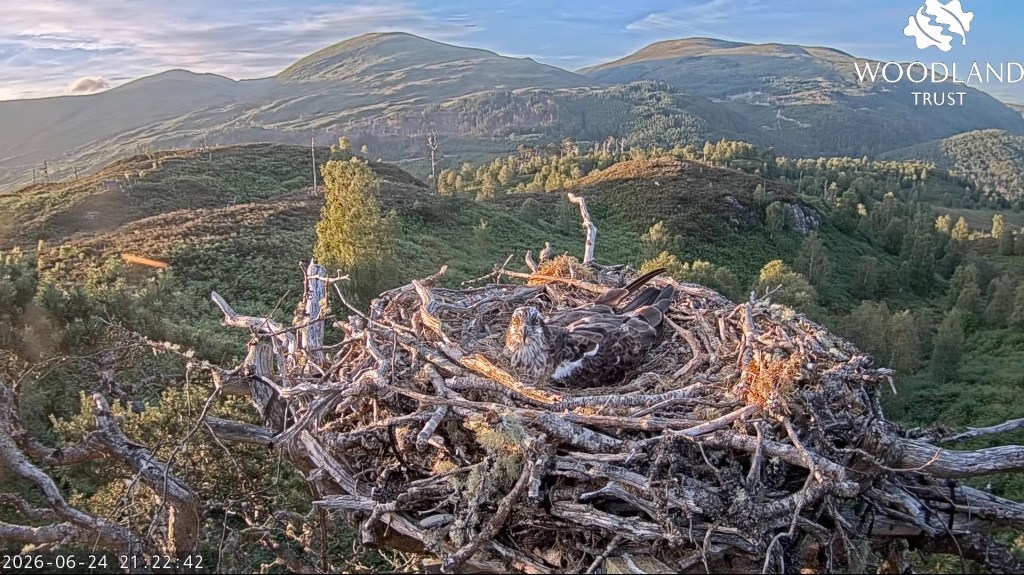
The weather during May had been good for the majority of the days, sometimes even hot. As we moved into June more unsettled weather materialised with rain & gusty winds at times. Although the weather was poor, Louis managed to deliver fish every day although the size varied & sometimes they were finished in a few minutes. Aggression between the chicks seemed to start earlier this season, generally between chicks 1 & 2. Chick 3 was sometimes stuck between the other two & when feeding started it couldn’t free itself or was facing the wrong way. Louis delivered two fish before 10am on the 11th June. During both feeds chick 3 didn’t beg for food & by 11.30 it was clear that it was either dead or dying. By the afternoon it was obvious that it had died. The daily routine of an osprey nest, fish deliveries, fighting chicks, preening, intruders, sticks etc etc continued throughout June & into July.
Ringing took place on the morning of the 9th July. The chicks were later named by the Loch Arkaig followers, Amber 8P6 & Juniper 8P7.
Both chicks were assessed to be female.
Chick 1 weighed 1.55kg & ringed 8P6
Chick 2 weighed 1.71kg & ringed 8P7
George Anderson from the Woodland Trust also reported:
“On a less happy note, Lewis had a nasty surprise when he got to the nest. It was festooned with fishing line, which was also wrapped around one of the chick’s legs. Thankfully he was able to get it all removed. I remember some people thought they could see line on the livestream a while back, but we concluded it might just be strands of grass as there was no sign it was troubling the birds. Not the case it seems! If Lewis hadn’t visited it seems likely the tangled bird while managing at the moment, would have had problems fledging safely.”
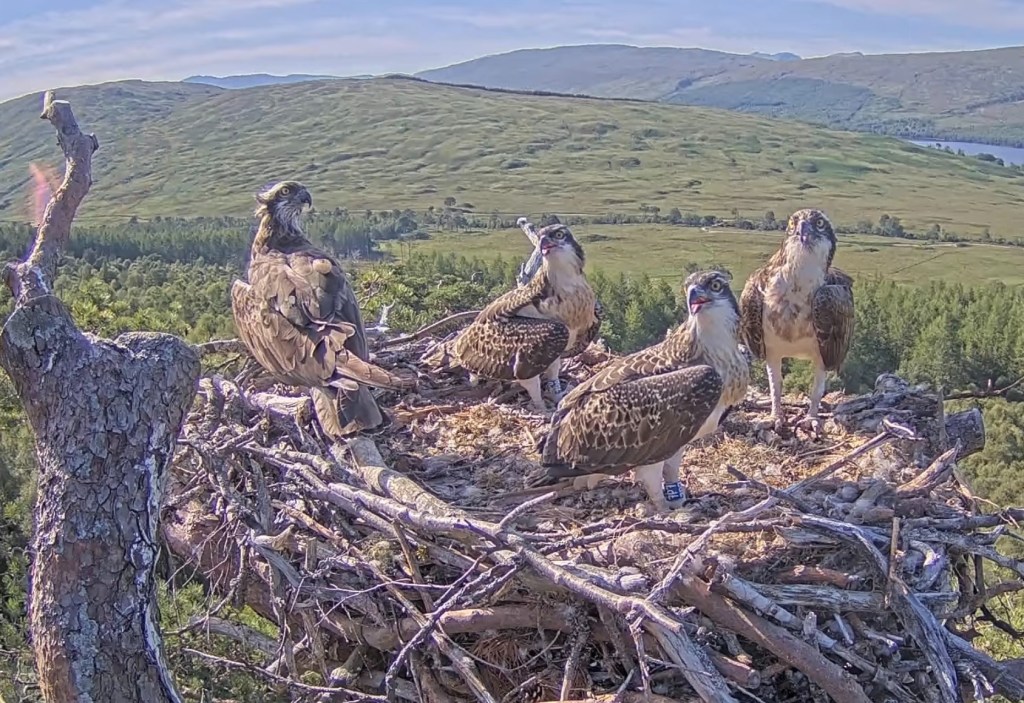
The girls displaying their ring numbers while Dorcha watches a potential intruder
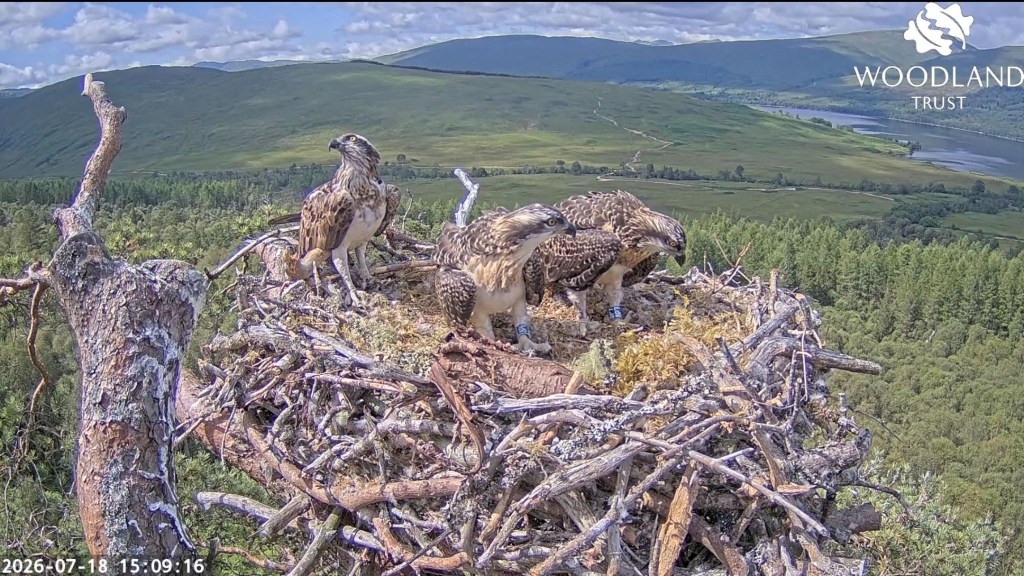
As we moved through July the chicks continued to grow, fish fought over, desperate to build up their strength in preparation for their first flights. Their vigorous wing flapping & brief lift offs from the nest resulted in successful fledges for both chicks.
Chick 1, Amber 8P6, fledged at 13.15 28th July, she returned 5 hours later.
Chick 2, Juniper 8P7 fledged at 17.44 29th July, she returned to the top of the cam after a short flight. It took her almost another hour to build up the courage to drop back down onto the nest, even a fish delivery didn’t entice her to move.
Into August & now that the chicks had fledged it was almost always a mad dash back to the nest when Louis was spotted bringing in a fish.
Initially Dorcha was always first back but the girls followed hot on her talons. Even though Dorcha managed to get the fish from Louis as he touched down, & then beat a hasty retreat, one of the girls would invariably snatch it from her. Depending on how hungry Dorcha was determined on how easily she gave it up. In the following days the girls were even more determined to get their talons on the fish & this resulted in some vicious battles, sometimes knocking one another off the nest. Louis had one of his best delivery days on the 7th August, delivering 8 fish to the nest. For the eighth fish nobody was there to take it, Louis flew away with it. The following morning the chicks visited the nest & on one of her visits Amber spotted a fish tail left over from the previous day. Although Juniper arrived whilst Amber was there there was no fish left.
Louis arrived at 10.44 with the first fish of the day, Amber arrived first to claim it. Juniper arrived soon after but was left wanting again as Amber finished the fish in 12 minutes. Both girls returned to the nest just before 1pm. It was another very blustery day, the girls clung to the nest at times, heads down.
A second fish was delivered by Louis after the girls had endured the poor weather conditions for nearly 3 hours, Juniper managed to get it this time.
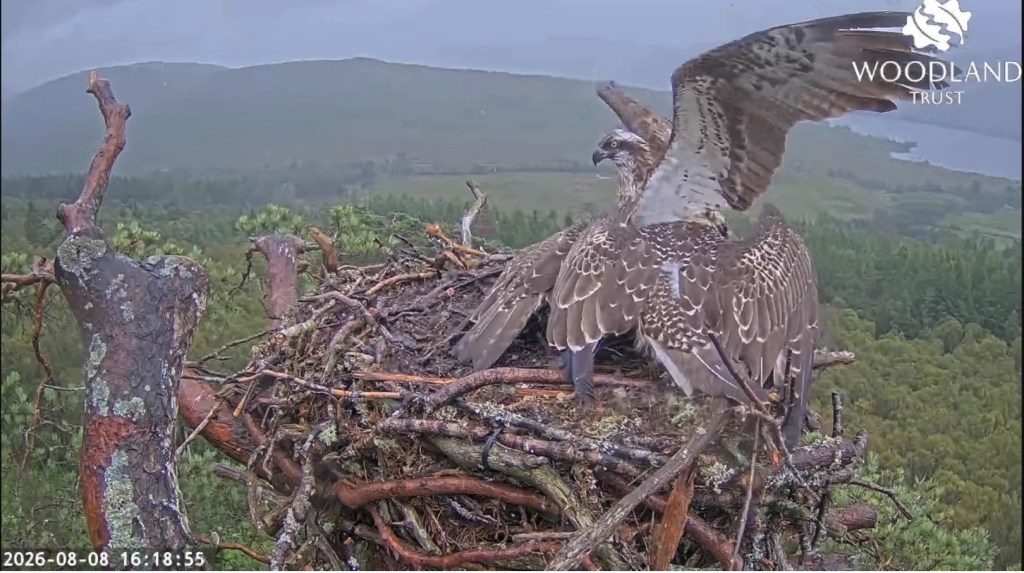
At 16.19 Dorcha, who hadn’t been seen on the nest since the morning of the 6th August, delivered the third fish of the day, Juniper was victorious again.
This was the last time that Dorcha was seen on the livestream, Liz B did report that she’d seen four birds perched in the nest area on the 11th so this could have possibly included Dorcha.
The last sighting of Dorcha, delivering a fish to Amber & Juniper on the 8th August
During the early hours of the 14th August the camera at nest 2 was struck by lightning which resulted in the livestream being off until 12.10 on the 19th. During the downtime Liz B was able to make some distant observations as to the number of birds at the nest or perched nearby.
On the morning of the 16th August Liz B reported seeing the 2 youngsters on the nest. Following this observation Liz only ever saw one of the girls on the nest at any one time. After the livestream came back online Juniper was the only youngster to be seen on the nest, so it was assumed that Amber 8P6 had migrated sometime after Liz B had observed the two girls on the nest on the 16th.
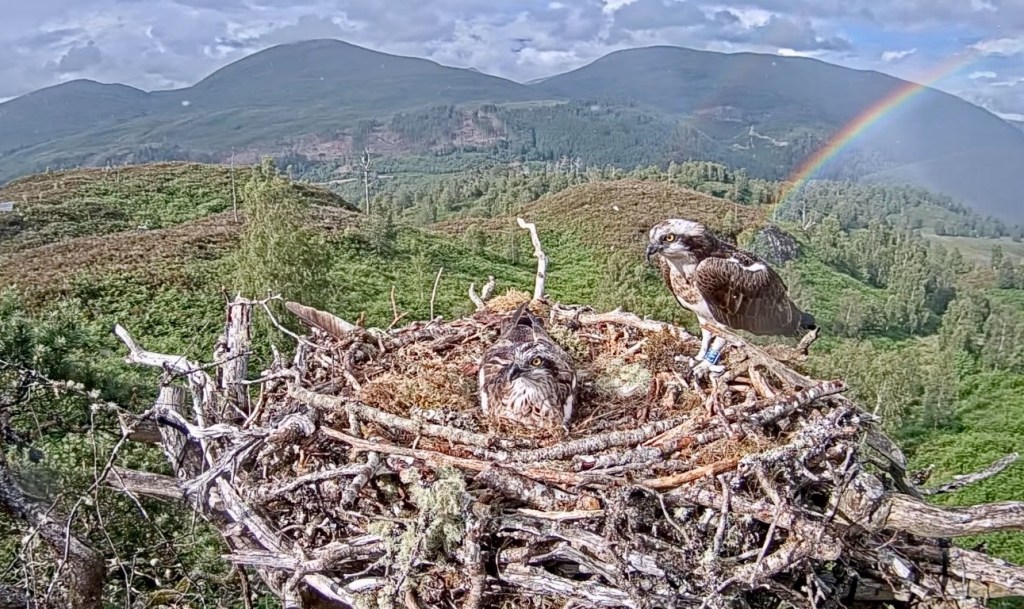
During the end of July & into the beginning of August, Garry & Aurora were seen less at the nest.
Aurora 536 was last seen at nest 1 at 08.55 on the 14th August but then photographed at Lychett Bay, Dorset for a few days around the 22nd August.
Garry LV0 was last seen at nest 1 at 09.35 on the 17th August..
Garry LV0 & Aurora 536 on the nest at the beginning of August
During the final days of August Louis continued to provide for Juniper, an average of 2 or 3 fish a day, more flatfish came in which indicated that Louis was probably having to travel further afield to fish. However on the 27th Louis equalled a previous record set in 2020, delivering 9 fish, his highest amount of the season. Everyone ate well on that day including the hooded crows who were regular visitors in the later weeks to clear up any scraps from the nest.
After the 27th fish numbers dropped back down to the average. On the 3rd September Louis delivered just one fish to the nest, again it was a flatfish.
The following morning, the 4th, Juniper arrived at the nest at 06.17. She spent over two hours on the perch on what was a very wet & windy day. She briefly left the nest at 08.20 only to return 20 seconds later. At 08.28.15 she left the perch again. This was to be the final time that Juniper was seen at the nest.
The final sighting of Louis was the same day on the nest at 14.10.02. He had another flatfish with him but after waiting & checking that nobody was coming to collect, he waited for just over a minute before leaving the nest for the final time of 2026.
Fish stats
Nest 2 Nest 1
Total 486 – Louis 481/ Dorcha 5 Total 201 – LV0 Garry 201 Brown trout – 453 Brown trout – 188 Flatfish – 27
Flatfish – 11
Pike – 2
Perch – 2
Arctic char – 2
Mackerel – 1
Silver tourist – 1
Estimate made when livestream was down on nest 1 during August.
Actual figure could be higher as livestream was down for several hours during daylight hours
Nest 2 family 2026
LOCH DOON
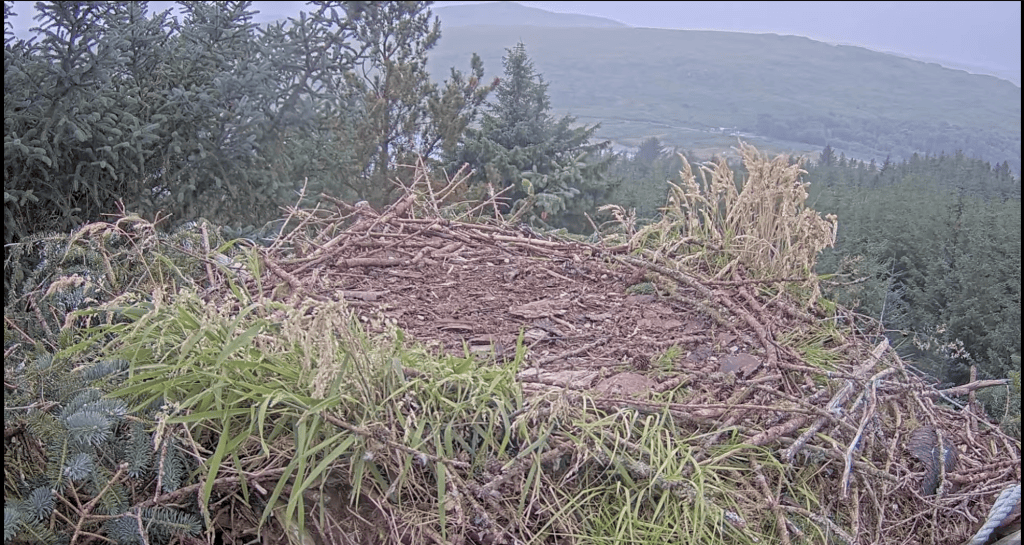
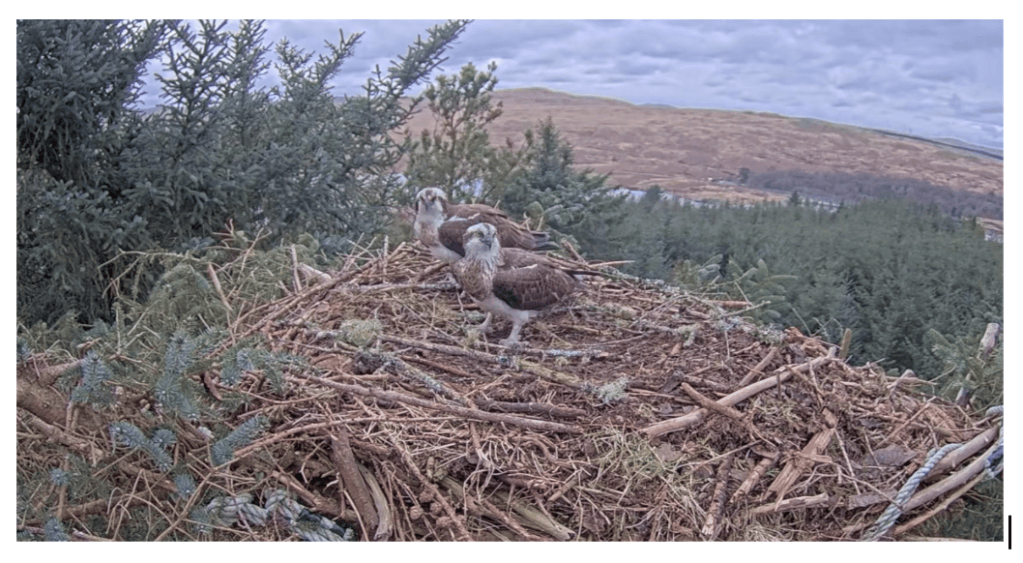
LOCH DOON 2026
Female:- Unringed Angel, Returned 27/3/26, Last seen 09/8/26
Male:- FK4 (Frankie), Returned 30/3/26, Last seen 25/8/26
Frankie (blue darvic FK4) and Angel have been together since 2018, they have successfully raised 17 chicks.
As an individual Angel has been breeding at Loch Doon since 2014, she has successfully raised 22 chicks. 5 chicks were from previous partner Cullen (blue darvic BN), who she was with from 2014 to 2018. Cullen was ringed by Solway Ringers in 2010. Frankie (blue darvic FK4) chased Cullen off in 2017.
Three chicks have been successfully sighted in Wales and Senegal, CX7 (Shalloch) was first sighted in Wales in 2016 and again at Loch Doon nest in 2018. A few years later in 2022, 4B1 (Nancy) was photographed at Senegal in February 2023 and the following year 4B8 was photographed in July 2024 at Popenguine, Senegal. Excellent news this year was that CX7 (Shalloch) was sighted on 15/8/26 at Penwhapple Reservoir, Girvan, Ayrshire which we were all delighted to hear. CX7 was one of Angel’s first chicks with Cullen (original partner), hatched in 2014 and is now 12 years old.
The season started really well with the camera going live on 17th March. The viewers started logging in and awaiting Frankie (FK4) or Angel’s arrival, with many trying to guess who would arrive first and when? Angel was first to arrive on the 27th March and Frankie (FK4) on the 30th. Loch Doon ospreys had returned for a new season.
Mating and nestorations happened over the following weeks. Frankie, (FK4), brought his first fish of the season on 31st March.
Excitement came on the 14th April when Angel laid her first egg, followed by another on the 17th and the third on the 20th.
Angel successfully incubated the eggs, with Frankie appearing regularly with fish deliveries and taking turns on incubating eggs.
On the 22nd May the first egg hatched and the second on the 23rd. The third egg unfortunately did not hatch. Angel and Frankie had two healthy chicks.
On the 30/5/26 at 10:18 hrs, when chicks were only one week old, a male unringed intruder tried landing on the nest a few times. It started with Frankie leaving and appearing back alert calling and mantling. The intruder tried landing on the nest to which Frankie attacked mid air and left with Angel protecting her chicks. When Frankie returned he brought some long grass with him, to which the male intruder followed him onto the nest, with some long grass too. Frankie quickly lunged at it, chasing it off the nest. Frankie returned and both him and Angel were calling and mantling again as the male intruder wouldn’t leave and kept circling above when suddenly it flew straight at Frankie to which Frankie dived off the nest narrowly avoiding getting attacked and chased after it.
Hours passed, people started asking if Frankie was alright, hoping nothing had happened to him. Angel stayed on the nest feeding chicks leftover fish and waiting, fish calling for him to hear. The next day came and still no sign of Frankie in the morning, then at 13:28 hrs Frankie arrived safe and well back. Angel was calling for fish so he brought her a stick first and then went to get them fish. Frankie had been missing for nearly 24 hours and everyone was relieved and happy to see him return.
June saw the weather being really hot and sunny for a few weeks, with a heatwave recorded on 23rd, temperature was 32° and above. Frankie was delivering up to 11 fish daily, these were mostly small fish but he kept them all well fed. Angel continued to shelter her chicks from weather and had a few days of really strong winds to deal with and everybody stayed safe. A bad thunderstorm hit the Loch Doon area on 26th June with thunder, lightning and really heavy rain. Angel stayed with the chicks throughout it, settled over them sheltering them.
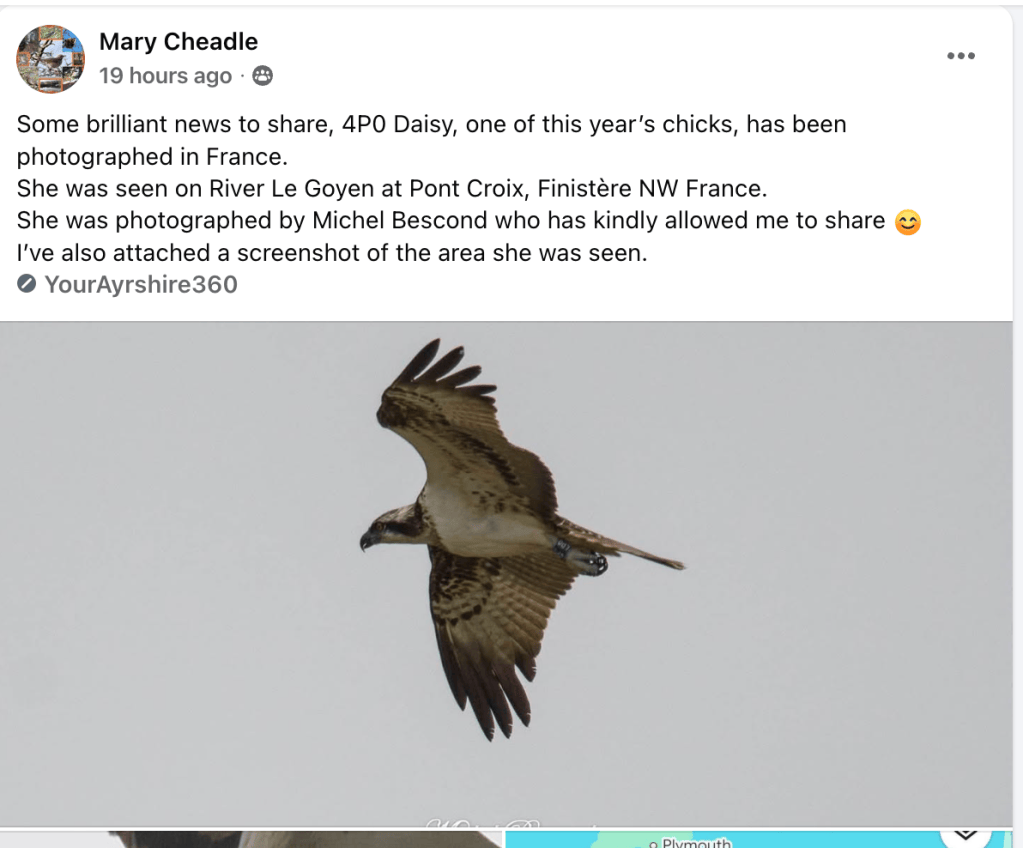
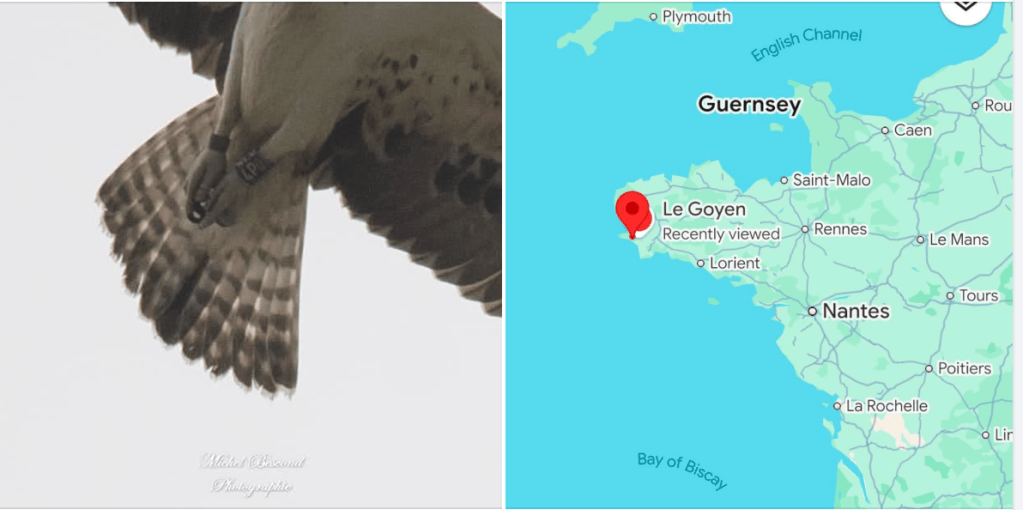
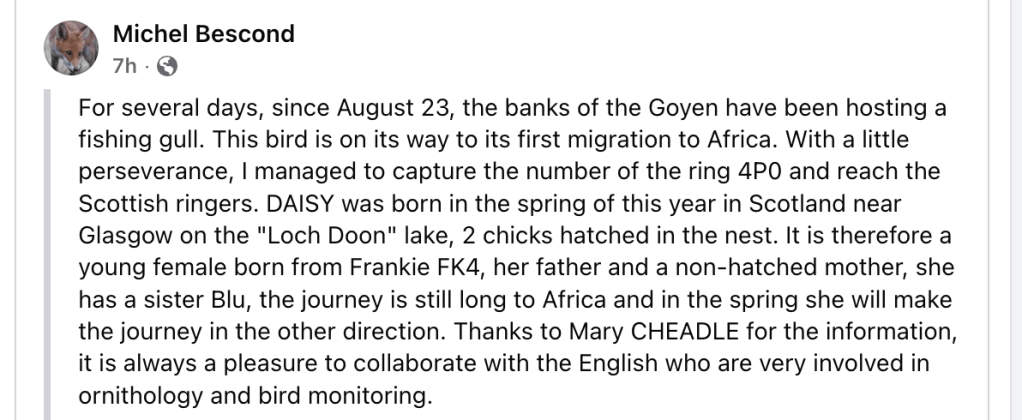
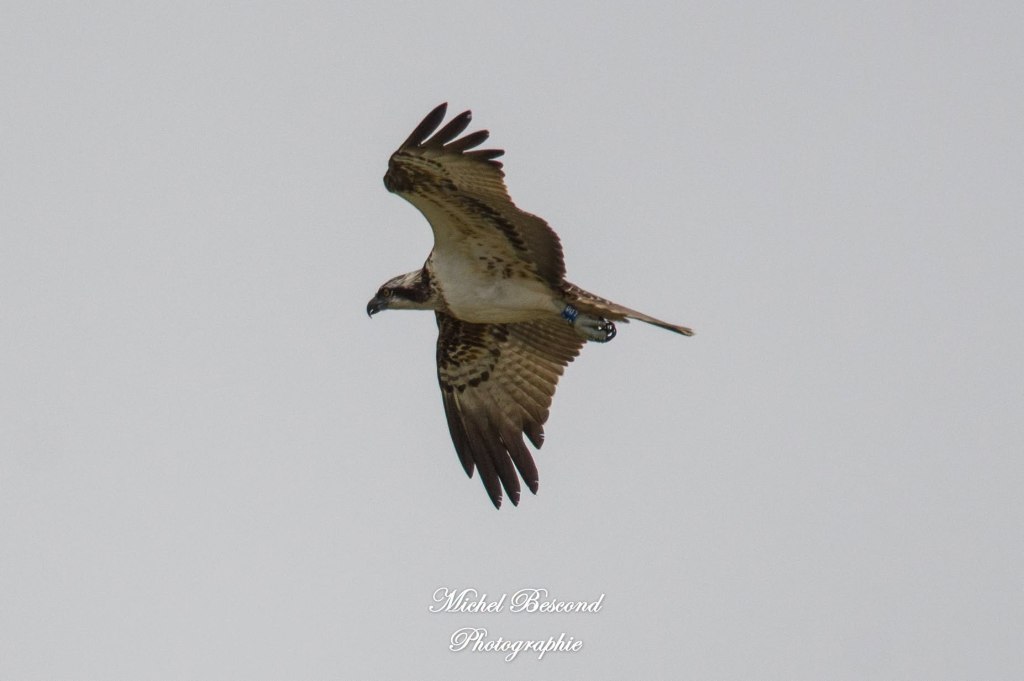
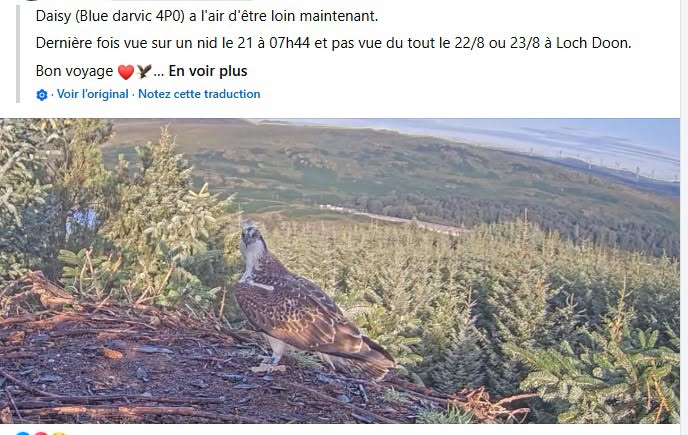
The chicks were ringed on 24th June by the Solway ringers and the unhatched egg was removed from the nest. The two chicks were believed to be female. One was ringed, 4P0 and weighed 2kg and the second 5B4 was 1.7kg. The chicks were named by the local school children at Bellsbank Primary in a competition. The names chosen were 4P0 (Daisy, Daiz McG) and 5B4 (Blu McT), inspired by Scotland at World Cup 2026.
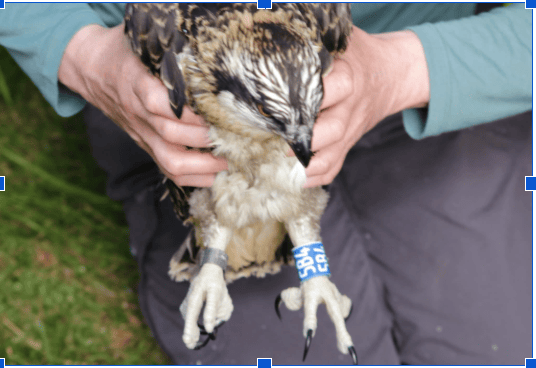
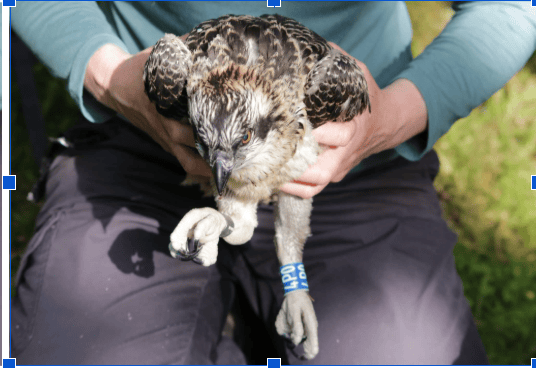
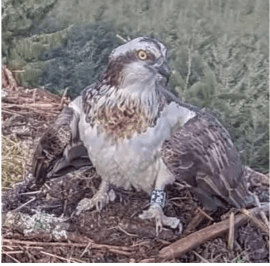
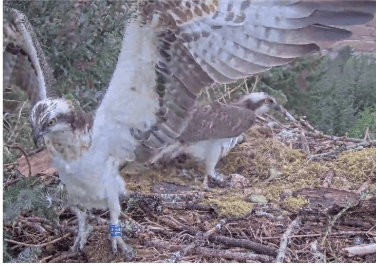
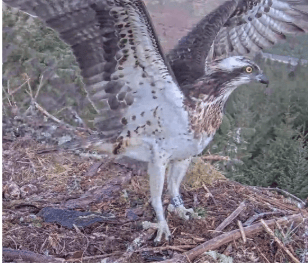
Blu was the first to fledge on 17th July, she was 56 days old. Then on the 19th July, Daisy successfully fledged and she was 58 days old. Blu didn’t return back to the nest after first fledge until 19th July, she was missing for 48 hours but returned back safe and hungry. Daisy returned back after her first fledge, minutes later. After a few nights of both back on the nest they went to roost for the first night on 21st July.
Blu carried her first fish off the nest to eat elsewhere on 30th July. Angel was still popping onto the nest daily but only maybe once or twice and Frankie still kept delivering fish to feed two hungry girls. The weather was wet and breezy and some days they only got one fish but it usually was a large trout minus head.
August saw the fish deliveries getting more competitive with Frankie usually making deliveries and leaving with all toes intact. Angel unfortunately was left to deal with two hungry girls, talons getting stuck into hers if she tried taking the fish and her toe got bit on one occasion. Blu and Daisy were also now in tug of wars over who was getting fish and flapping wings and jumping at each other to stop them getting the fish, if one had it. Angel started perching in a tree close to the nest and only coming to the nest to snatch a fish and leave with it.
Angel was the first to leave on 9th August, this was her last sighting this year. We wish her well and a safe journey, looking forward to seeing her again next year. The nest went quiet with the girls spending more time away on their adventures. Frankie continued to bring fish which the girls rushed to be first to get.
Blu was the next to leave on 19/8/26 at 20:33 hrs. This was the last time she was seen on the nest, she was 89 days old. Then on the 21/8/26, Daisy was last seen on the nest at 07:49 hrs, she was 90 days old. Frankie was seen on the nest on the 20/8/26 and is believed to have flown past the nest with a fish on the 21/8/26 at 12:30 hrs. Frankie was later seen on 25/8/26 defending the nest after an unringed male intruded, this was the last time he was seen on the nest.
Frankie had an amazing fishing season with his final total being 498 fish. This was fish seen brought onto nest delivered to Angel and girls. These were mostly trout, perch and pike.
The nest had its share of intruders during the 2026 season, all kept at a safe distance by Angel and Frankie. Many of them were unringed birds and a few of them were ringed, all reported to the Roy Dennis Foundation. Blue darvic PW5 intruded on 6th April, Tweed Valley Forest Park confirmed as female ringed on 2016 breeding in Ayrshire. 3rd May another ringed blue darvic 741 intruded on the nest to be chased off by Frankie. This was confirmed as a male osprey ringed at Carron Valley Forest on 7/7/23. On the 14th May, blue darvic 3C3 intruded, this was confirmed as a female osprey ringed at a nest near Aviemore on 16/7/24.
I would like to say thank you to everyone for all the help and advice for making 2026 a really enjoyable season at Loch Doon and a special thank you to Wildlife Windows and YourAyrshire360 for the livestream. Solway Ringers for a fantastic job in tagging the ospreys, especially Sam Boley (the climber) and everyone at the Roundhouse for updates at Loch Doon.
© Friends of Loch Doon Ospreys, Jacqueline Reilly
LOCH DOON POST FLEDGING NEWS
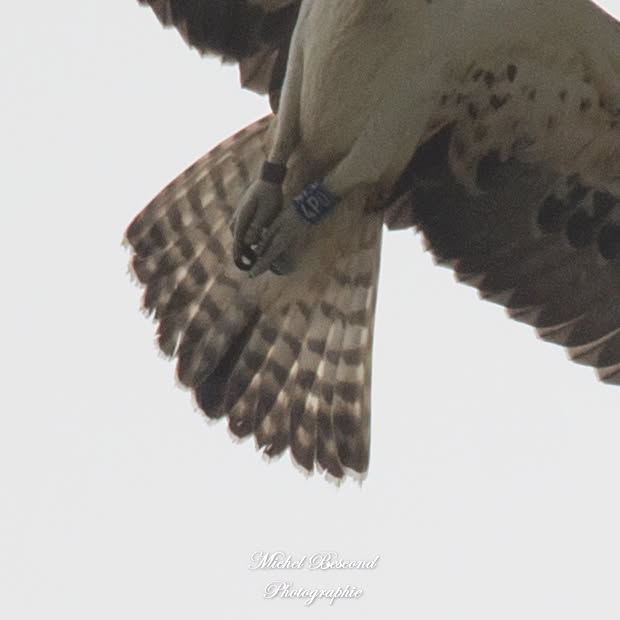
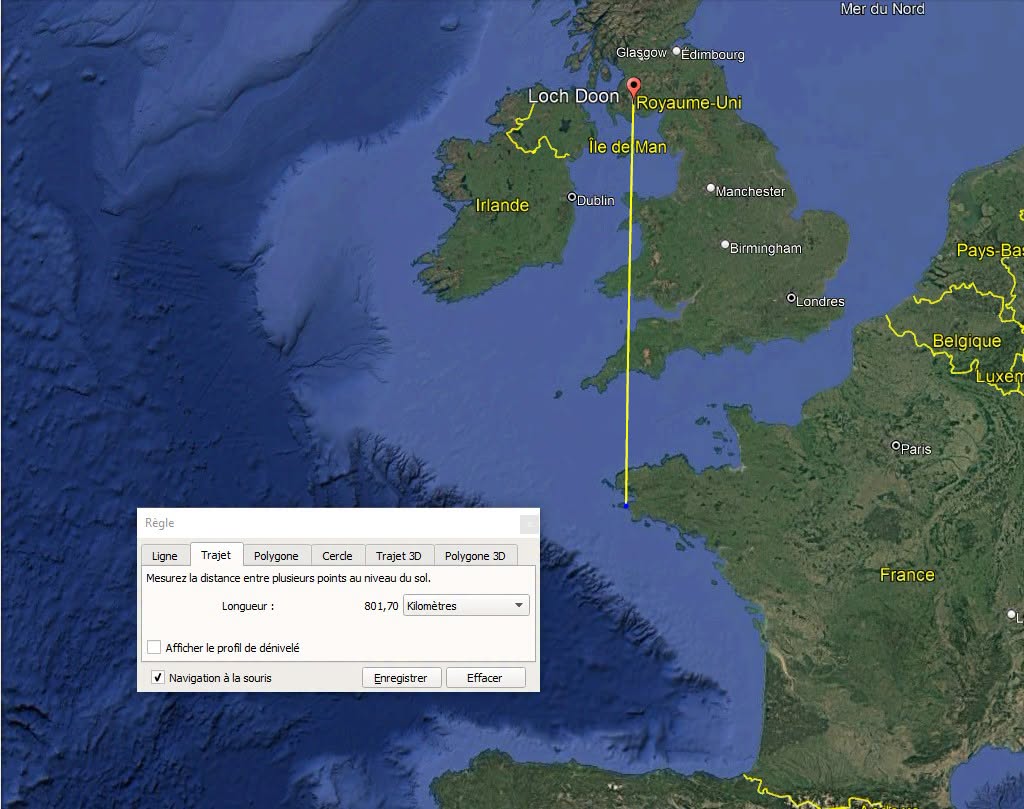
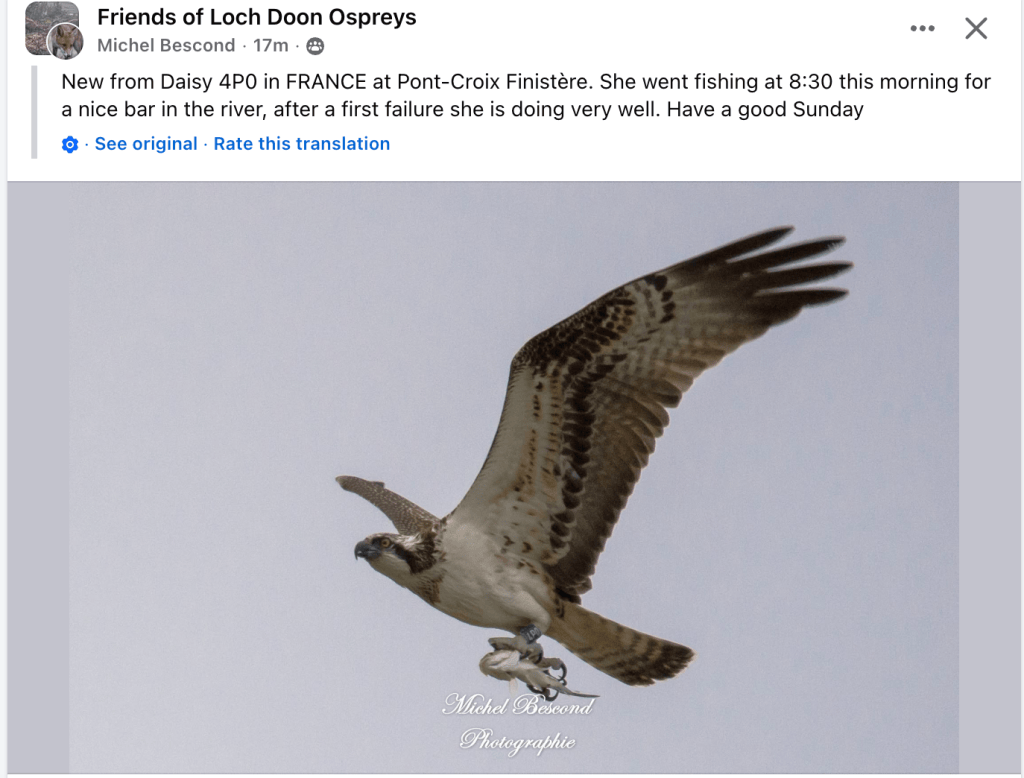
03/09/26 REPORTED SIGHTING OF BLUE 4P0(26)
TWEED VALLEY
The Tweed Valley Osprey Project, covers a vast area and is certainly one of the largest Projects if not the largest. Diane Bennett Project Officer, produces regular updates, We have put these together to produce the file below, Credit for which remains with D, Bennett, Forestry England and credited photographers. There was no better way of presenting the Tweed valley Poject. 2026.
THREAVE CASTLE
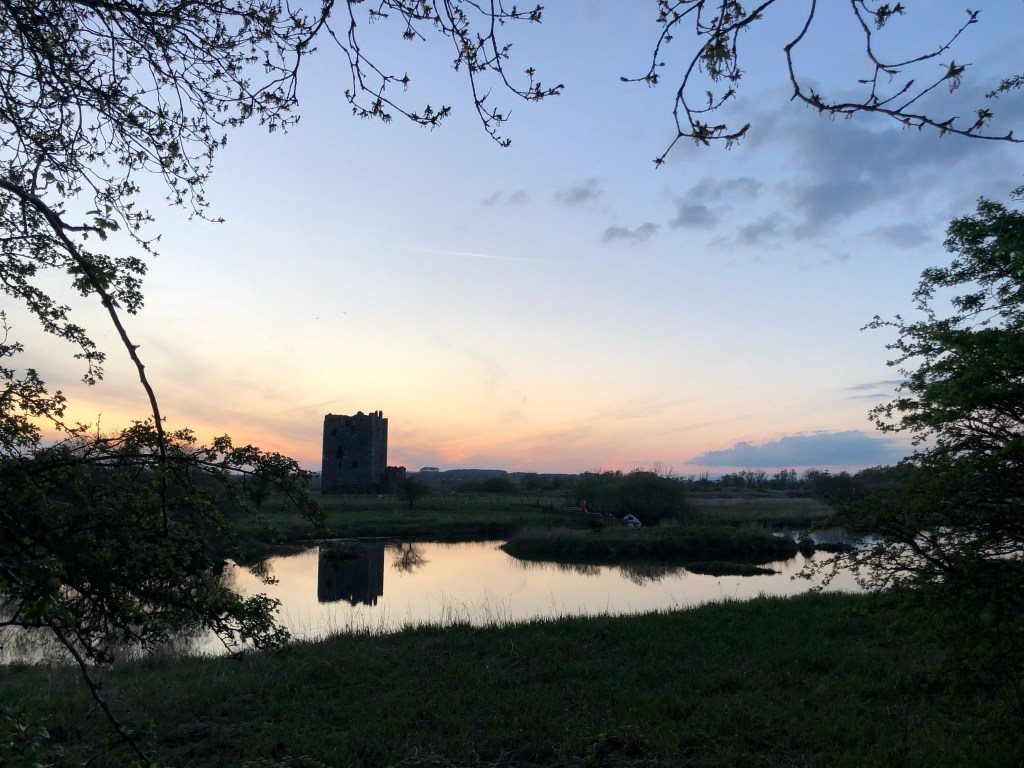
NEST 1
Male:- Black 80, returned 18/03/26
Black 80 has been the resident breeding male at this nest since 2008, Although no chicks were produced in 2008.
Female:- Remains unidentified, thought to be the same female as previous year.
Link below to Black 80’s History
This pair Managed to raise 2 chicks to fledging, Ringed Blue 5B5 and Blue 5B6 sex at ringing was not declared.
One of the 2024 Chicks Blue 4B9(24) Intruded the Friends of the Osprey PC Nest in the Glaslyn Valley on 12/08/26.
NEST 2
Was occupied by a pair of Geese
NEST 3
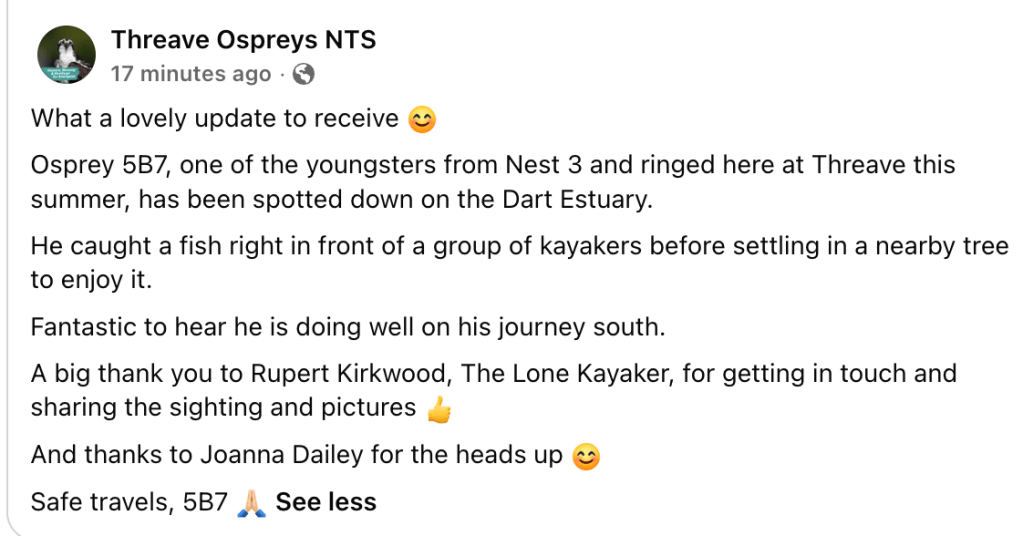
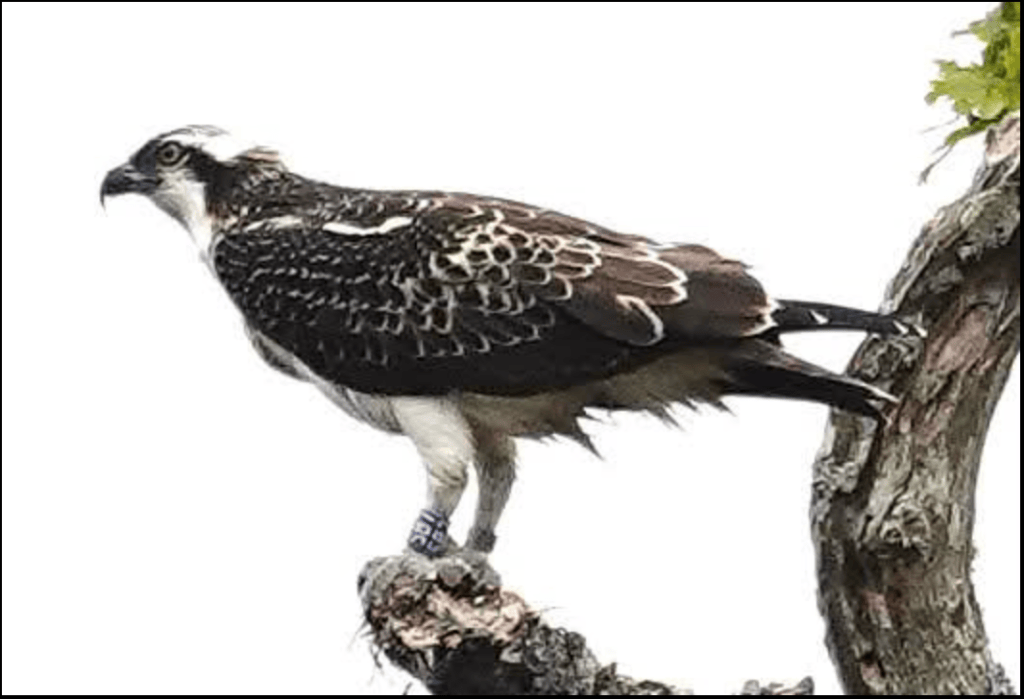
A pair of unringed ospreys have built a nest in the same tree as the platform nest built by C Ostroznik at the Stepping Stones site, due to the platform being used by Greylag Geese. This pair also raised Chicks ringed Blue 5B7 Male and Blue 5B8 Female,
POST MIGRATION NEWS
OTHER SCOTTISH NEWS.
RESCUE
OSPREY CHICK RESCUE
 Update Parent reported on the nest this morning

Saturday began with an urgent call about 3 nestfall Osprey chicks that David had found on his morning walk.
Soaked and grounded after yesterday’s rainfall, the chicks had tumbled from their nest that had become waterlogged, which had resulted in a serious break in the structure, and then a full collapse.
The fall, of about 20m / 60 feet was significant and first we arranged for David and Melissa to return and uplift the chicks to go to fabulous vet Ella at Highland Vet Referrals & Emergencies with the full cooperation of the estate.
There, sadly, one chick was found to be badly injured so on welfare grounds he was spared any further suffering and euthanised. The other two had miraculously avoided any serious trauma and once dried, they perked up well. Ella kept us fully updated while we took advice from Brian about next steps. An Osprey expert on “the team” comes in very handy!
Without delay the sensational ornithology duo of Brian and Daniel kitted up and headed to the nest site where a phenomenal rebuild got underway.
With the two chicks cleared for return David and Melissa collected them to head back to their newly refurbished nest where Brian and Daniel got them back in situ with a combination of professional tree climbing skills and expertise as ringers.
Reaching out to colleagues, experts, professionals and friends is an essential part of our work. Collaboration, consultation and teamwork can create wildlife magic and these two lucky youngsters now have a second chance, with their parents in view and our entire team happy to have helped them get back up high, where they belong.
Thank you very much
David and Melissa Ella Brian Daniel Phillipa
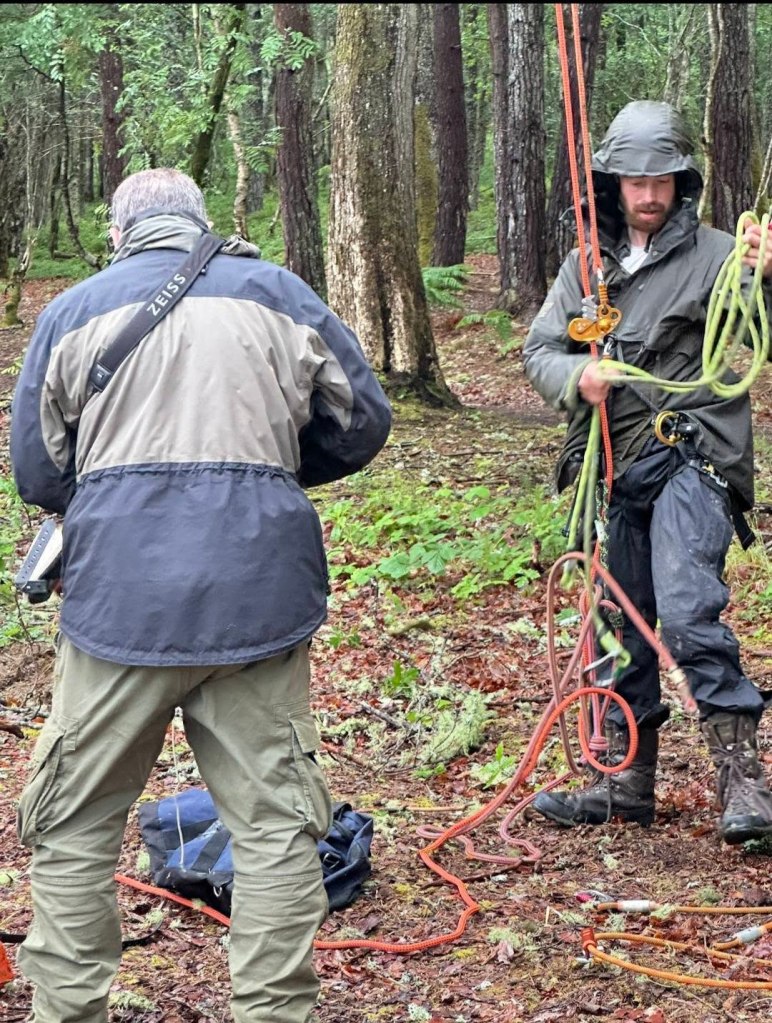
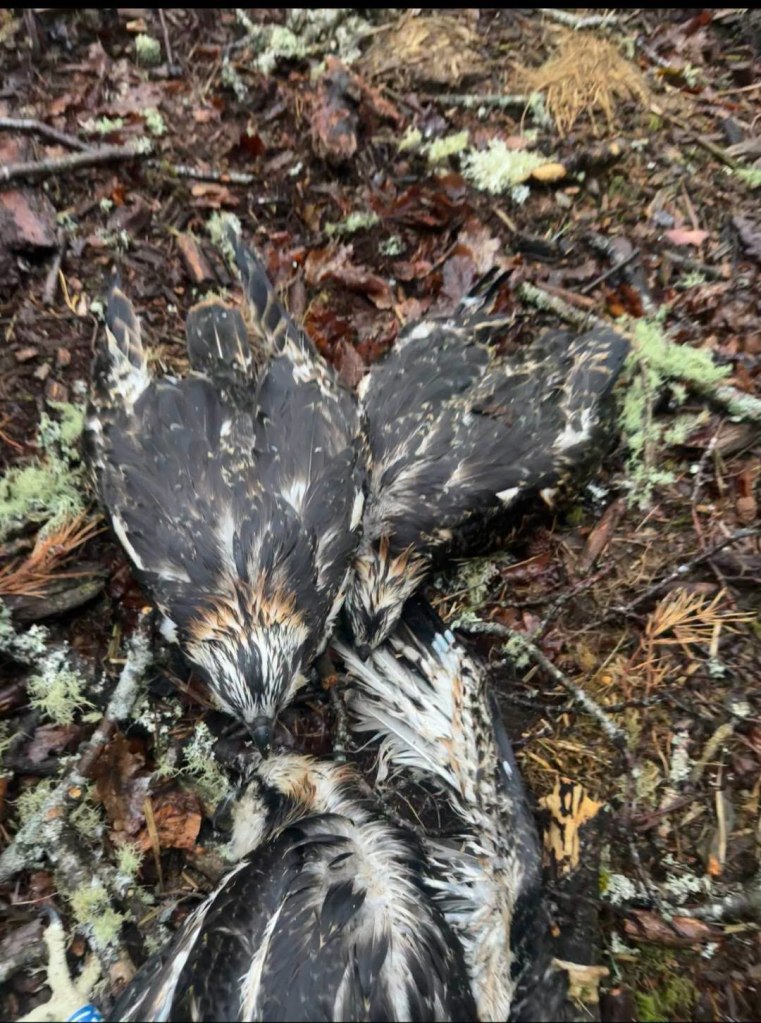
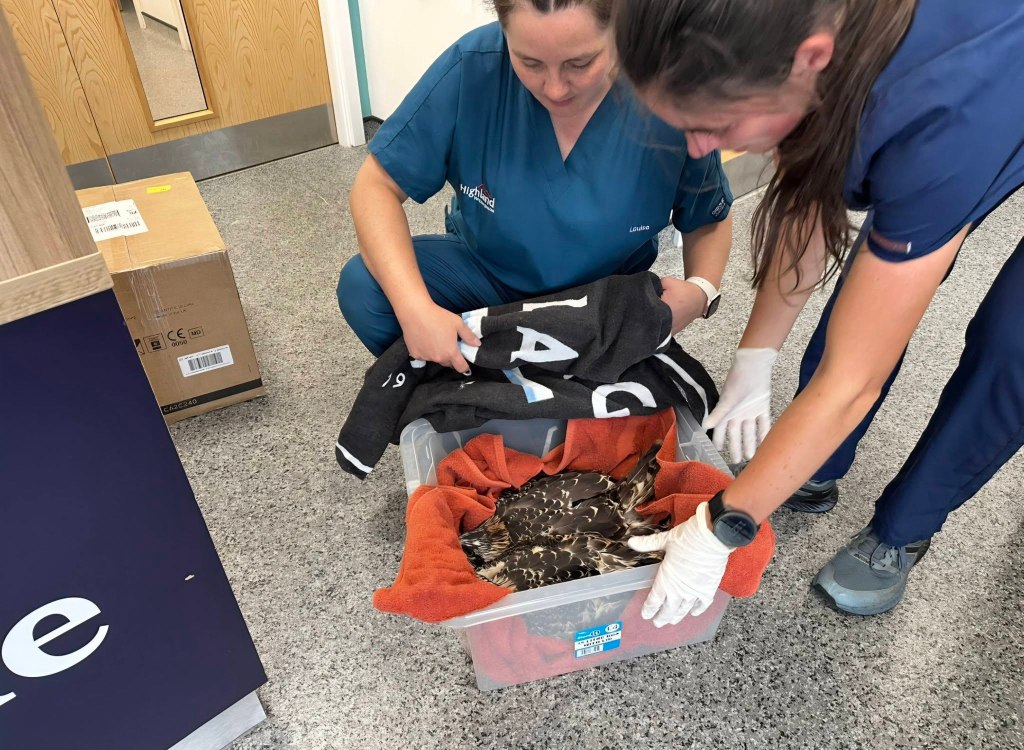
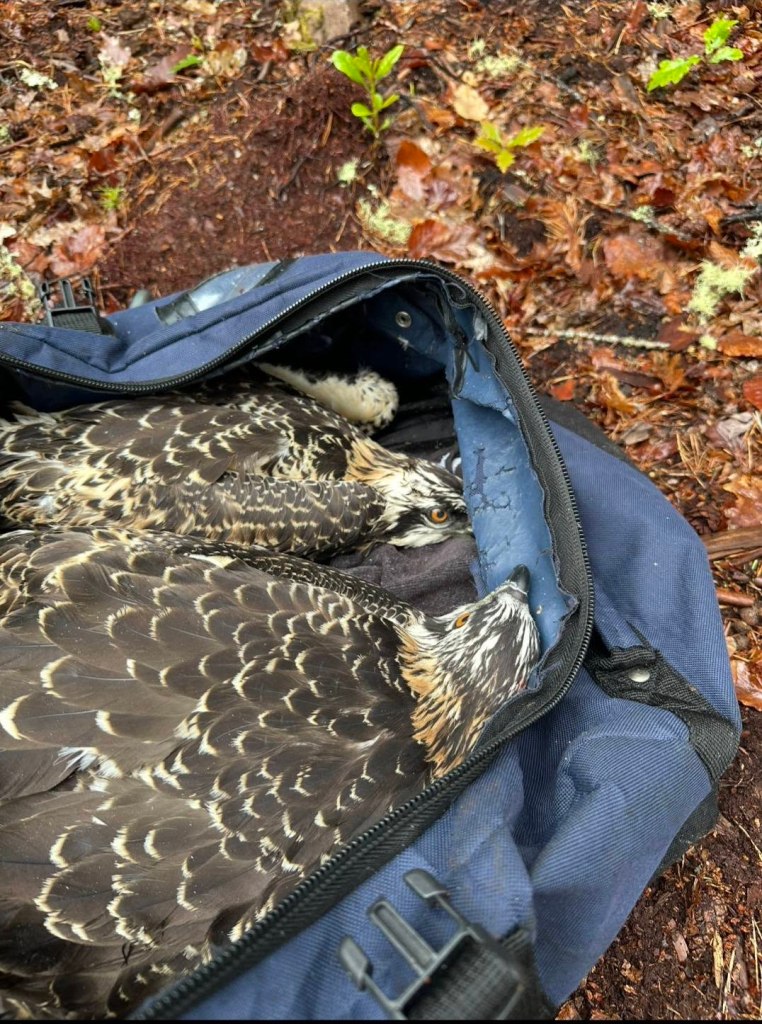
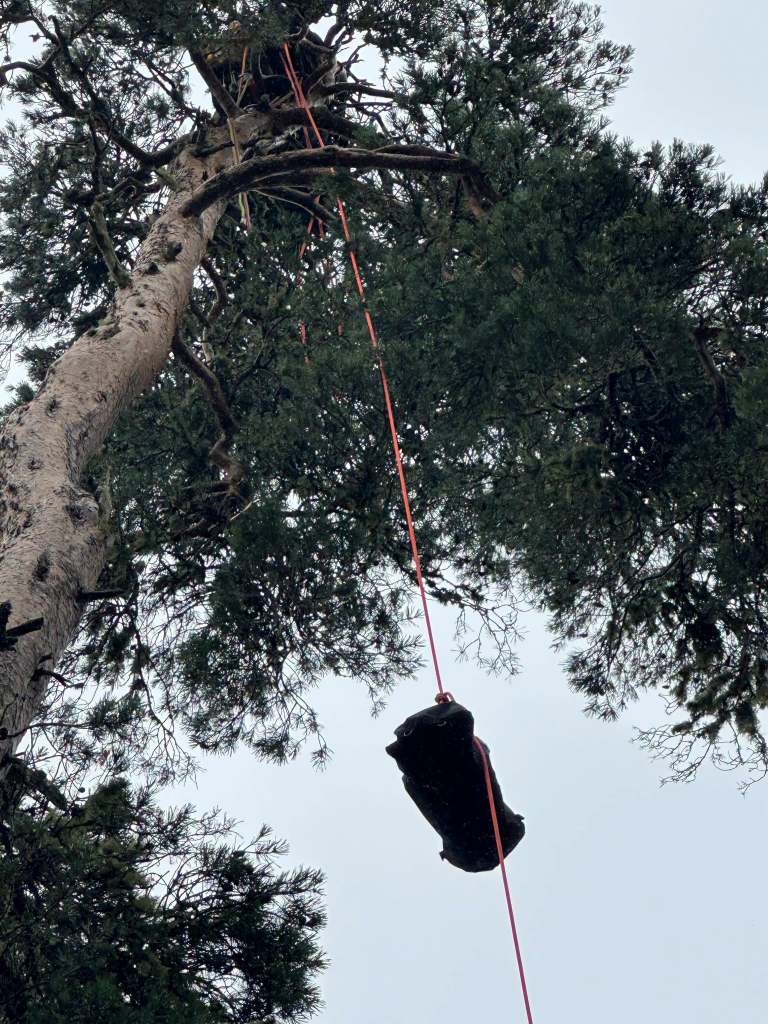
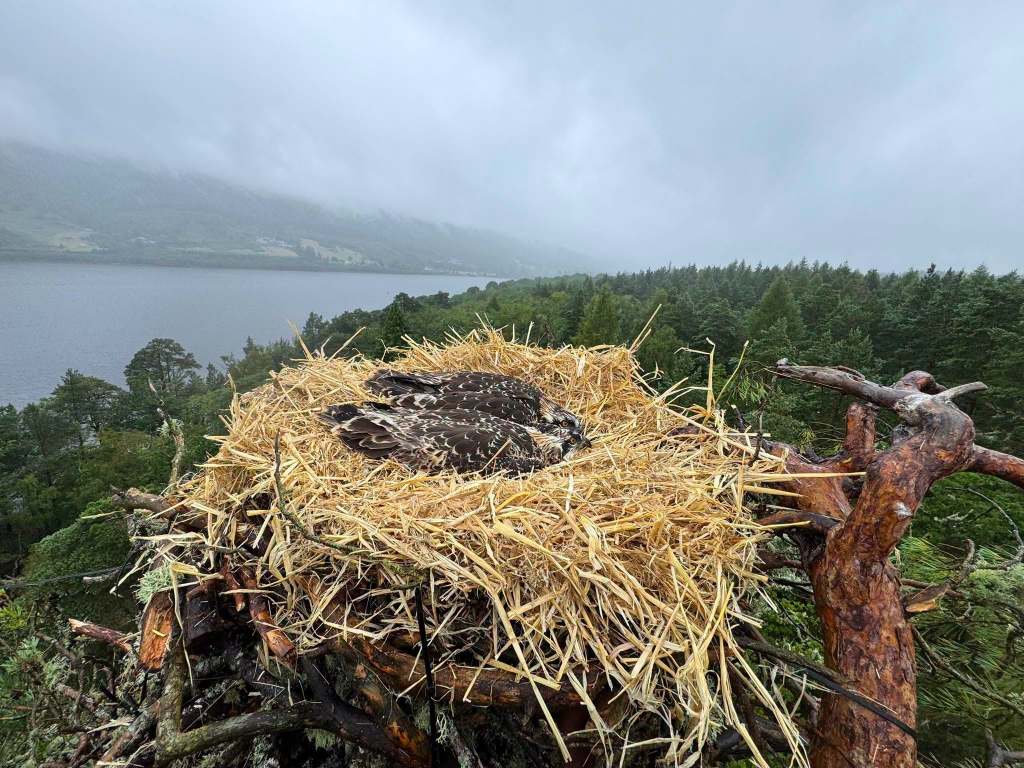
An excellent example of Team Work, Conservation and Care and a great outcome. well done one and all.
Reading the sightings pages in the above publication and information from Facebook , there appears to be upto 5 nests in the area with at least 3 nest active this year. Nest 5 was abandoned early season, nessts 1 and 4 producing 2 chicks each, No other information is currently available.
ENGLISH NESTS

BASSENTHWAITE
BASSENTHWAITE
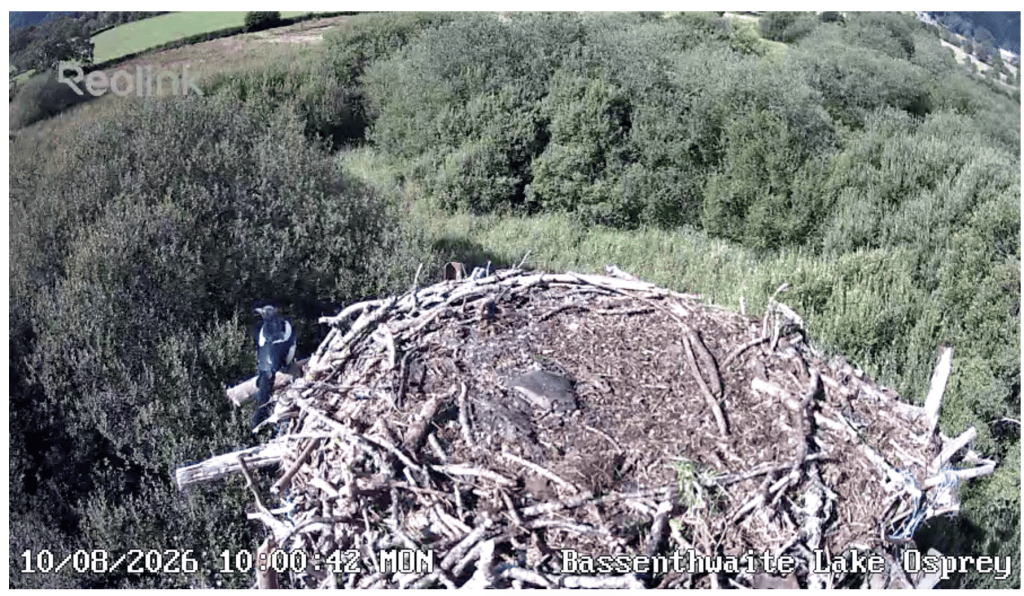
A quadruple bonus season, Firstly we have camera, Thanks to the Barnes Family and The Lake District wildlife Park, Secondly we have a pair of Birds an Unringed Male and Blue PH2(17) She hatched at Loch of The Lowes, Thirdly they raised 3 Chicks to Fledging and finally the chicks were Ringed, This is the first time since 2019 that the chicks have ringed on this site. Details below.
Unfortunately due to how the camera worked ( on a loop of around 10 minutes every hour or so, and no overnight coverage) it was not possible to determine last seen dates/times.
BOLTON CASTLE
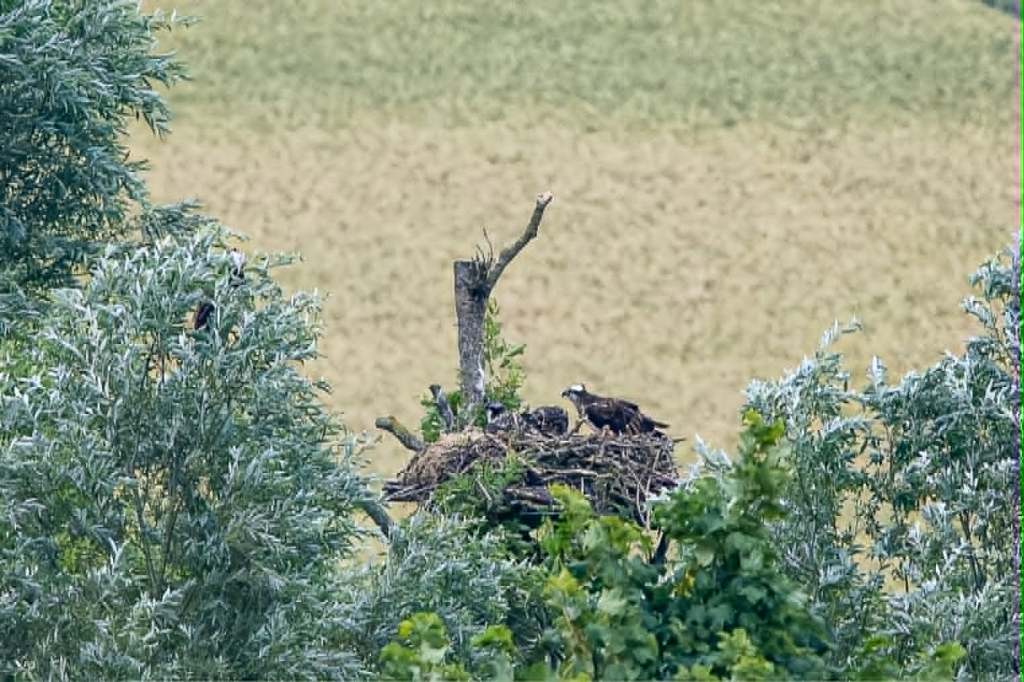
MALE:- Unringed
FEMALE:- Blue KS1(18) Hatched Glaslyn 2018, parents being Unringed Aran and Unringed Mrs G
Bolton Castle Osprey Nest – 2026 Summary
The same breeding pair returned to the Bolton Castle nest in 2026, with the unringed male and blue-ringed female KS1(18) returning approximately a week later than in 2025. Their later arrival followed a period of poor weather early in the season. It was not until 10 April that both birds were observed together at the nest for the first time.
Unfortunately, the nest camera was unavailable throughout the 2026 season, so it was not possible to establish how many eggs were laid. However, observations confirmed that two chicks hatched and both subsequently fledged, with this confirmed by 31 July. Following fledging, both chicks appeared strong, vocal and active. Both chicks were ringed at the nest on 13 July. The sex of the chicks is not currently known to us; if it was established during ringing, this information has not yet been made publicly available. The female, KS1(18), appeared to have departed the area by 25 August.
Records of Bolton Ospreys at Other Sites
The 2026 season also produced several interesting records of Bolton-reared and Bolton Estate ospreys at other sites. 7C4, a Bolton Castle chick from 2022, was recorded intruding at the Glaslyn nest on 16 April and subsequently at the Usk Valley nest at 10:18 on 24 May. A further one-year-old osprey was recorded at Nosterfield in mid-June and was confirmed as a bird originating from the Bolton Estate. The individual details are not currently available. Another Bolton Castle-reared bird, 3K9(25), was recorded intruding at the Foulshaw Moss nest on 10 August. Having been raised at Bolton Castle in 2025, 3K9(25) had returned to the area as a one-year-old. These records provide valuable evidence of the movements and dispersal of young ospreys originating from the Bolton Castle nest and the wider Bolton Estate, and will hopefully contribute to our understanding of where these birds go during their first years.
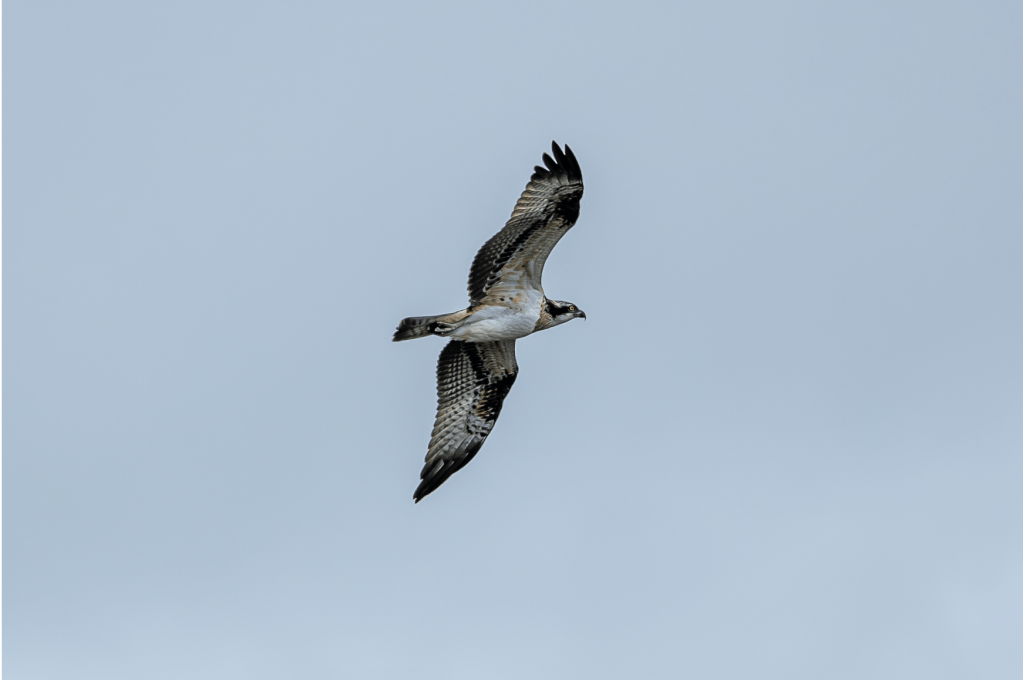
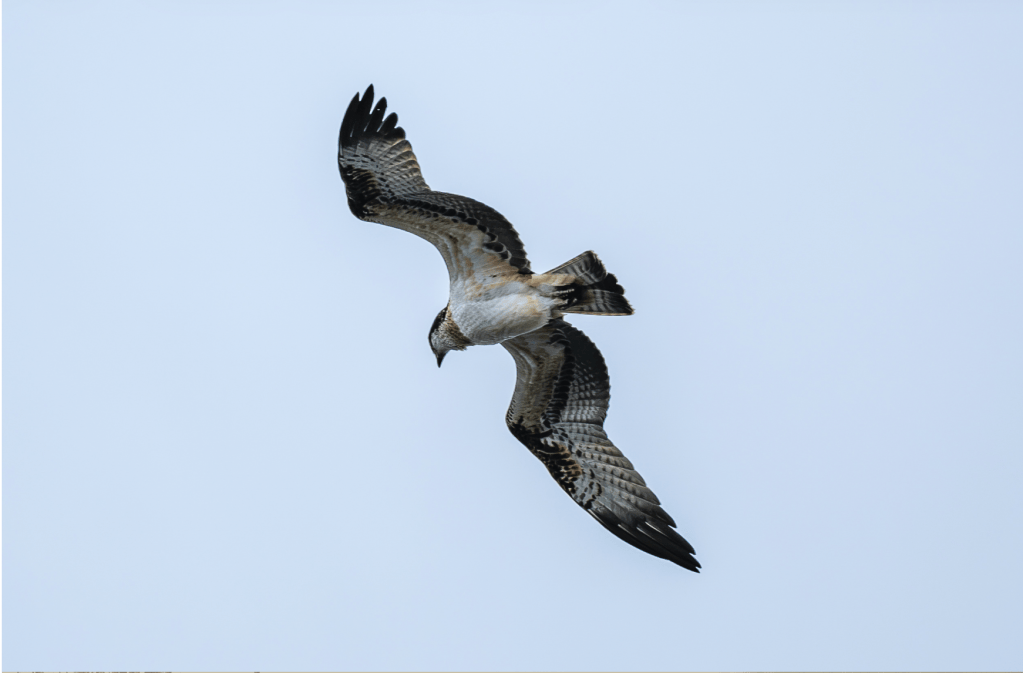
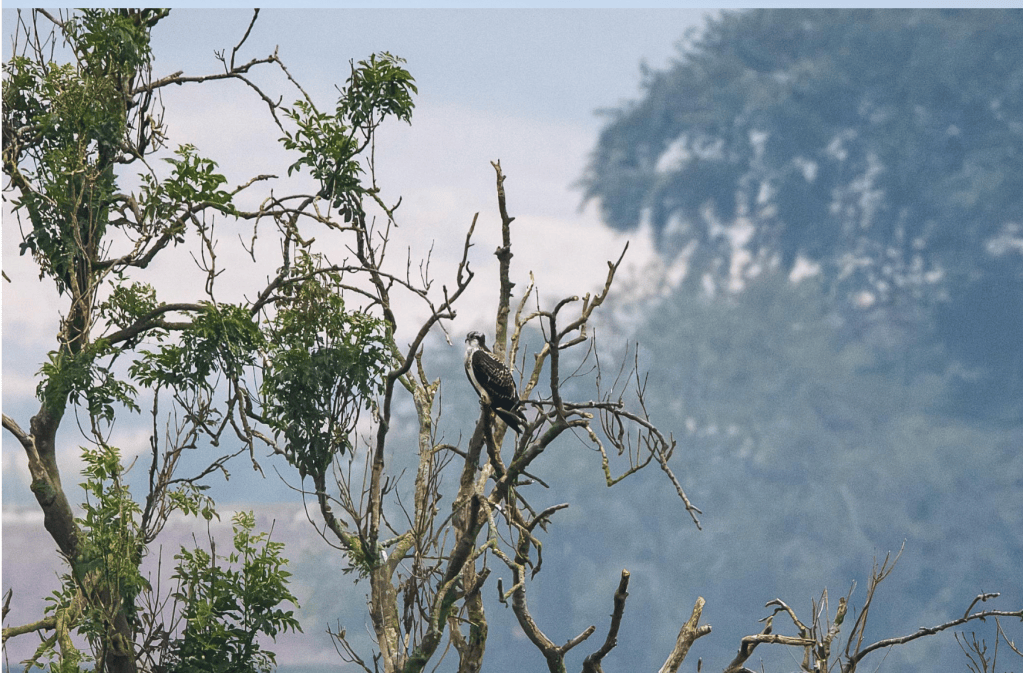
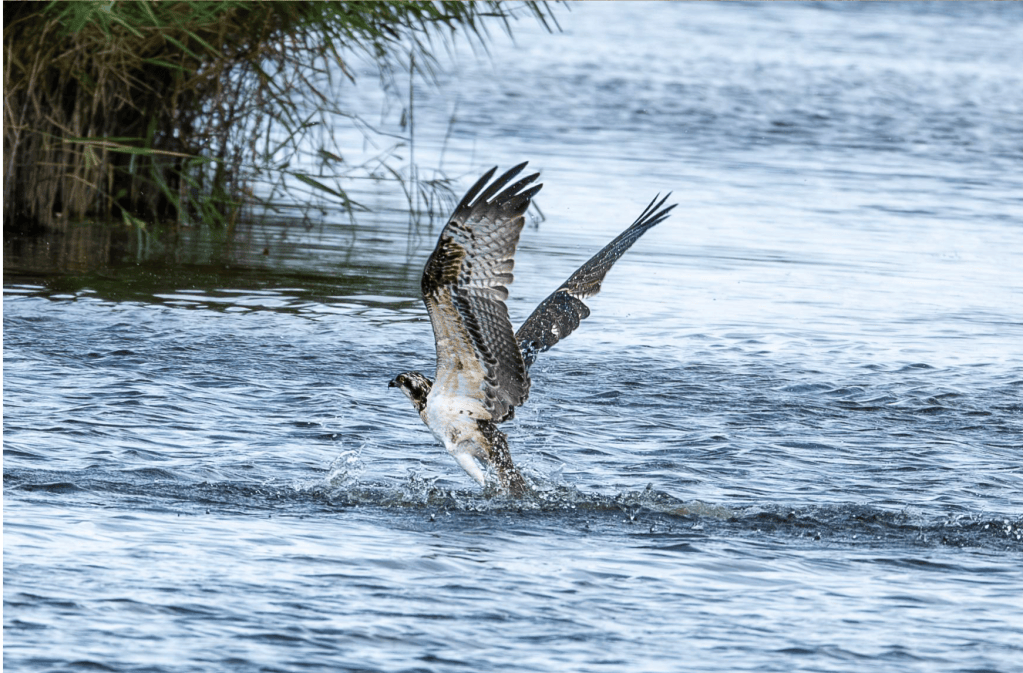
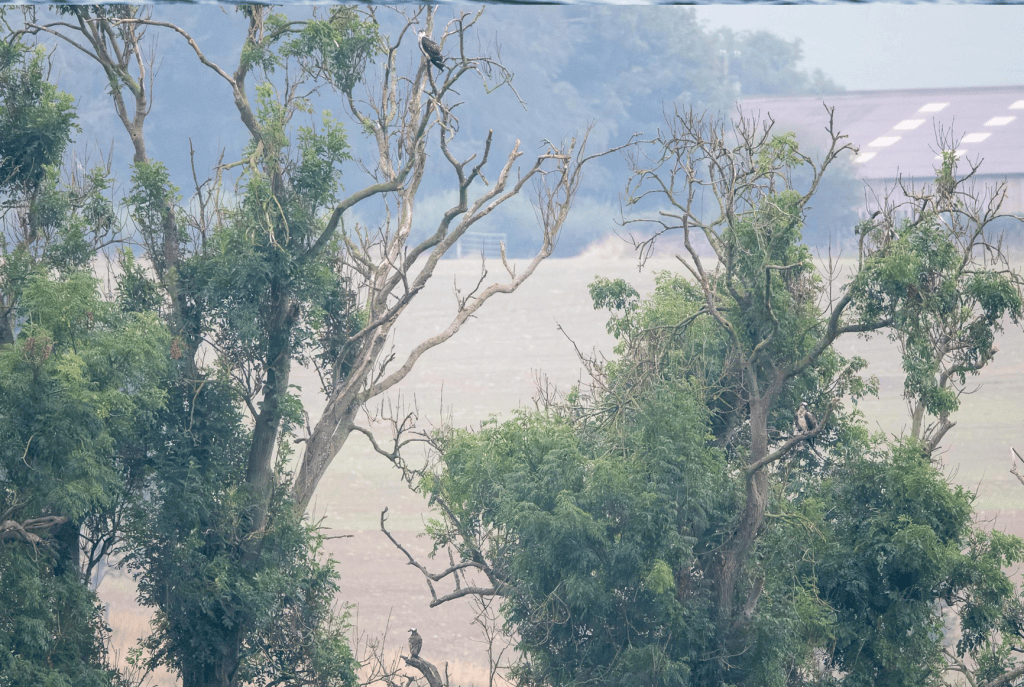
(C) SAM MASHFORD
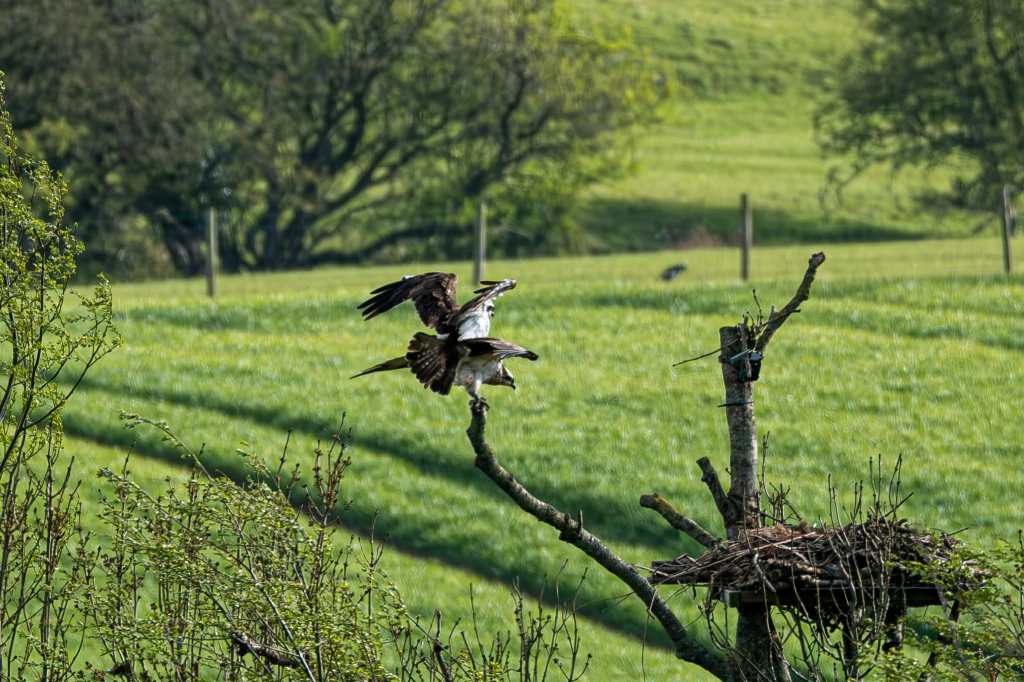
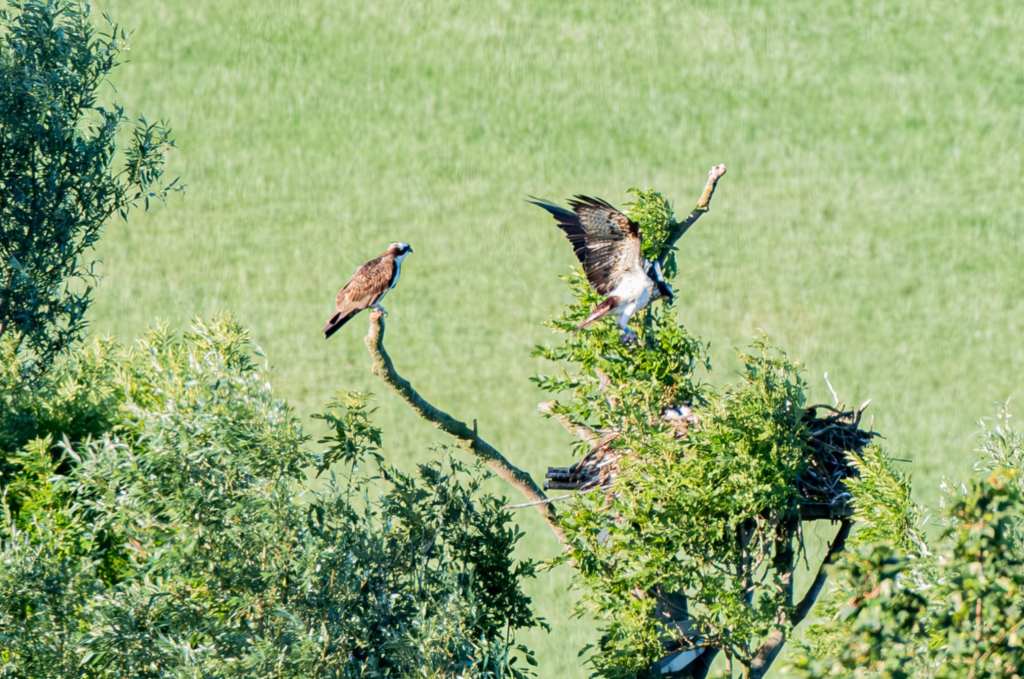
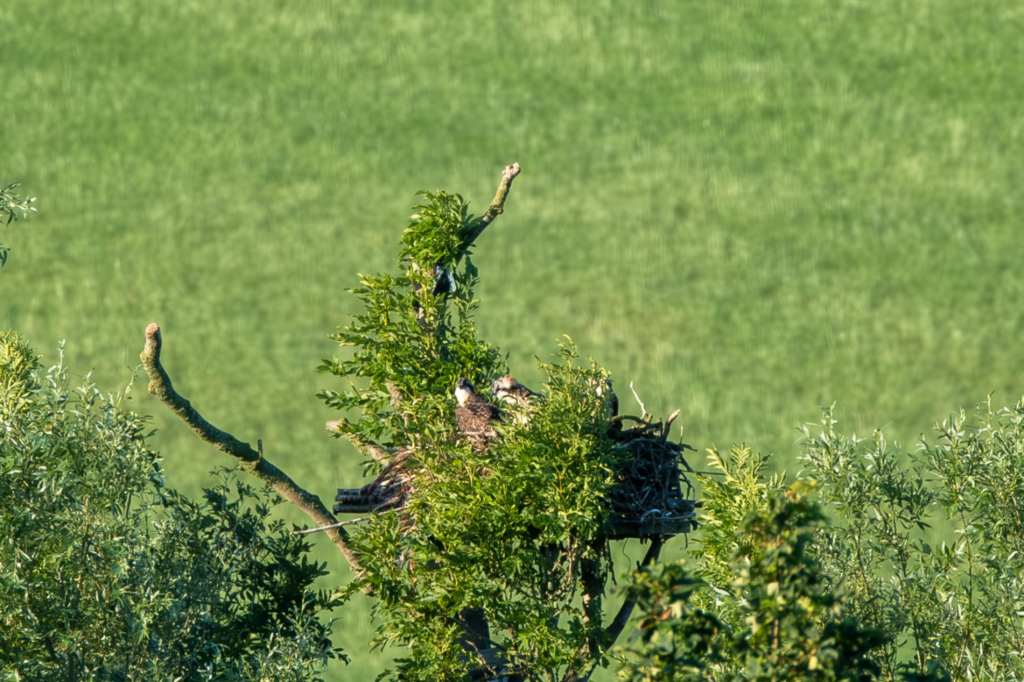
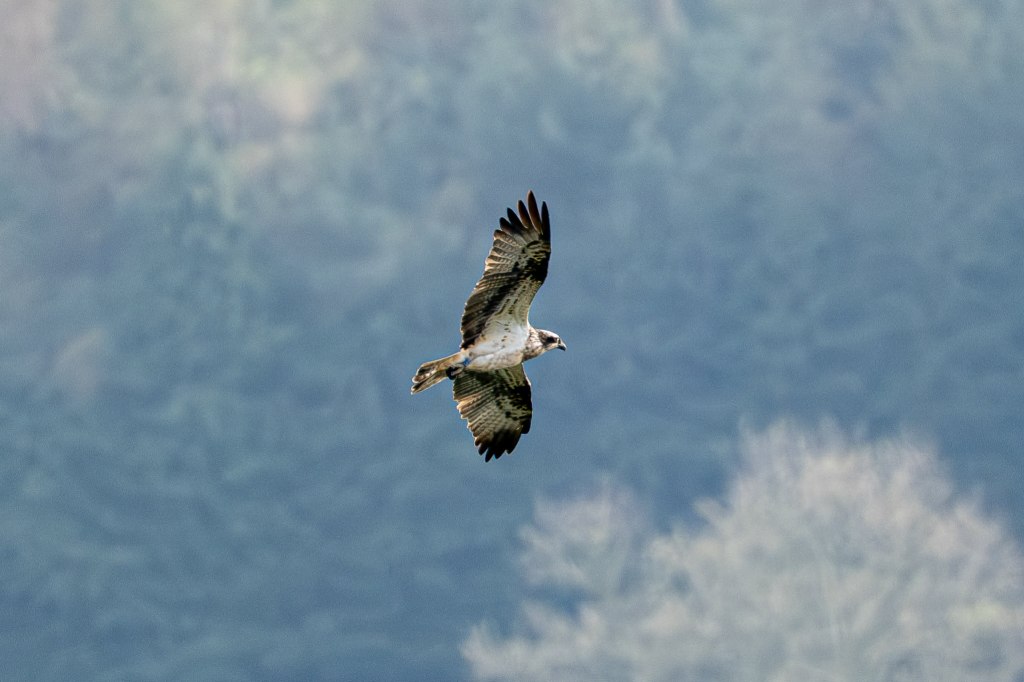
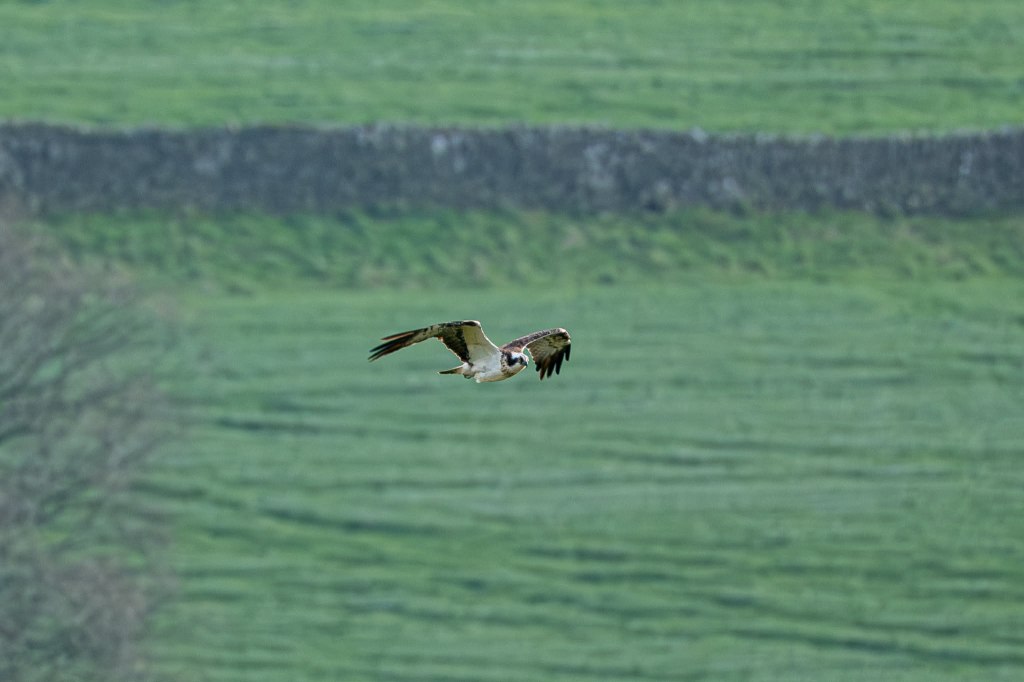
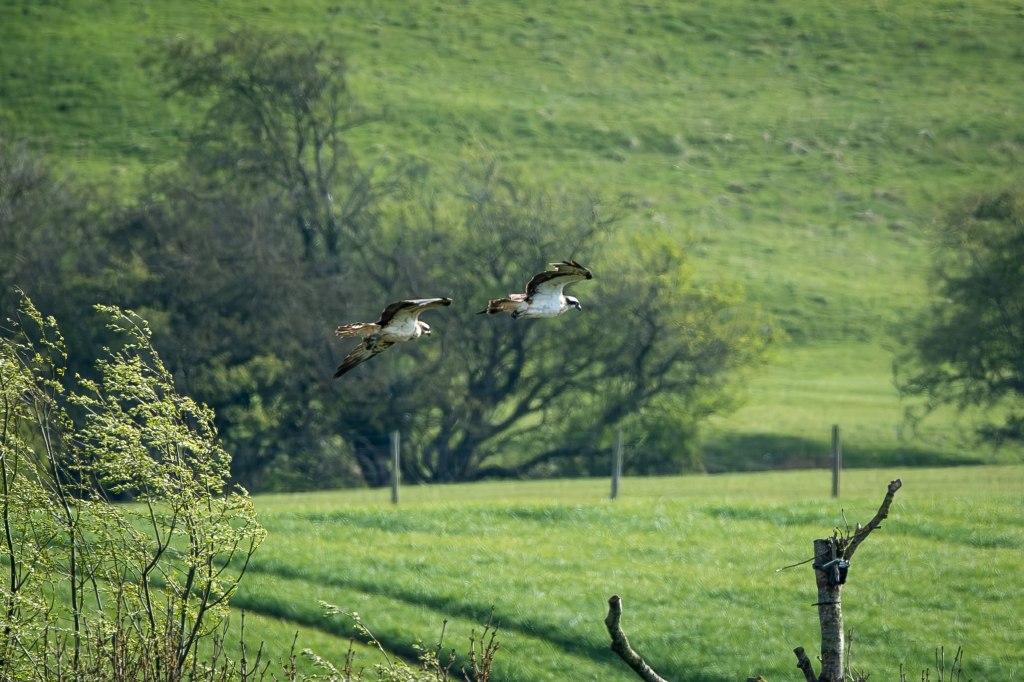
(C) Sam Mashford
ESTHWAITE
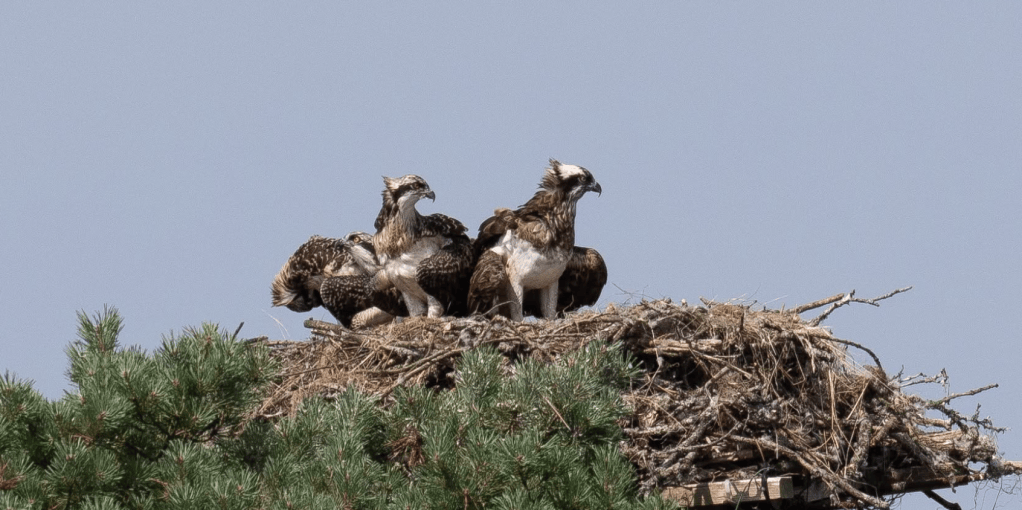
(C) OSPREY SAFARI
ESTHWAITE
MALE:- Blue 7A, Returned 24/03/26
FEMALE:- Unringed, Returned 02/04/26 (Confirmed)
Blue 7A has been the Breeding Male since at least 2018, his unringed female partner is named Mrs O, it is not certain that it has been the same bird throughout his tenure, Blue 7A and Patner have raised 22 chicks thus far at a rate of 2.4 Chicks/Year
Blue 7A(14) returned 21/03/26 and the site declared a pair on the 4th April.
Blue PH2 who later bred at Bassenthwaite intruded on 02/04/26
This year they have raised three chicks who were ringed on 30/06/26 Using Blue 4k6 Female, Blue 4K7 Female and Blue 4K8 Male.
Other news two of the chicks hatched in 2024, have been seen returned to the UK this year, Blue 0C7 and Blue 0C9.
Blue 5H5(23) from Poole Harbour nest 1 intruded the nest earlier in the season.
CUMBRIA WILDLIFE TRUST NESTS
FOULSHAW MOSS
Foulshaw Moss Nest 1
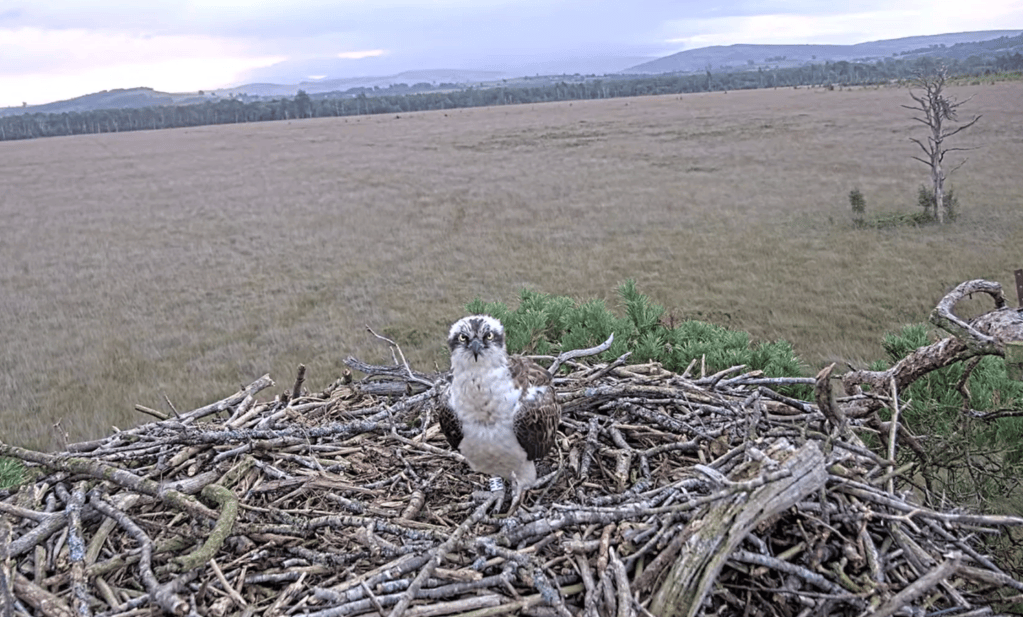
Male:- White YW, Returned 28/03/26, Last seen
Female:- Blue 35,Returned 06/04/26. Last seen on the nest 11/08/26
This pair have been together since their first breeding season together in 2014, they have raised 34 chicks. to the fledging stage at a rate of 2.61 chicks/ year which puts them right up there with the top breeding birds at monitored nests.
Foulshaw Moss nest 2
(C) CWT
Male:- BLUE 476, arrived 08/04/26 Last seen
Female:- Blue 717, Arrived 31/03/26, last seen 14/08/26
PARENTS DETAILS.
Blue 476, Hatched at a Private Nest in Cumbria 2021. Returned as a 2 year old in 2023 and was seen both in Ireland and at Leighton Moss.
Blue 717, Hatched at nest in Fife in 2022, Father was Blue YD and an Unringed Mother.
NEST 3 CAMPFIELD
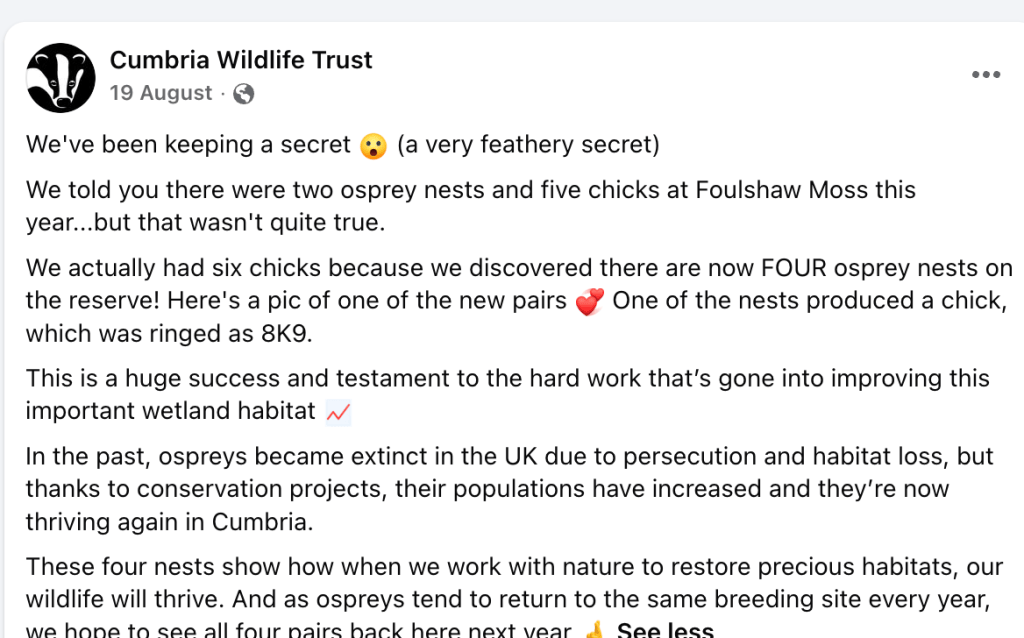
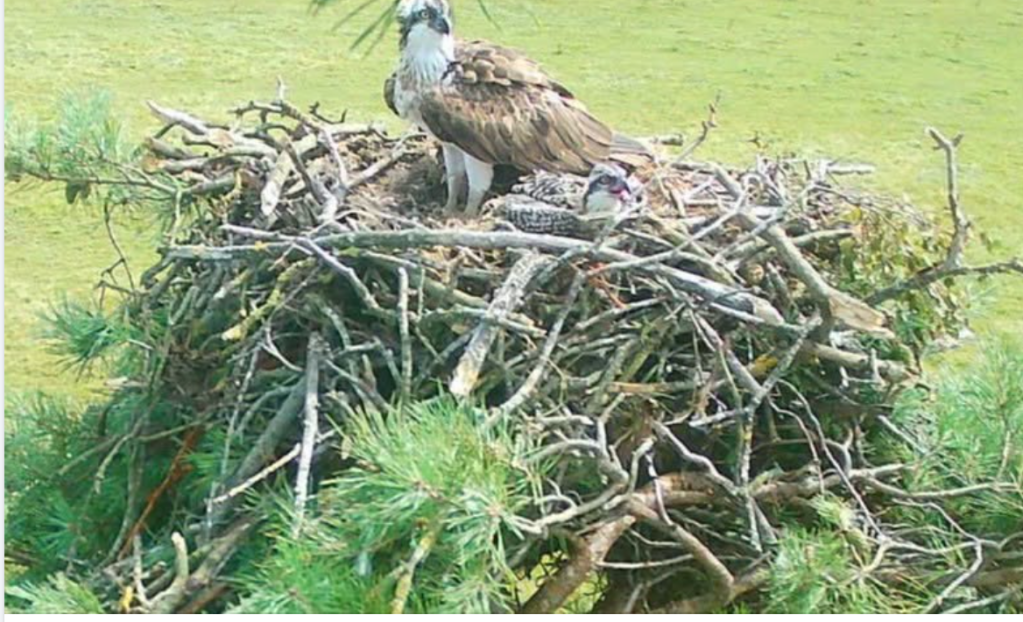
INTRUDERS.
23/03/26 Blue 547 (2023 Errogie) Intruded at 10:38
26/03/26 Blue CE (2009 Easter Ross) seen at 17:45
27/03/26 – Blue CE again on the nest at 06:39
30/03/26 Blue N0 (2017 Foulshaw Moss) intruded Dyfi at 10:39
14/04/26 White DP (2016 Stirling ) intruded Nest 1 at 13:02
16/04/26 Blue 7C2 (2022 Cumbria Private Nest) intruded Nest 1 at 14:30
19/04/26 Blue ringed Osprey intruded Nest 2 – unable to read ring
10/08/26 Blue 3C1 at 19:24 0
Blue 8K6 at 19:26
Blue 3K9 (2025 Bolton Estate) at 20:04
31/08/26 Blue 5M4 (2024 Foto Fron Nest) intruded Nest 1 at 15:50
01/09/26 Unringed Male landed on the nest Followed by Blue 5M4( Private FoTo Nest 2024)
03 September – Blue 5M4 Intruded nest 1 at 06:13
OTHER LAKE DISTRICT NEWS
OTHER LAKE DISTRICT NEWS
A nest in the northern Lakes, whose resident pair is Blue 207 (Cawfields) and Blue NT9 succesfully bred again this season raising two chicks. (thanks to Kielder Forest Osprey Project for the information.)
NEWS FROM NORTHERN ENGLAND
KIELDER FOREST
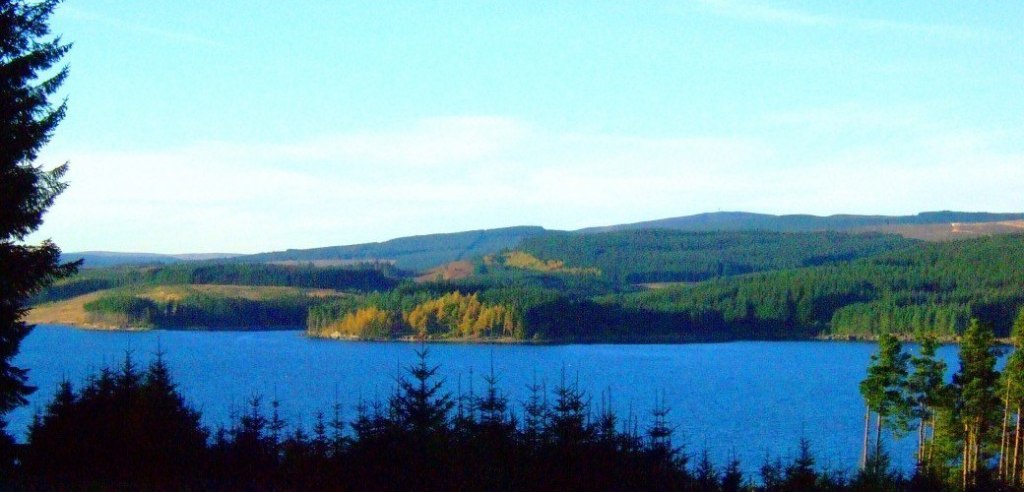
Kielder Forest is a vast remote area, covering nearly 250 Square Miles. We are totally reliant upon Joanna Dailey and the team at Kielder Forest Osprey Project for information, They Produce Regular Blogs and Annual Data Sheets, for which we are extremely grateful. There is only one way to keep up to date with the comings and goings at Kielder is through the regular Blogs and to the synopsis covering all nests throughout the forest in 2026.
LINKS BELOW:-
It has to be said, a HUGE thank you to Joanna Dailey and the team at Kielder Forest Osprey Project and Forestry England. THe amout of data they produce and share is quite outstanding. Thank You.
NEST 1A
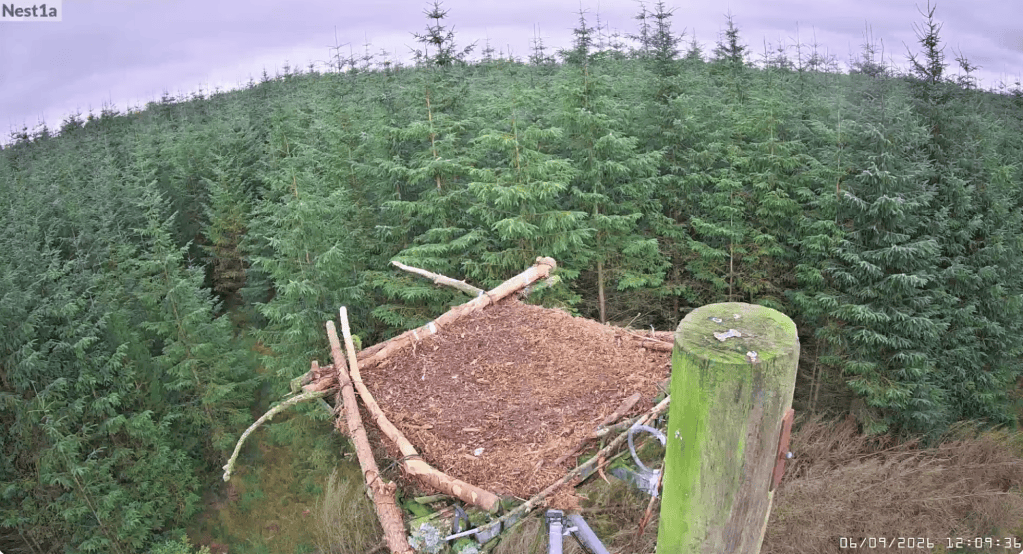
| KIELDER FOREST NEST 1A NEST / CHICK DETAILS 2026 | |||||
| PARENT | RING NUMBER | ARRIVAL DATE | LAST SEEN DATE | ||
| MALE | W6 | 06/04/26 13:32 | 11/09/26, Last seen eating on nest 6 | ||
| FEMALE | UNRINGEDMrs W6 KF13 | 04/04/26 15:41 | 23/08/26 08:30 | ||
| DAYS TO FIRST EGG | 10 | 69hrs 55mins | 71hrs 30mins | ||
| CHICK DETAILS | |||||
| RING NUMBER | GENDER | DATE LAID | HATCH DATE | FLEDGING DATE | LAST SEEN DATE |
| INCUBATION PERIOD | |||||
| 3B6 KILHAM | FEMALE | 16/04/26 11:50 | 25/05/26 19:38 | 21/07/26 15:04 | 19/08/26 11:39 |
| 39D 7H 48M | |||||
| 3B7 KNOWESGATE | FEMALE | 19/04/26 09:45 | 26/05/2602:12 | 26/07/26 09:19 | 05/09/26 09:26 |
| 36D 16H 27M | |||||
| 3B8 KYLOE | ??? | 22/04/2609:15 | 27/05/26 21:00 | 26/07/26 19:12 | 28/08/26 11:40 |
| 36D 11H 45M | |||||
| DATE | NOTES | ||||
| 29/06/25 | RINGED ON THIS DATE | ||||
NEST 2
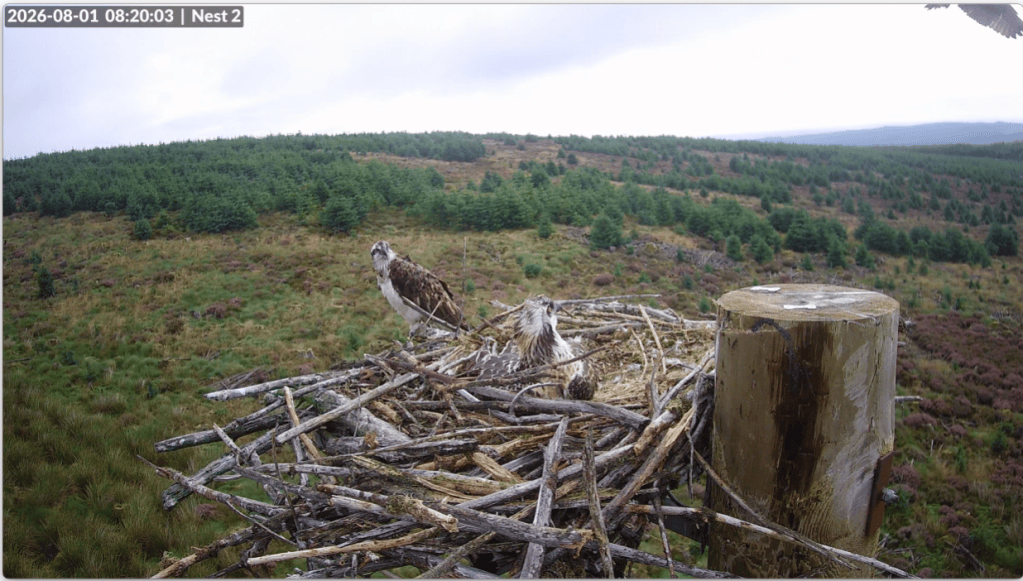
| KIELDER FOREST NEST 2 NEST / CHICK DETAILS 2026 | |||||
| PARENT | RING NUMBER | ARRIVAL DATE | LAST SEEN DATE | ||
| MALE | 280 | 31/03/26 | 07/09/26 | ||
| FEMALE | PC8 | 10/04/26 | 28/08/26 | ||
| DAYS TO FIRST EGG | 16 | 67hrs 01min | 67hrs 55mins | ||
| CHICK DETAILS | |||||
| RING NUMBER | GENDER | DATE LAID | HATCH DATE | FLEDGING DATE | LAST SEEN DATE |
| INCUBATION PERIOD | |||||
| 1K4 KEENLEY | MALE | 26/04/26 20:21 | 05/06/2607:49 | 06/08/26 16:37 | 04/09/26 |
| 39D 11H 28M | |||||
| 1K5 KIMMER | MALE | 29/04/26 15:22 | 06/06/26 15:31 | 01/08/26 08:20 | 23/08/26 07:01 |
| 38D 9M | |||||
| 02/05/26 11:17 | 08/06/26 16:00 | DECEASED 10/07/26 | |||
| 37d 4h 43m | |||||
| DATE | NOTES | ||||
| 10/07/26 | Ringed this date | ||||
| 23/08/26 | 1K5 KIMMER LAST SEEN ON CAMERA, ACTUAL DEPARTURE DATE UNCLEAR | ||||
NEST 3
NEST NOT USED FOR SEVERAL YEARS
NEST 4
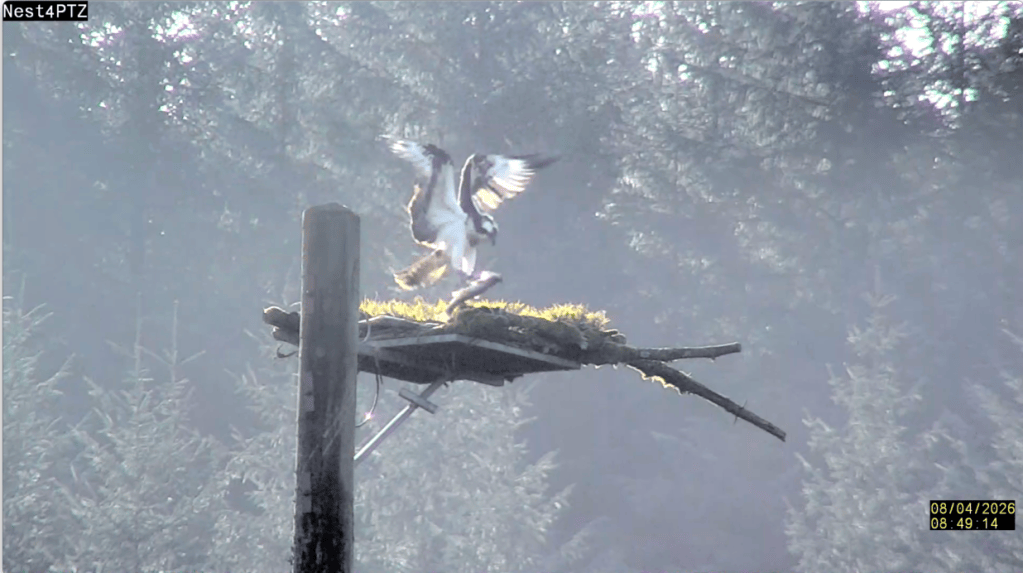
| KIELDER FOREST NEST 4 NEST / CHICK DETAILS 2026 | |||||
| PARENT | RING NUMBER | ARRIVAL DATE | LAST SEEN DATE | ||
| MALE | Y1 | 08/04/26 | |||
| FEMALE | 9B2 | 21/04/26 | |||
| DAYS TO FIRST EGG | |||||
| CHICK DETAILS | |||||
| RING NUMBER | GENDER | DATE LAID | HATCH DATE | FLEDGING DATE | LAST SEEN DATE |
| 12/05/26 | 21/08/26 | ||||
| DATE | NOTES | ||||
NEST 5A
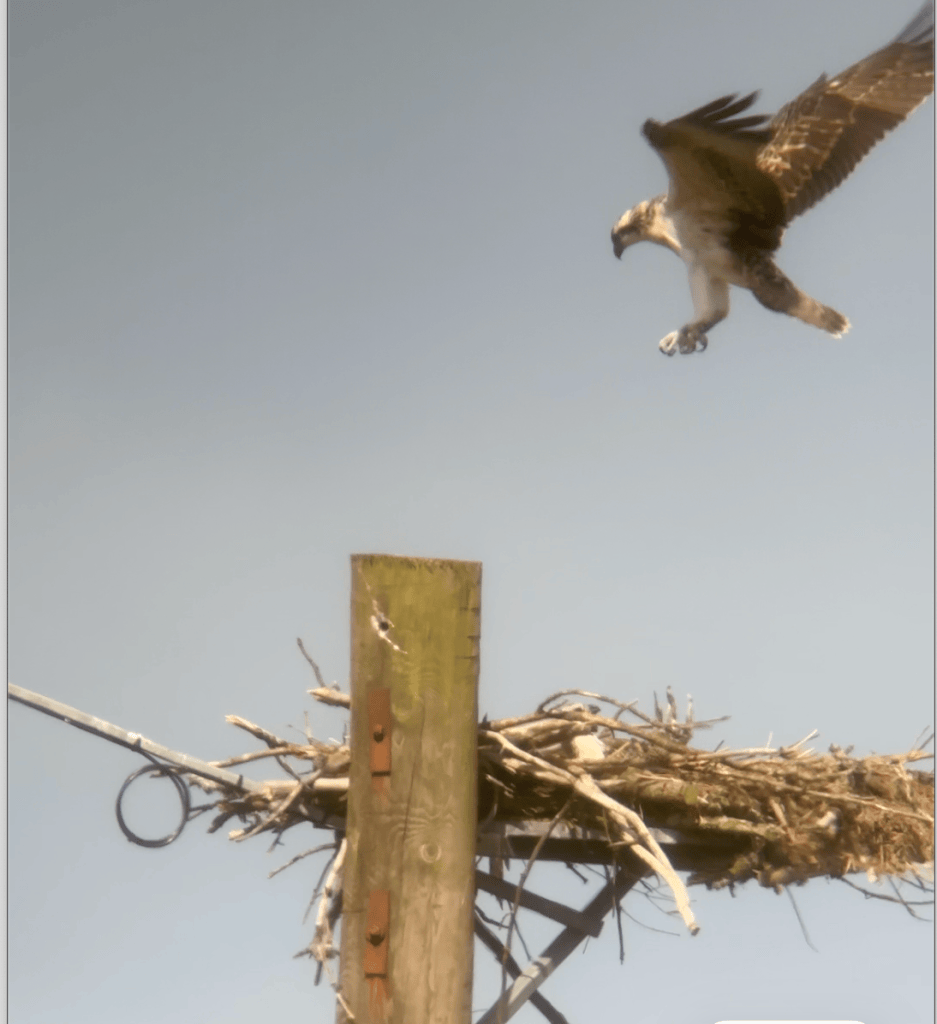
| KIELDER FOREST NEST 5A NEST / CHICK DETAILS 2026 | |||||
| PARENT | RING NUMBER | ARRIVAL DATE | LAST SEEN DATE | ||
| MALE | UV | 06/04/26 19:12 | |||
| FEMALE | 643 | 04/04/26, She went walkabout, returned 10/04/26 | On or Before 20/08/26 | ||
| DAYS TO FIRST EGG | 20 | 75hrs 38mins | 68hrs 43mins | ||
| CHICK DETAILS | |||||
| RING NUMBER | GENDER | DATE LAID | HATCH DATE | FLEDGING DATE | LAST SEEN DATE |
| 1K3 KELLAH | MALE | 26/04/2606:51 | On or before 31/07/26 | Last Seen 31/09/26 | |
| 29/04/26 10:29 | DNH | ||||
| BTO ONLY KEVELIN | 02/05/2607:22 | ||||
| DATE | NOTES | ||||
| 09/07/26 | Ringed this date | ||||
| 09/07/26 | Second chick believed to be from egg 3, Was extremely small weighing only 640 grms Darvic Ring Fell off during process | ||||
NEST 6
NEST 7
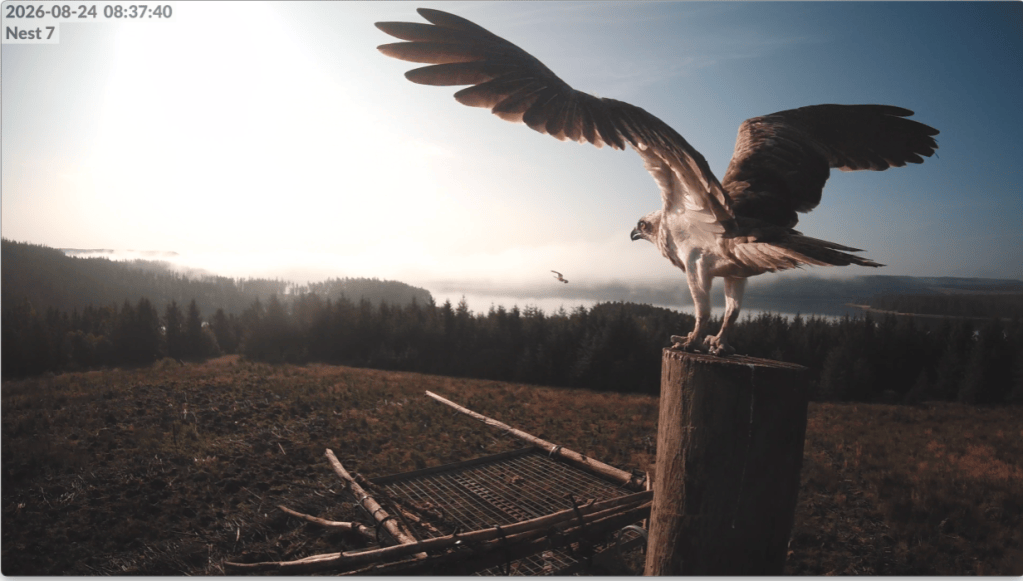
| KIELDER FOREST NEST 7 / CHICK DETAILS 2026 | |||||
| PARENT | RING NUMBER | ARRIVAL DATE | LAST SEEN DATE | ||
| MALE | UNRINGEDKM18 | 06/04/26 14:31 | 29/08/26 | ||
| FEMALE | KX7 | 21/03/26 07:45 | 15/08/26 | ||
| DAYS TO FIRST EGG | 7 | 67hrs 29mins | 72HRS 08MINS | ||
| CHICK DETAILS | |||||
| RING NUMBER | GENDER | DATE LAID | HATCH DATE | FLEDGING DATE | LAST SEEN DATE |
| INCUBATION PERIOD | |||||
| 2B9 KIirkharle | FEMALE | 13/04/26 21:27 | 24/05/2600:13 | 18/07/26 18:46 | 12/08/26 |
| 40D 2H 46M | |||||
| 3B9 Kirknewton | MALE | 16/04/26 16:56 | 24/05/2623:15 | 20/07/2609:00 | ON NEST 20/08/2706:16 INTRUDED LLYN CLYWEDOG 21/08/26 |
| 39D 6H 19M | |||||
| 19/04/26 17:04 | DNH | ||||
| DATE | NOTES | ||||
NEST 8
NEST 9
Information about this Nest is limited, it is situated outside Kielder Forest, but within the Ringing area. We do know that this pair (same as last year) raised two chicks to fledging. The Following is from Kielder Forest Timeline,”Both 2025 breeding birds, 699 and BTO right leg male, had returned by 7 April
Two chicks were seen and fledged successfully
All thought to have migrated by 1 September”
NEST 10
8 April: 330 at the nest
10 April: PY0 present
24 April: egg 1 by early morning
21 April: at least one chick
24 June: 3 chicks visible
31 July: all 3 chicks had fledged successfully
17 August: 330 thought to have migrated
1 September: probably all juveniles had departed as none seen thereafter
NEST 11
This nest collapsed in 2025, resident pair moved to Nest 12
NEST 12
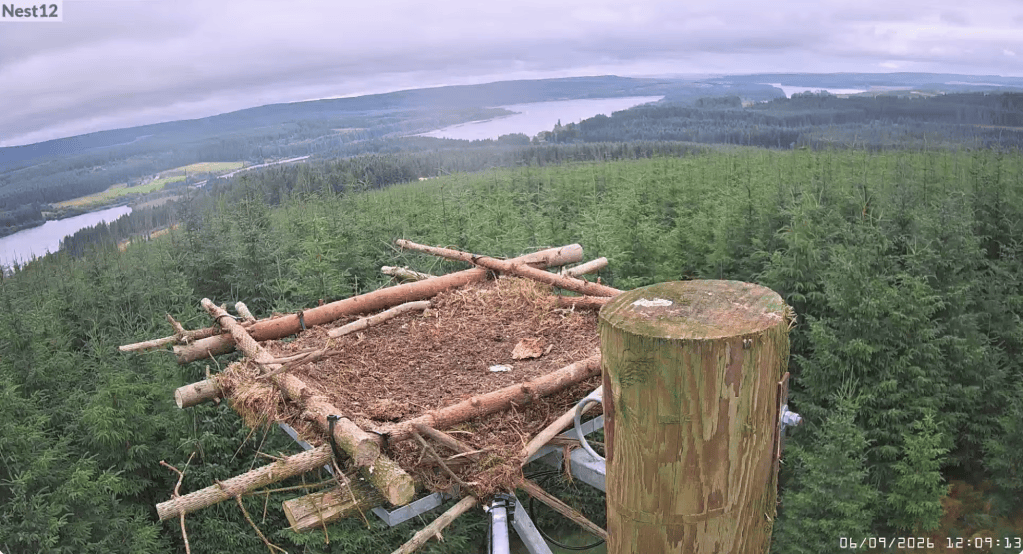
| KIELDER FOREST NEST 12 / CHICK DETAILS 2026 LORD ROBINSON NEST | |||||
| PARENT | RING NUMBER | ARRIVAL DATE | LAST SEEN DATE | ||
| MALE | UNRINGED | 07/04/26 | 02/09/26 | ||
| FEMALE | UNRINGED | 16/04/26 | 03/09/26 | ||
| DAYS TO FIRST EGG | 19 DAYS | 75H 26M | |||
| CHICK DETAILS | |||||
| RING NUMBER | GENDER | DATE LAID | HATCH DATE | FLEDGING DATE | LAST SEEN DATE |
| INCUBATION PERIOD | |||||
| 1K1 KIELDER | FEMALE | 05/05/2600:15 | 12/06/26 02:44 | 06/08/2608:02 | 04/09/26 06:52 |
| 38D 2H 29M | |||||
| 1K2 KERSHOPE | MALE | 08/05/2603:41 | 13/06/26 17:34 | 05/08/2608:25 Blown off nest | 05/09/26 06:22 |
| 36D 13H 53M | |||||
| DATE | NOTES | ||||
| 17/07/26 | 1K1 Named Kielder, 1K2 Named Kershope, Ringed this date | ||||
Kielder Ospreys’ offspring breeding elsewhere
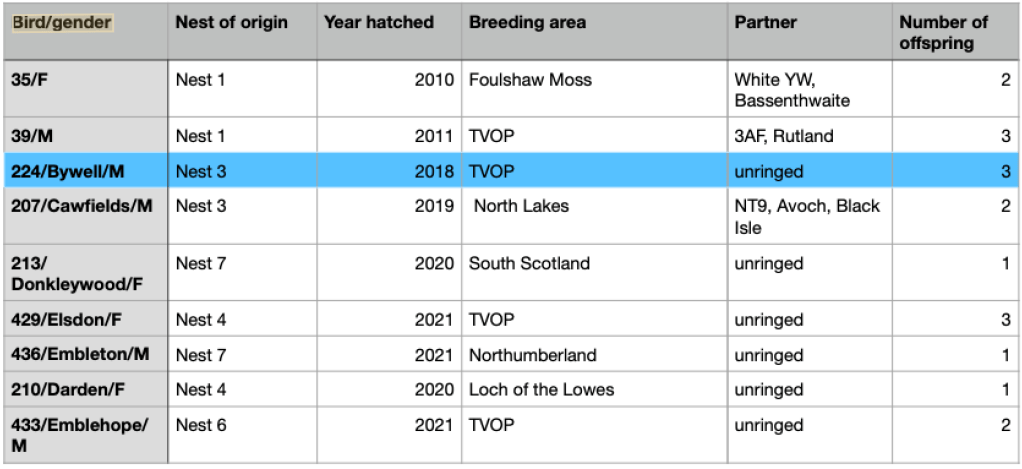
It is noteworthy that the Nest 7 male, KM18, formerly at Nest 3, has reared four of the successful breeders elsewhere.
2020 Nest 4 210/Darden failed to breed in Perthshire where she had 2 chicks in 2024. This year Blue 210 Darden laid 3 eggs at Loch of the Lowes, from which one chick fledge, she partnered with an unringed male known as LM24.
© Kielder Forest Osprey Project/ Joanna Dailey
RUTLAND WATER
MANTON BAY
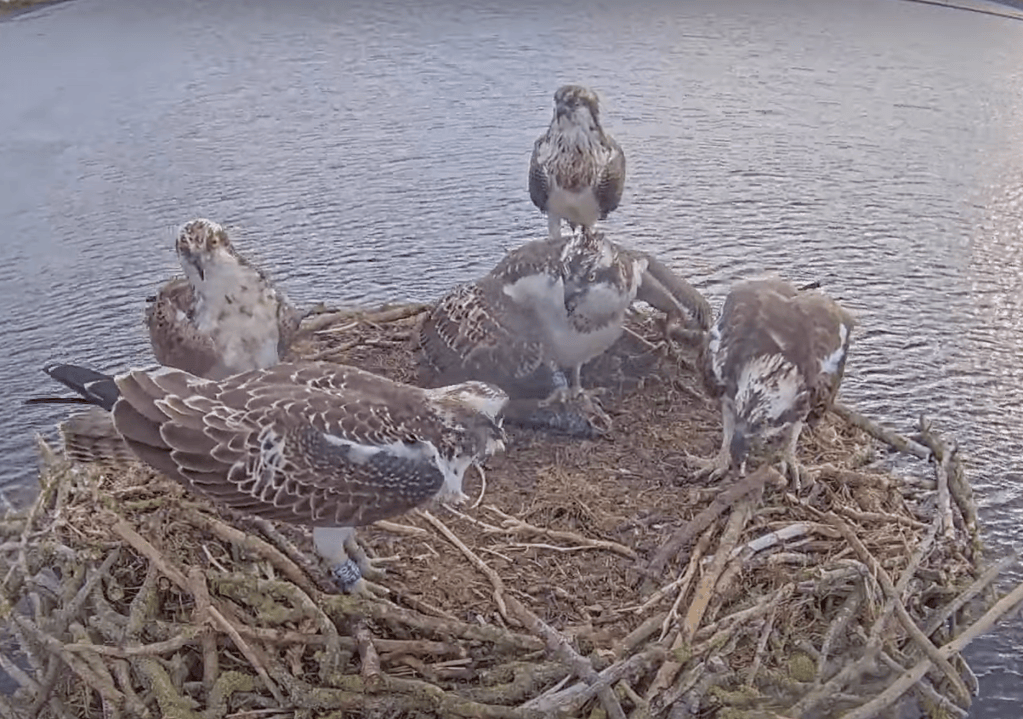
Male:-Blue 33, Returned 24/03/26, Last seen
Female:- Unringed MAYA, returned 24/03/26, Last seen
THIS PAIR HAVE BEEN TOGETHER SINCE 2015, BETWEEN THEM THEY HAVE RAISED 34 CHICKS. at a rate of 2.83/Annum
11 are known to have returned a rate of 40.7%
As an individual Maya has been breeding at Manton Bay since 2010, she has raised:-
45 CHICKS. at a rate of 2.64/Annum
17 are known to have returned at a rate of 42%
This has been another very successful season, raising 3 chicks to fledging. Details Below
Manton Bay 2026 Season Summary
2026 was a very special year for Rutland Osprey Project as it was thirty years since the project first reintroduced chicks into the area. The season started on 15th March when the first osprey to land on the Manton Bay nest at 12:29 was for the fourth year running 25(10) who nests elsewhere in the Rutland area. With 33(11) having arrived last year on 13th March and Maya on 17th March there then followed an anxious wait for their return.
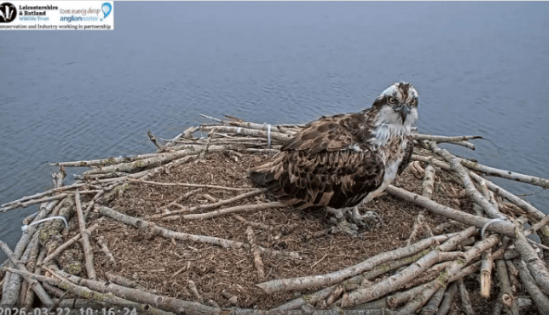
On 22nd March at 10:11 an osprey with a BTO ring on the right leg landed on the nest. Using the zoom on the new high resolution camera it was possible to read the ring number and identify her as the Argyll female from Site N, and previously Site O, who has been breeding in the Rutland area since 2009. After initially spending around half an hour on the nest she visited again for almost an hour the same afternoon. Interestingly she is the mother of 25(10) who had visited the week before.
There was much excitement when on 24th March at 06:28 an unringed female landed on the nest but it was soon apparent that it was not Maya. It wasn’t long though before 33(11) landed at 07:17. He quickly left and was soon seen on the nearby dead tree eating a huge rainbow trout which he later brought back to the nest and shared with the unringed female. Suddenly at 14:32 another osprey arrived carrying a huge fish and Maya too was home just seven hours after 33(11). Yet again they had arrived back on the same day and Maya had returned to find 33(11) spending time with another female.
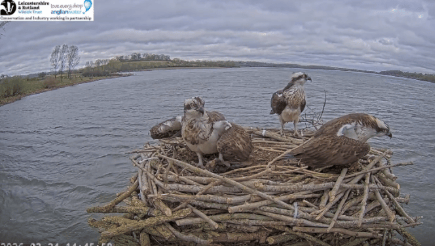
Arriving later this year Maya and 33(11) were keen to make up for lost time with mating quickly starting that same day making it their twelfth consecutive season together. Despite the often strong wind 33(11) who is known as a master nest builder continued to build a very impressive nest. On 29th March 5H1(22) a female now breeding at Site Z cheekily landed on the nest for a few minutes before Maya flew in to scare her away.
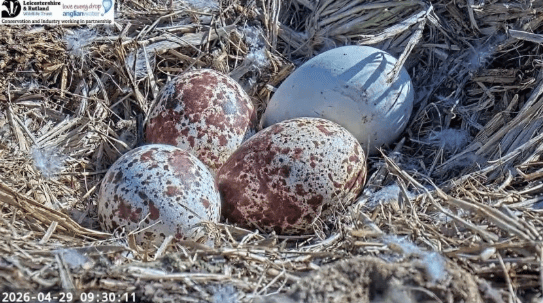
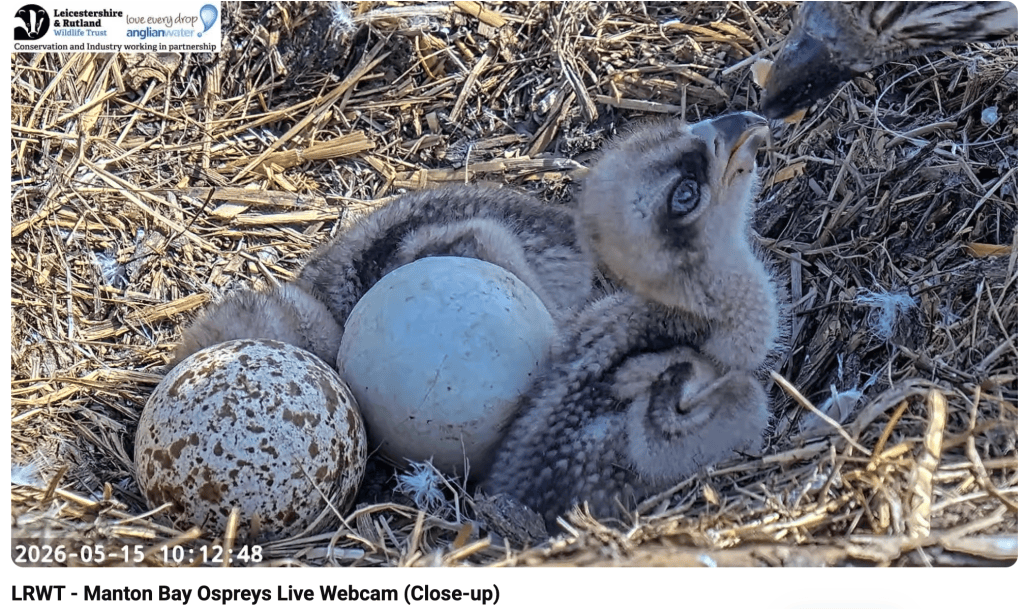
The arrival of Storm Dave coincided with 33(11) bringing in mainly goldfish for a week (he caught 13 this season) and also with the first egg being laid on 5th April at 18:05. The second egg arrived surprisingly fast after a gap of only 61.7 hours on 8th April at 07:45 and to everyone’s surprise was almost completely white. A third egg was laid on 11th April at 14:39 and then for the sixth time Maya continued to lay a fourth egg on 14th April at 17:07.
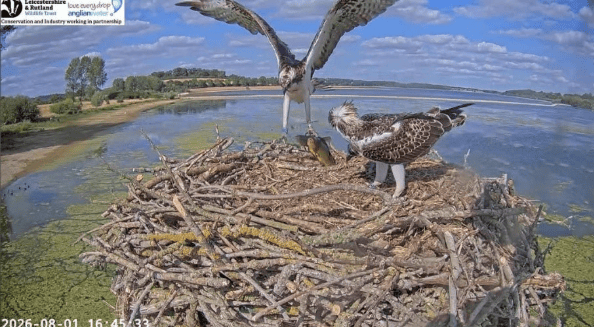
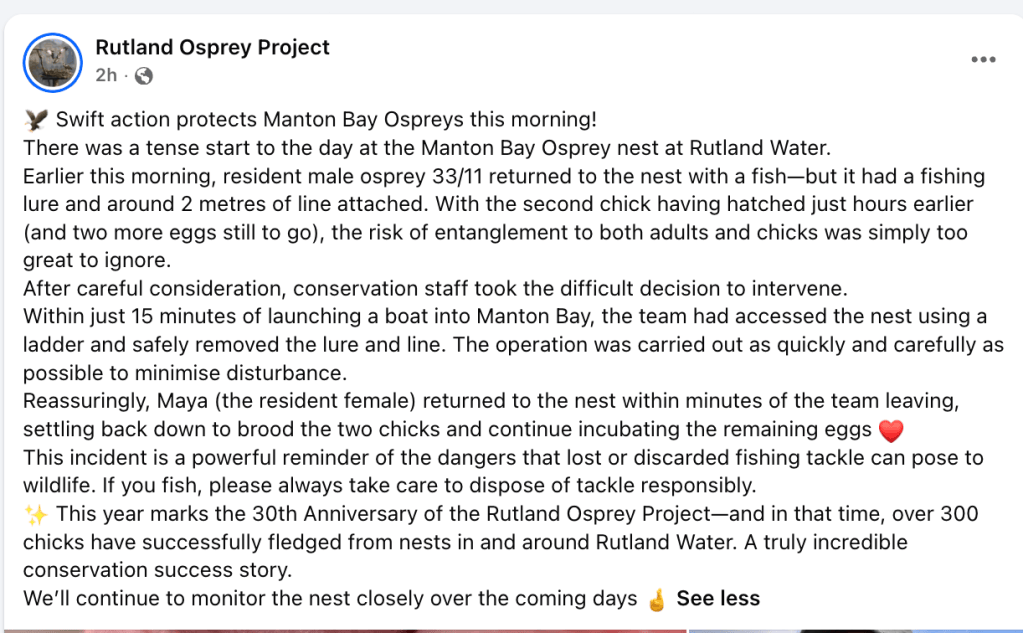
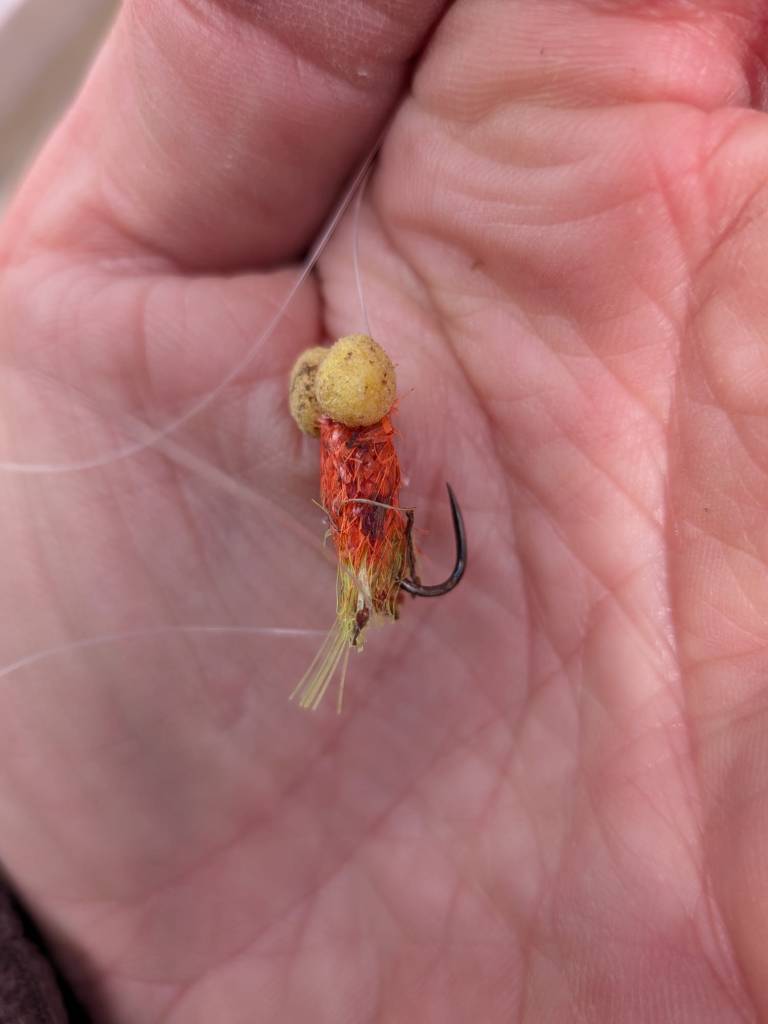
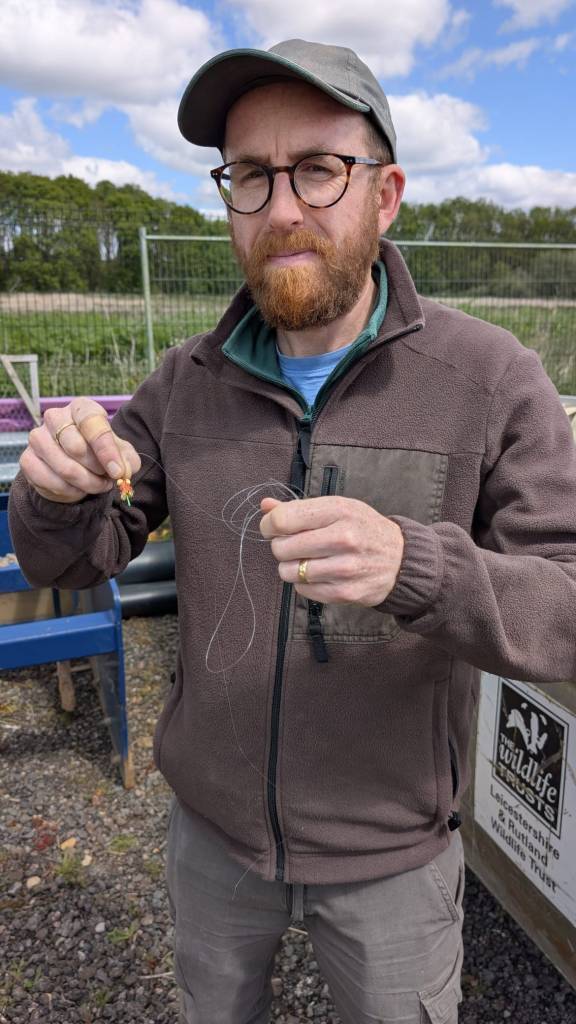
As usual 33(11) shared incubation duties with Maya and the first egg hatched on 12th May at 21:51. The second white egg hatched as normal despite some earlier concerns on 14th May at 22:18. The following day it was noticed that an early morning trout brought into the nest had around two metres of fishing line and a lure attached. The risk of entanglement was high so Rutland Osprey Project made the decision to intervene and quickly removed the line and lure from the nest. Shockingly just two days later the same happened again but this time did not cause any problems with Maya removing it from the fish and it then being taken from the nest by 33(11) when he later took the fish away. Later that day 17th May the third egg hatched at 14:57. It eventually became apparent that egg four would not hatch and this remained in the nest, sometimes being partly buried, until ringing time.
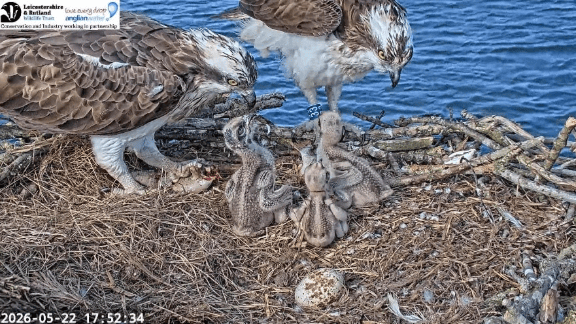
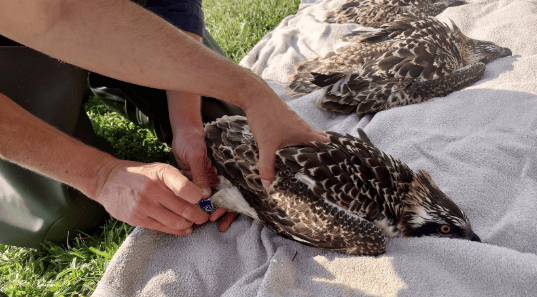
The ringing of the chicks took place early in the morning on 23rd June with the chicks this year being taken to the shore. The eldest chick was determined to be male with the ring number 8R5 weighing 1545g, middle chick female 8R6 weight 1760g and youngest chick male 8R7 weighing 1550g. The fourth egg that had been removed from the nest was tested and found not to have been fertilized.
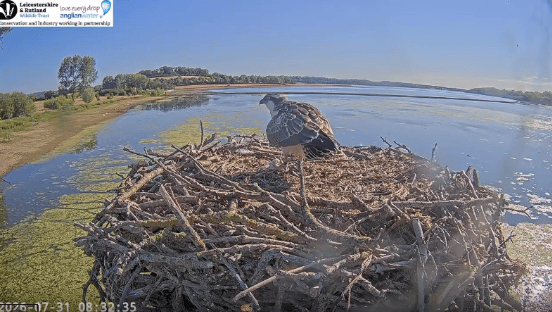
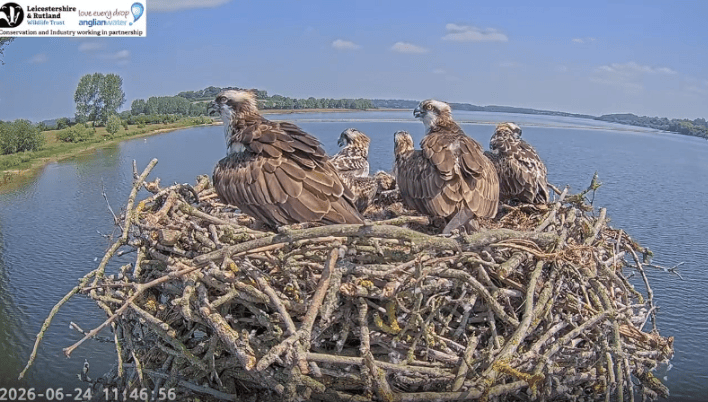
The first chick to fledge on what had been a breezy day was 8R5 at 51 days old on 2nd July at 18:51. The two other chicks then fledged on the same day 7th July just a few hours apart with 8R7 fledging at 08:24 also at 51 days old and 8R6 at 10:46 aged 54 days old. This year as well as the usual T perch and poplar tree resting places the chicks were regularly seen spending long periods on the fishing limit signs on the bund.
On 31st July 8R5 was last seen on the Manton Bay nest at 08:32 before leaving to eat a fish in the poplars until 09:35. At just 80 days old and 29 days since fledging it did seem slightly early for migration but according to Tim Mackrill was not unheard of as 8R5 had been showing independent qualities and performing many dives for fish. He had also previously spent 34 hours away from the nest. There were no further sightings of 8R5 so he is recorded as migrating at 09:35 on 31st July.
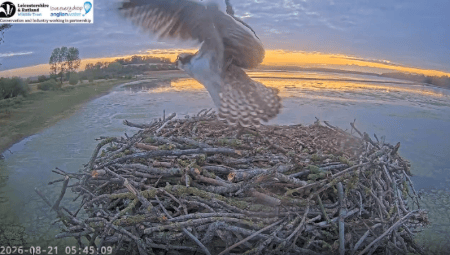
The two remaining chicks stayed for a further three weeks and were last seen spiralling up into the sky together accompanied by 33(11) on 21st August at 10:18. They were last seen actually on the nest in camera view at 08:41 for 8R7 and 10:15 for 8R6.
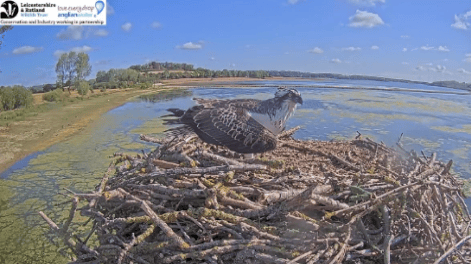
With the juveniles leaving earlier this year Maya and 33(11) were able to enjoy each other’s company for a further ten days. Maya was last seen on camera on 31st August at 14:30 after finally getting a fish delivery from 33(11) after almost three hours of fish calling. She was then spotted flying easterly from Manton Bay about 10:15 on 1st September leaving 33(11) sitting alone in his favourite poplar tree. After remaining in the bay alone for a couple of days 33(11) was seen flying off in a southerly direction on 3rd September at 12:25.
Maya and 33(11) have now fledged 34 chicks together at a rate of 2.83 per year with a return rate of 40.7%. Maya has raised 45 chicks in total since first breeding at Manton Bay in 2010 with her previous partner Green 5R(04) at an overall yearly rate of 2.64 and return rate of 35.6%.
This season 483 fish were caught in total including four caught by Maya. This was made up of 135 trout, 92 roach, 80 tench, 71 pike, 39 perch, 13 goldfish, 2 dace, 1 common carp, 1 carp, 1 bream and 48 others not identified. 33(11) even managed a one-legged double fish delivery!
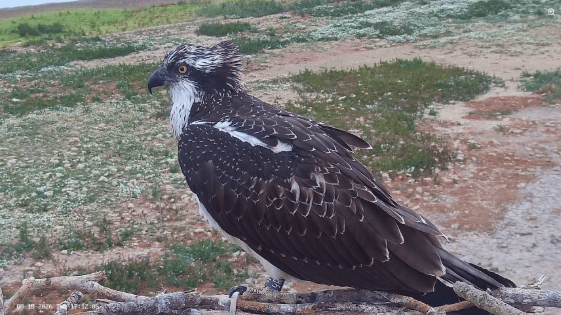
Looking at Manton Bay chicks from previous years 2AM(17) failed to return to his nest in Staffordshire this year but one of his sons is now breeding in the area. 3J(13) Telyn successfully raised three chicks again with Idris at Dyfi. Unfortunately T7(16) arrived back at Rutland late this year and so did not end up breeding but was seen spending time with an unringed female later in the season. 1H1(22) raised three chicks with 374(21) on the second nest at Poole and 3H4(23) was again seen back at Rutland this year but did not breed.
This year Rutland Osprey Project very kindly provided full ringing details from all their nests. They have confirmed that 24 chicks were ringed from 12 nests this season with 14 being male and 10 female. Although this is slightly less than the 31 chicks last year two of the very experienced adults failed to return and were replaced by younger ospreys and no nests raised four chicks this year.
Last season 359(21) and 3H9(23) spent the summer at Lagoon 4 and so cameras were installed at the nest there during the winter. Although both returned this season 359(21) replaced 30(10) who also sadly did not return to his nest at Site B. With HJ8(14) he had two female chicks 8R9 and 9R0. Interestingly near the end of the season 359(21) used the Lagoon 4 nest as somewhere to feed 9R0 and she would spend long periods of time sitting on the nest there. This was an interesting insight into what may happen elsewhere.
3H9(23) fortunately found a new partner too and bred with 1H7(22) at Site W having two male chicks 9S5 and 9S6. Four pairs in total, including a few very experienced pairs, had just one chick this year. At Site C 25(10) and 11(10) had one female chick 8R4 and at Site K 00(09) and 06(09) also had one female chick ringed 8R8. At Site L an unringed female and 3AH(17) had one male chick 9R4 as did Yellow 30(05) and T3(16) at Site S whose single male chick was ringed 3R9.
At Site J 2AF(16) and 1K(13) had two male chicks 9R5 and 9R6 and at Site Y an unringed female and 355(21) had two female chicks 9S3 and 9S4. At Site N a Metal-ringed female and 6K(14) had three chicks 9R1(M), 9R2(M) and 9R3(F) as did 5H1(22) and 3AY(19) at Site Z whose chicks were ringed 9R7(M), 9R8(M) and 9R9(F). Finally at Site O an unringed female and 093(20) also had three chicks 9S0(M), 9S1(F) and 9S2(M).
A total of 31 ospreys returned to Rutland as adults this season so in addition to those already mentioned there were another five single males 358(21), 1H5(22), 4H6(23), 2H3(22) and 3R2(24) so hopefully they will find themselves a partner and nest next year.
All screenshots © LRWT Rutland Osprey Project
(C)ROSE RAINSFORD
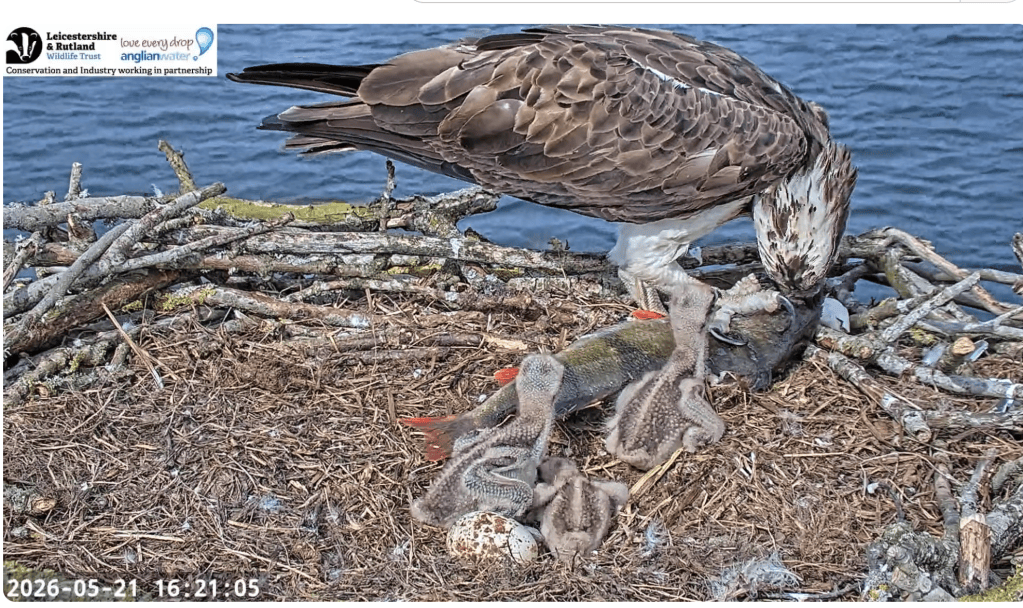
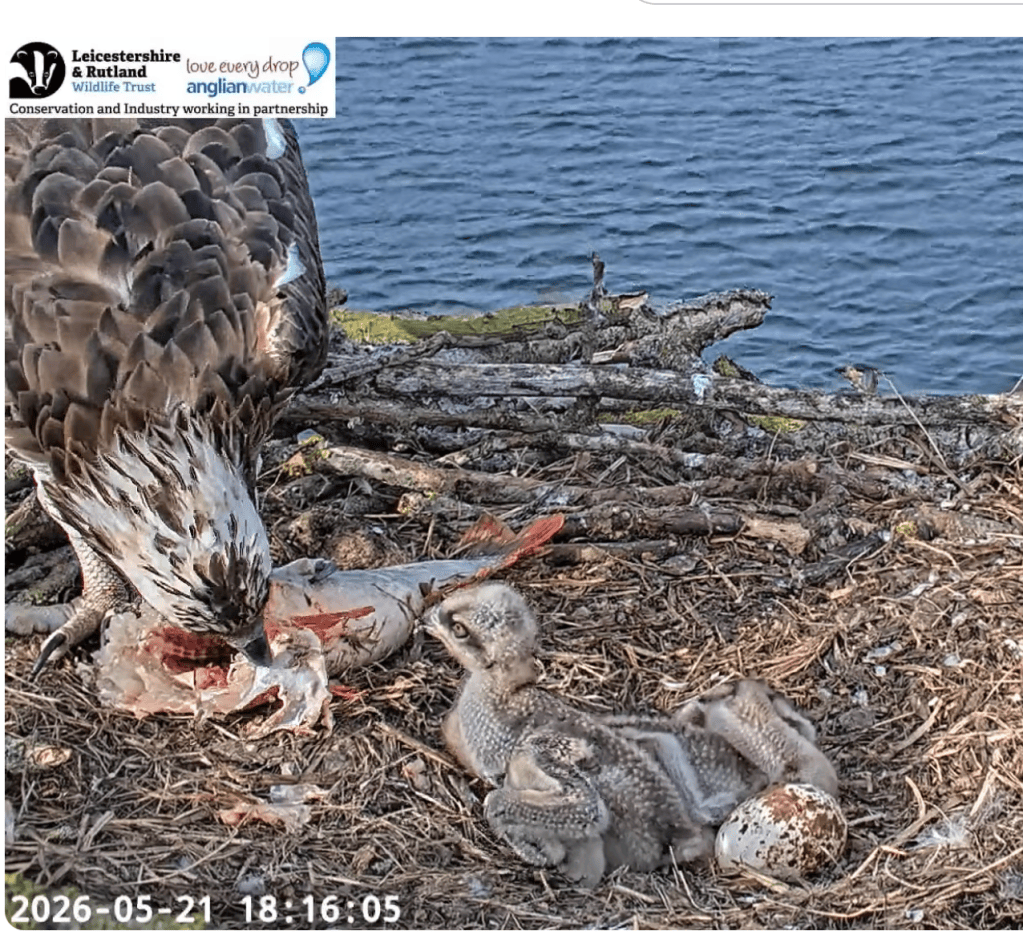
Manton Bay, 15/05/26
HOOK, LINE AND SINKER
15/05/26
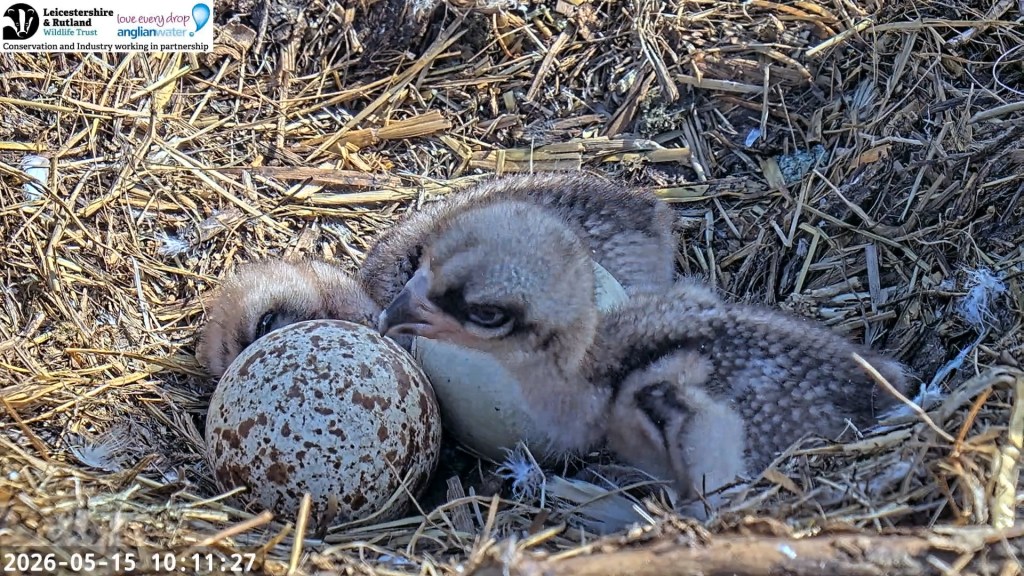
Feeding the First Two
15/05/26
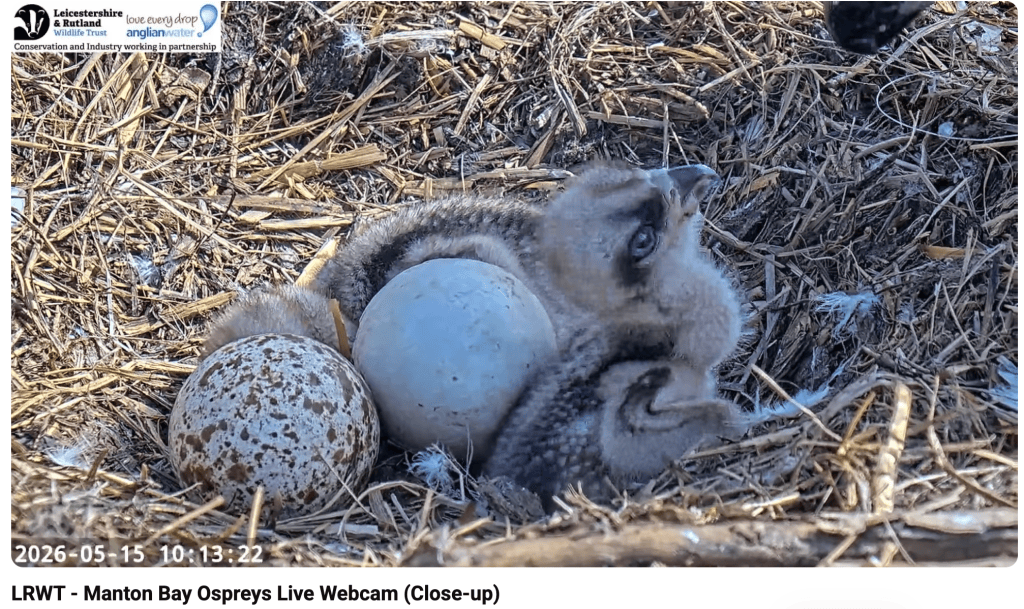
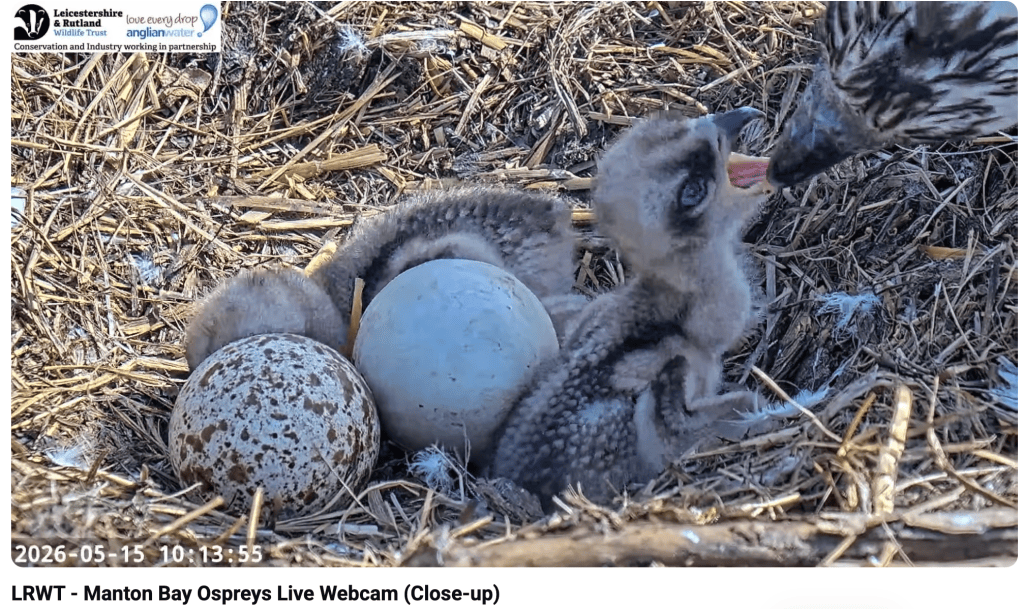
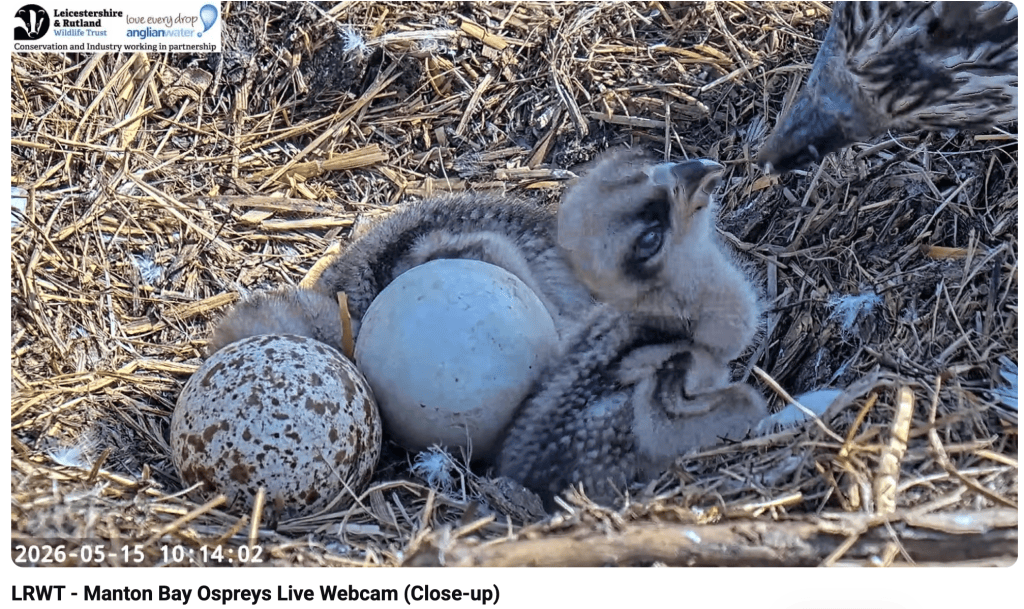
Images:- (C) LRWT/ROP.
Another Feeding Session 1,2 and 3.
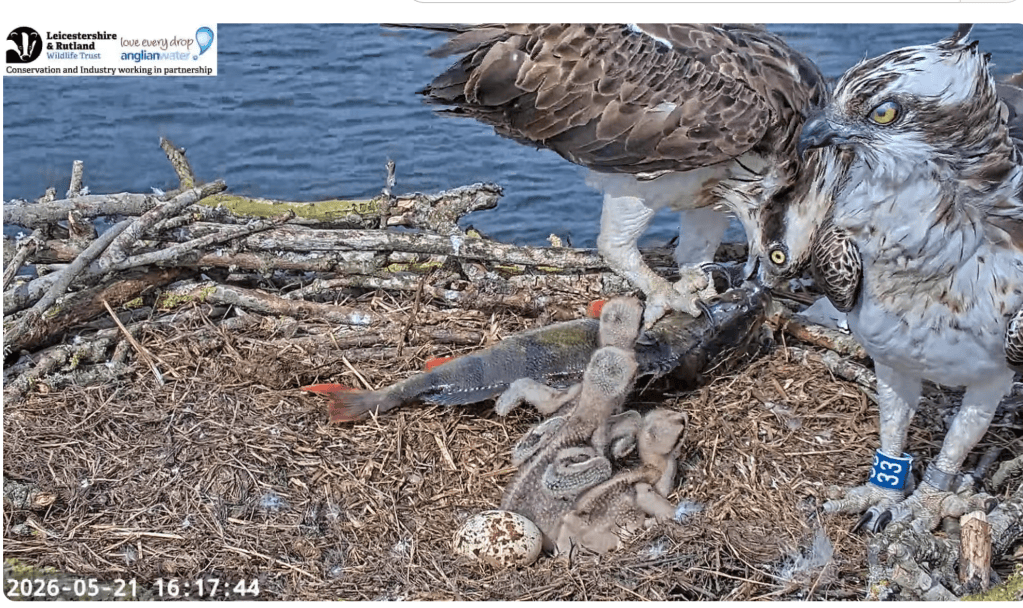
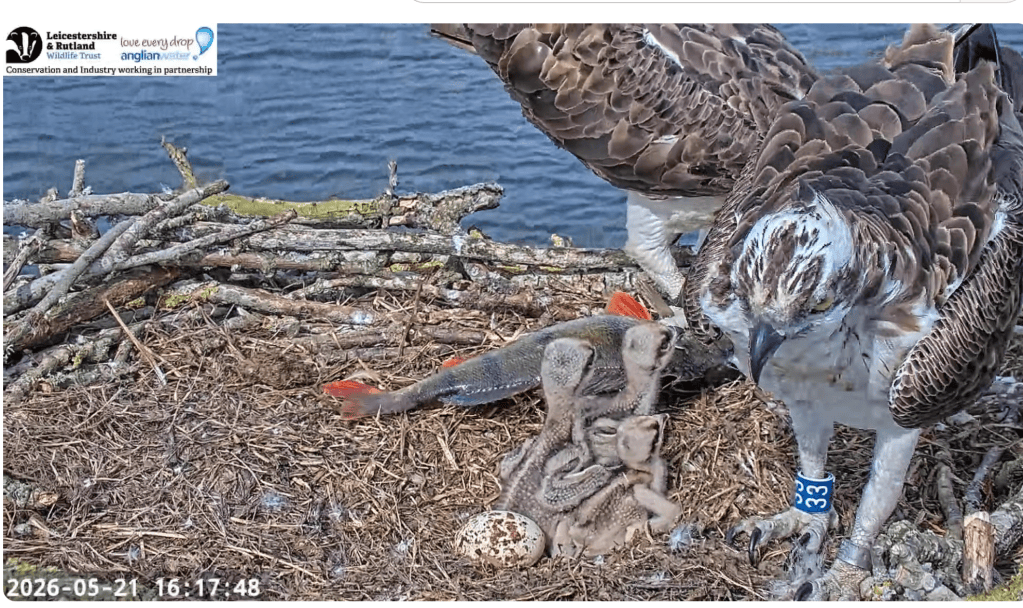
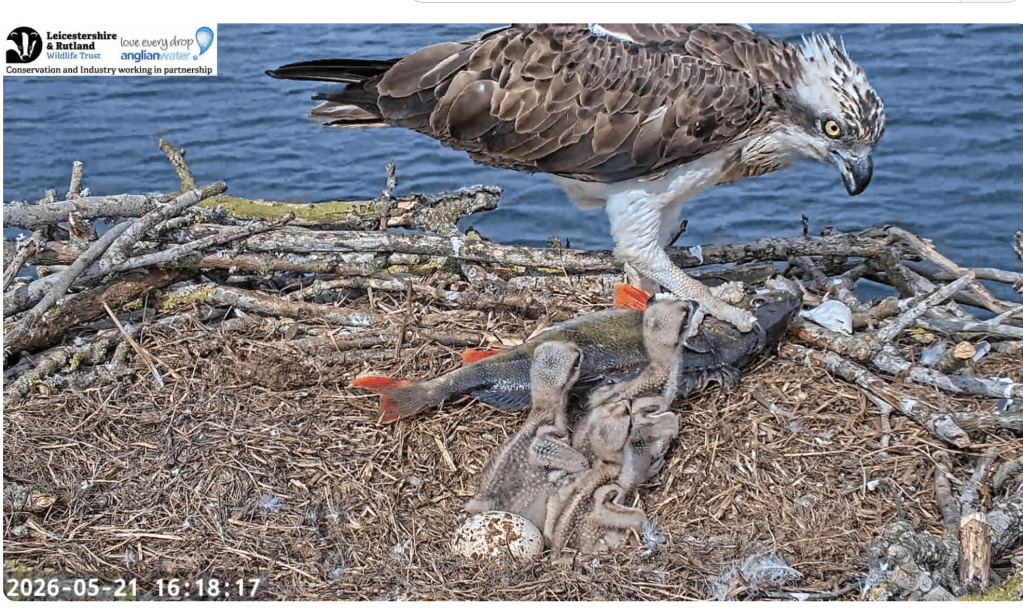
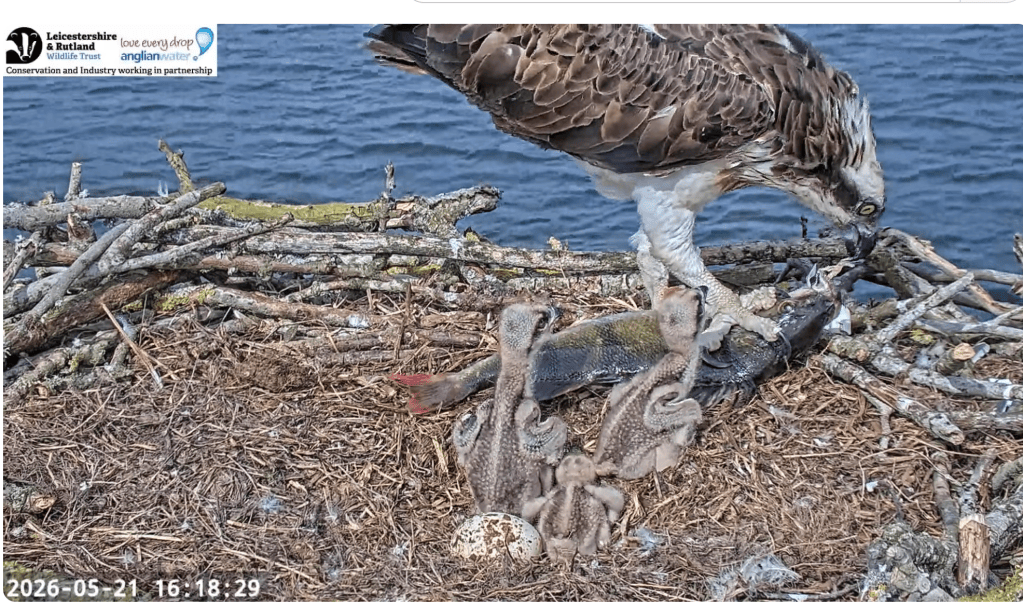
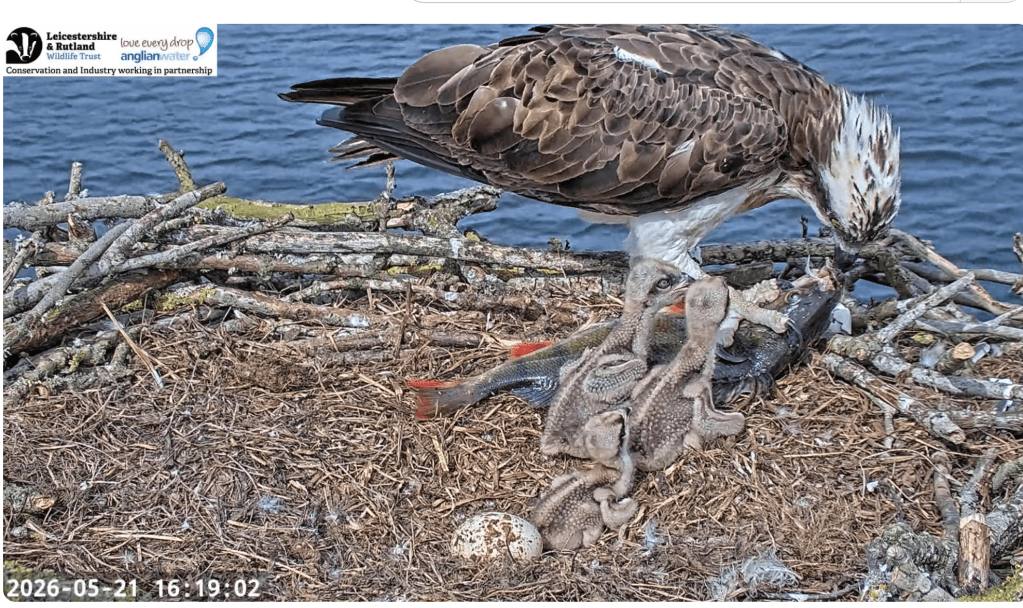
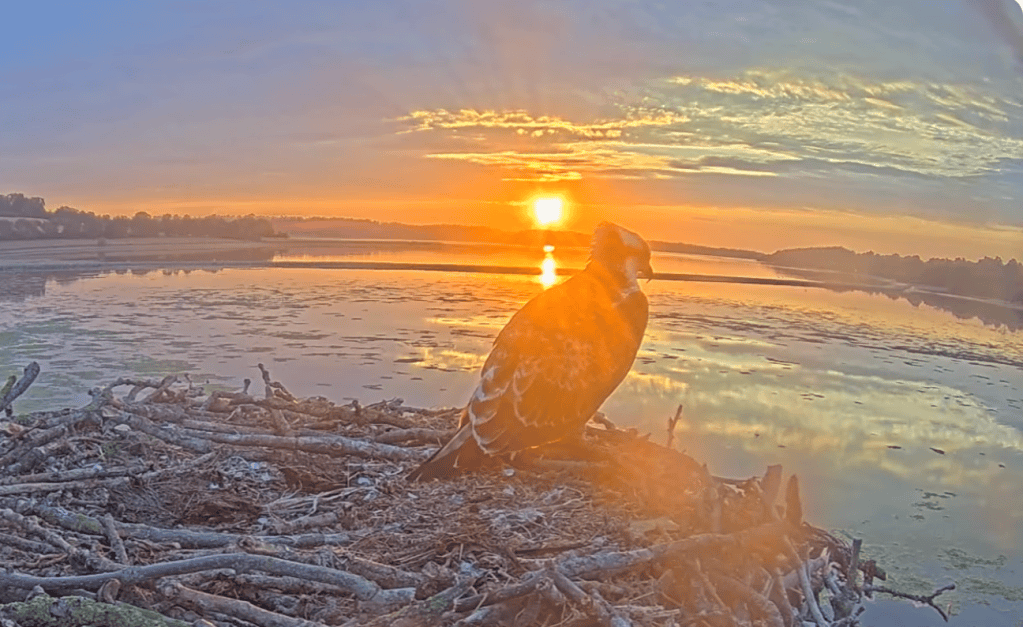
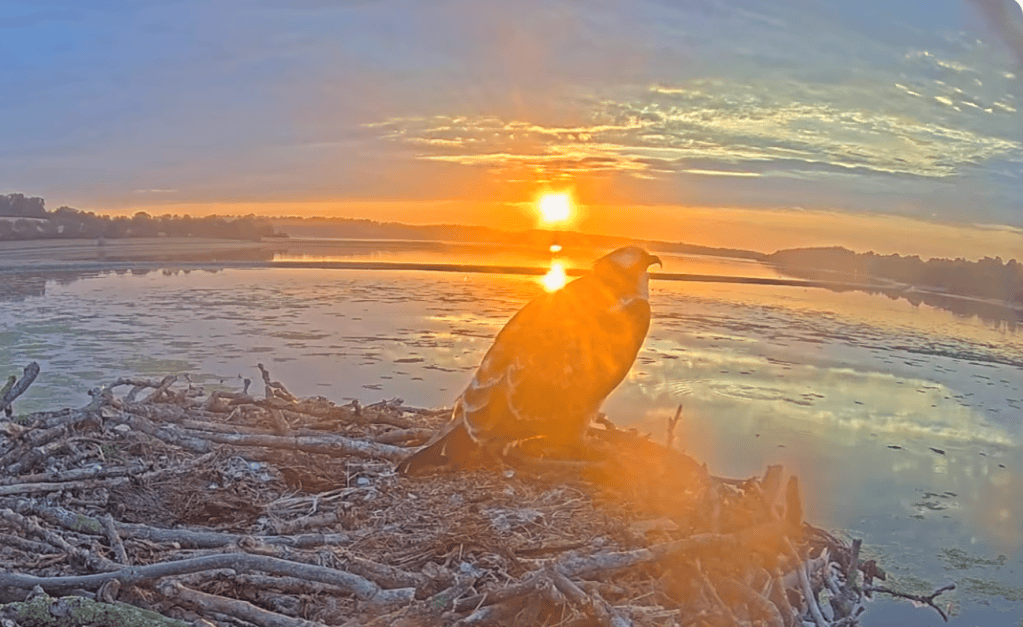
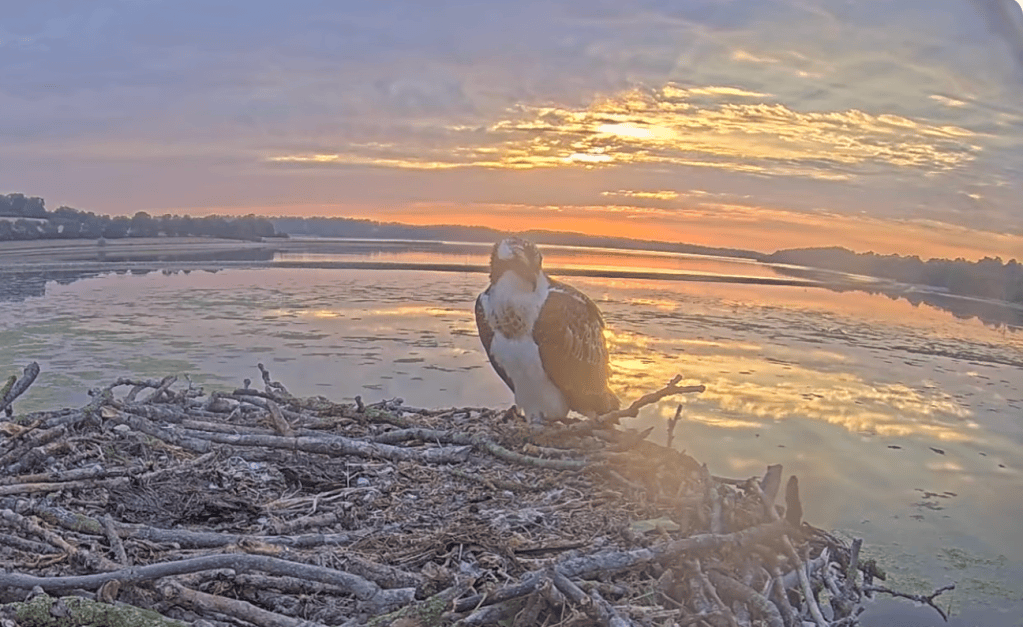
SUN RISES AT MANTON BAY.
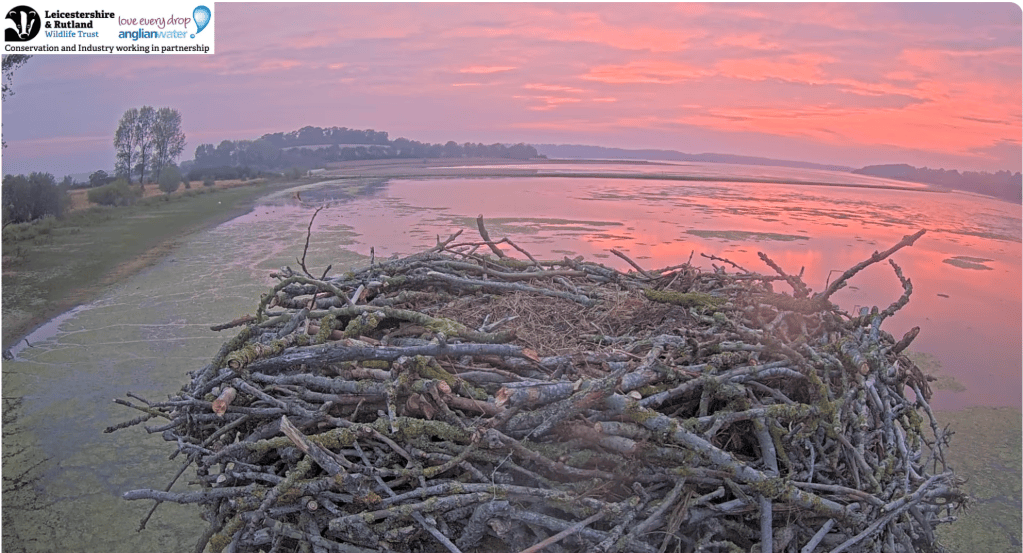
SUN SETS ON MANTON BAY.
MANTON BAY INFORMATION
Bart Molenaar, moderates the Live Chat on the Manton Bay Youtube Cameras, He also owns and runs Ospreycam.net. an unparalleled site for data and information about Manton Bay and some other nests, Link Below.
SITE B
2026 Season
This year, Blue HJ8 returned as usual in March, but sadly 30(10) did not, and in 2026 a new male has taken over, Blue 359(21) – the male that occupied Lagoon 4 with Blue 3H9 in 2025. He is also a descendant of both 03(97) and Maya, through Maya’s son (and 30(10)’s full brother) Blue 8F(12), so I guess you could say this is the osprey equivalent of “keeping the stately home in the family”! 
I’m pleased to be able to report that Blue 359 and Blue HJ8 have had a successful first season together, raising two female chicks in 2026, which were ringed last week with the numbers Blue 8R9 and Blue 9R0. Whilst it’s a shame that we weren’t able to watch 359 breeding on camera at Lagoon 4 this year, it’s lovely to know he’s now become a dad at Site B instead!
At the end of the season Blue 359 has been feeding Blue 9R0 at the Lagoon 4 Platform, possibly due to sibling rivalry on the nest a Blue 8R9 continued to be fed on the natal nest.
(C) CW/JK
OTHER RUTLAND INFORMATION
RUTLAND BIRDS KNOWN TO HAVE RETURNED
RUTLAND BIRDS SEEN AWAY FROM RUTLAND WATER
RUTLAND PROGENY BREEDING OUTSIDE OF RUTLAND WATER
POOLE HARBOUR
For a season summary by Birds of Poole Harbour see:
https://www.birdsofpooleharbour.co.uk/osprey-news/osprey-results-2026/
For the Osprey Diary (compiled by Phyl England and Paula Thorpe) see:
https://www.birdsofpooleharbour.co.uk/osprey-news/osprey-diary-2026/
Nest 1 (Carey)
CJ7: first seen 25/03/26, last seen 31/08/26.
022: first seen 26/03/26, last seen 12/09/26.
The resident pair of male Blue 022(19) (hatched at Nest B01 Moray,
Scotland, translocated to Poole Harbour) and female CJ7(15) (hatched at
Rutland Water Site K) returned for their fifth breeding season.
CJ7 returned on 25 March and 022 brought her a large fish early on 26
March, so he may also have arrived back the day before. For the third year
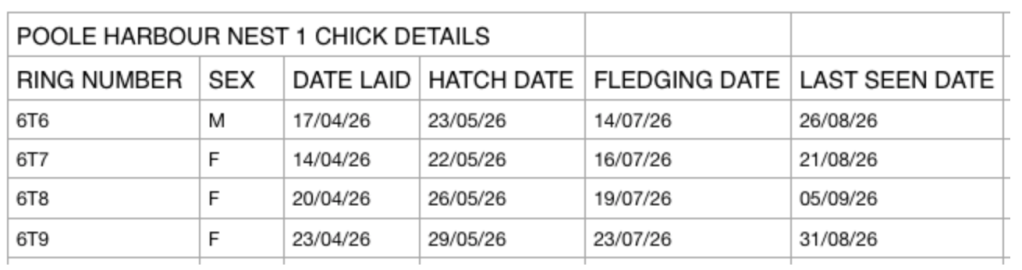
running, they produced four strong chicks, a feat not apparently knowingly
equalled in the UK: 6T6(M), 6T7(F), 6T8(F) and 6T9(F). The chicks were ringed
on 1 July (Darvic rings were fitted upside-down).
Once again, there have been a number of intruders at the nest site, both
ringed and unringed, including male offspring of CJ7 and 022 from both
2023 and 2024 (see ‘Other News 2’ below). Magpies were a constant
nuisance on the nest!
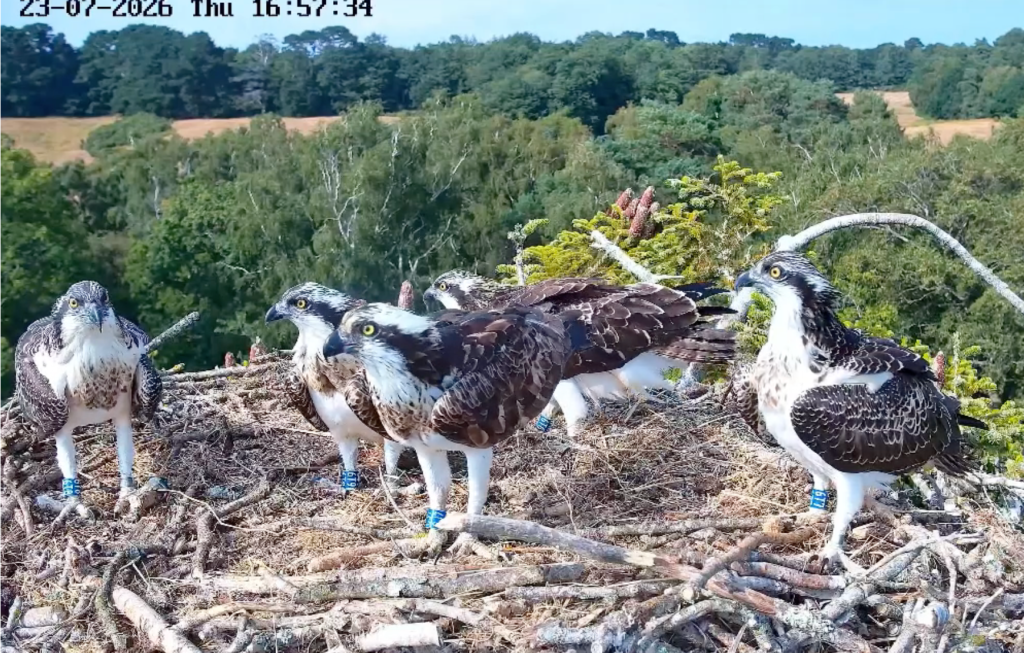
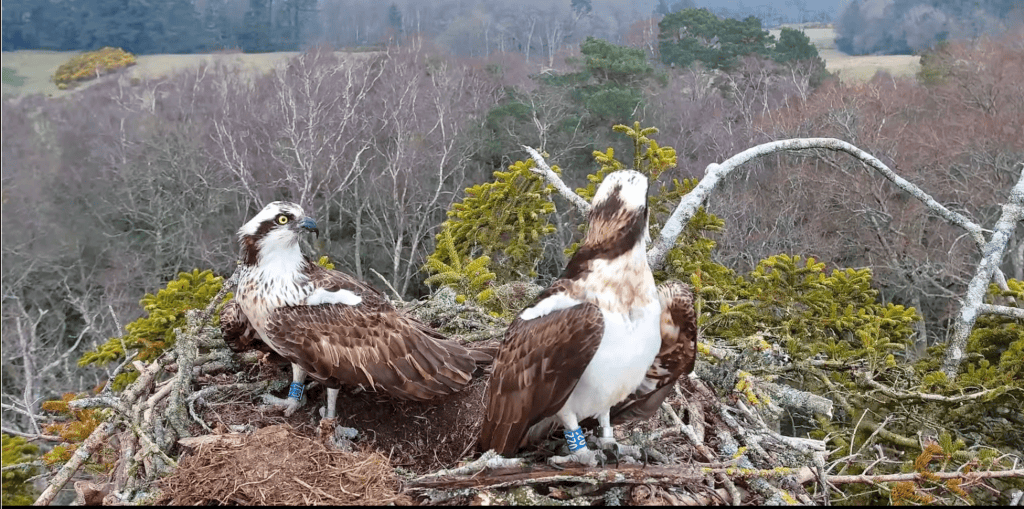
Class of 2026 (left to right: 6T8, 6T9, CJ7, 6T6 and 6T7) Nest 1
Nest 2 (undisclosed location)
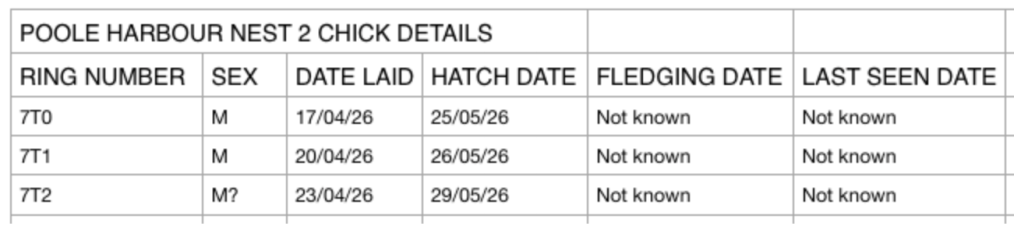
Poole’s second pair, translocated male Blue 374(21) and Rutland female Blue
1H1(22), also had another successful year, raising three chicks at a private
location north of the harbour: 7T0(M), 7T1(M) and 7T2(M?).
Potential further pairings
Four males (see below) hatched on the Carey nest have been regularly seen
around the harbour, visiting various different nest platforms and spending
time with females, especially Scottish 6J8 (‘Teddy’, Tweed Valley 2024).
There have also been sightings of the males with unringed females. This is
very promising for a potential third nest next year. Osprey sightings in June
and July were higher than in previous years, showing that the translocation
project is achieving one of its goals of increasing the presence of the species
here throughout the season rather than just passing through on migration.
5H3 (Nest 1 2023) first seen 23/04/26.
5R0 (Nest 1 2024) first seen 17/04/26.
5R1 (Nest 1 2024) first seen 20/07/26.
5H6 (Nest 1 2024) first seen 17/05/26.
Other news
Female 5H1 (Nest 1 2022) bred with male 3AY (Rutland 2019) for a second
year at Rutland Site Z. Three chicks were ringed 9R7(M), 9R8(M) and 9R9(F)
on 3 July.
Poole Harbour Nest Watch
Thanks are due to the dedicated team of webcam watchers who contribute
to the highly detailed Nest Watch document:
(C) ALISON COPLAND
2 YEAR OLD RETURNERS
17/05/26
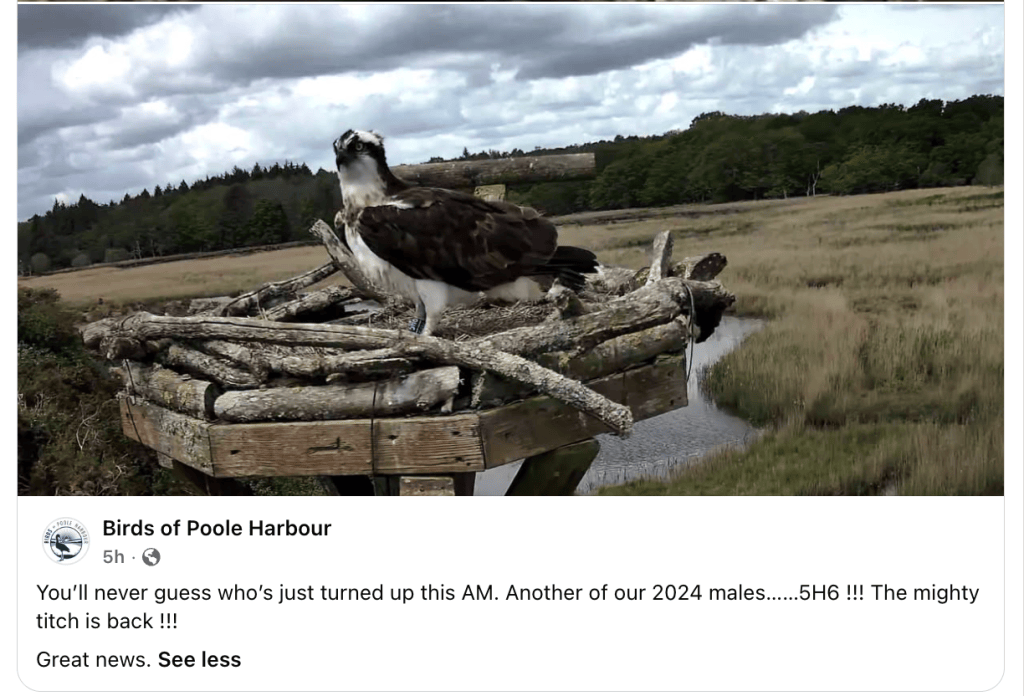
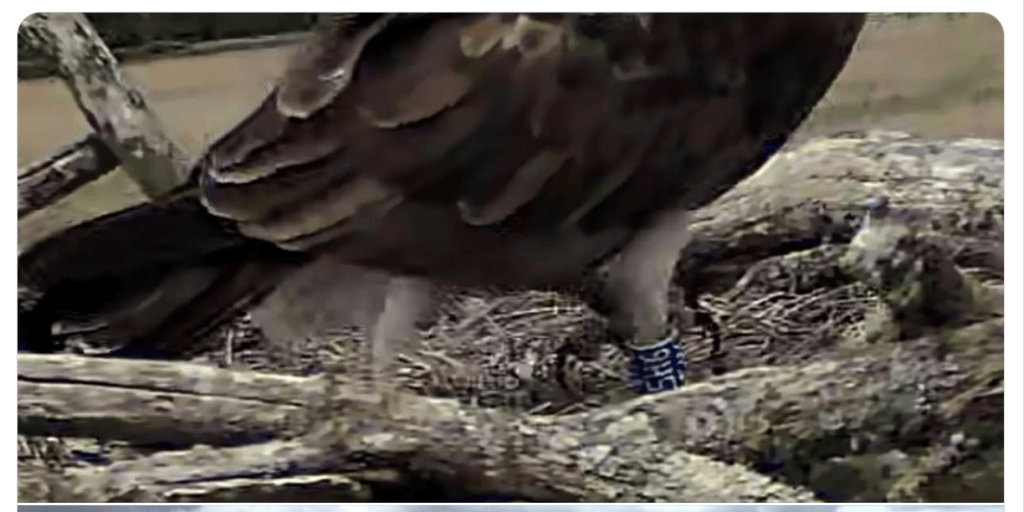
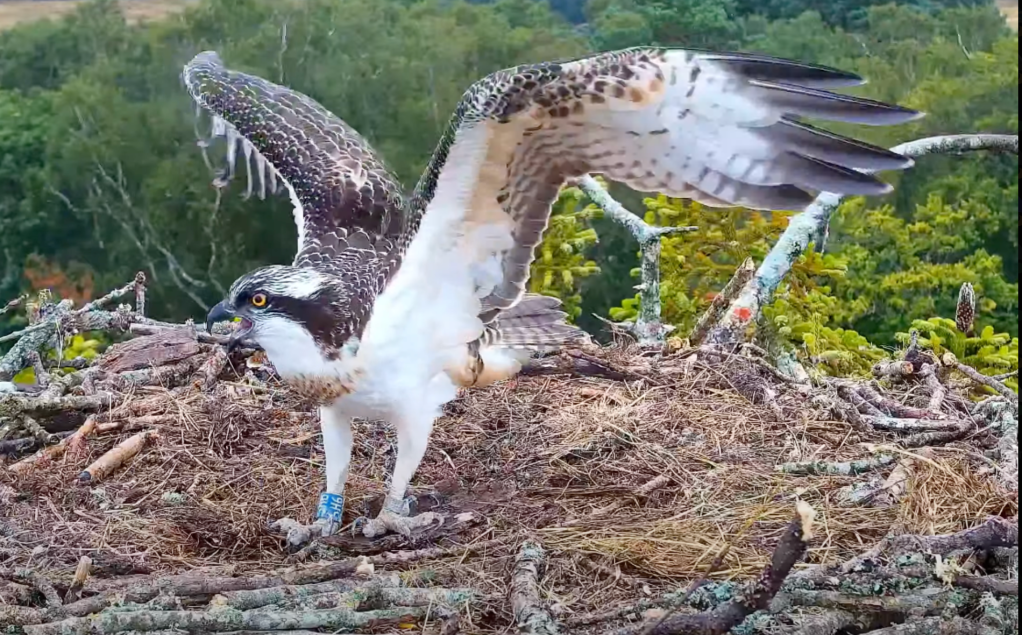
5H6 in 2024 (C) BoPH and thanks to Alison Copland for 2024 image.
INFORMATION REGARDING NEST 2.
(C) BIRDS of POOLE HARBOUR
RANWORTH BROAD
Ranworth Broad Ospreys 2026
ARRIVALS
| DATE | BIRD |
| 25th MARCH | UNRINGED MALE, RESIDENT MALE |
| 28th MARCH | BLUE 2H7(22), RESIDENT FEMALE |
LAST SEEN ON THE LIVE STREAM
| DATE | BIRD |
| 11th AUGUST | BLUE 2H7(22) |
| 1st SEPTEMBER | JUVENILE |
| 6th SEPTEMBER | UNRINGED MALE |
BREEDING
| EGGS LAID | HATCHED | FLEDGED |
| 15th APRIL10:32 | DNH | |
| 18th APRILOVERNIGHT | 26th MAY | 19th JULY07:36:55 |
| 21st APRIL0VERNIGHT | DNH |
2026 marked the third year that these adults have been on the nest after they successfully bred here in 2025. Hopes were therefore high for this pair that 2026 would be a success. This year we would be able to watch the action on the nest. A camera had been installed earlier in the year. It is a fixed camera that can move in and out but does not pan. It also doesn’t provide night vision.
Both birds returned within 3 days of each other at the end of March. They settled in quickly to the usual bird bonding behaviour. We saw lots of nesting material being brought in and plenty of mating. It took the male a while to get the hang of bringing in the food for the female. A number of times he was seen bringing in a fish and flying off with it, leaving the female on the nest with no dinner. Fish deliveries did become more regular for the female once the first egg had been laid.
Egg no1 was laid at around 10.32am on 15 April. Eggs 2 and 3 followed, both being laid overnight. Times cannot be certain, but nest cam footage would suggest c04.50 on 18 April for egg 2 and possibly 04:38 on 21 April for egg 3.
As we watched patiently for the eggs to hatch, we observed the behaviour of the birds as they settled down into a routine. Their relative inexperience showed in their behaviour. The eggs were knocked and stood on a number of times, by both birds. 2H7 seemed to deploy delayed incubation in the first days after the first egg was laid. Both birds shared incubation duties, with the female seen prodding her other half to get off the eggs when she returned from a rest break.
Within two weeks of the first eggs being laid, 2H7 was seen fishing in the broad, presumably as a result of the lack of fish deliveries by the male.
Around that time, it was observed that on a few occasions the male would arrive on the nest and 2H7 was seen to be looking for something. On 26 April, she turned on the male. At 07:38 he was seen flying past the nest and 2H7 was chirping and watching him. He landed a minute later, when she became extremely agitated and defensive, being literally in his face, and forced him off of the nest. In the fracas she stood on one of the eggs.
What had that been about? Some observers speculated it had been an intruder which had landed. No intruders had been reported however, and the markings on the bird corresponded with the resident male.
In 2020 DOP published a blog about ‘Redirected behaviour’, which related to aggressive behaviour being shown by the resident female Blue 3J, Telyn, to the new male Idris. It is thought such behaviour is triggered by when ‘some course of action is thwarted or inhibited, leading to frustration’.
Was 2H7 frustrated by lack of food? At the time she appeared to be trying for something (that wasn’t there) in his beak. I have sensed that she has been previously frustrated by the male’s fish deliveries.
For some hours after this, 2H7 spent a fair amount of time off the nest. It was also reported that she was fishing in the broad. It was later reported that she had been fishing again in the broad after the chick had hatched.
There was a hatching overnight on 25-26 May. This would have been day 40/41 for egg 1, and day 37/38 for egg 2. The timings suggest that it was the second egg which hatched. The remaining eggs did not hatch and remained in the nest, often being used as a prop by the chick!
Why did only 1 egg hatch? It’s hard to say. This was this pair’s second brood and you could see their inexperience. Eggs were left unattended at times. They were knocked about and stood on. We don’t know if any of them were damaged. Maybe it was a mixture of inexperience and inattention.
The chick’s hatching, and first few weeks, coincided with some very hot weather. Fish deliveries varied between 6-9 a day. Fresh water fish were the usual option, particularly Bream. By 10th June we saw a delivery of dab, a saltwater fish. Was the very hot weather forcing the freshwater fish down in the Broads system? If so, was the male having to fly further afield to find fish? We don’t know. Ospreys were not reported anywhere but I did notice deliveries were down a bit at this time.
The nest is fortunate that only a couple of intruders were reported during the season. An unringed male was seen on 6 May and possibly another on 12 May.
Earlier on in the season Greylag Geese got too close to 2H7 on the nest for some reason. A curious Tawny owl was seen on the nest taunting 2H7.
The single chick was not ringed. NWT said it is not their policy to ring birds unless undertaking scientific study. They also cited concerns regarding access to the nest.
By mid-July the chick was matching 2H7 in size. The consensus amongst those who were watching the nest is that it is female, based on size and attitude! She certainly is a bird that makes her feelings known! By 14 July she had been feeding herself for a few days.
In the run up to the fledging, she was seen making wing flaps. By 17 July she was practicing helicoptering.
On 19 July, she did a huge helicopter flight and then left the nest at 07:36:55. She was away from the nest for 6 minutes. For the next couple of days, the flights were short but got longer as the days went on. On 23 July she left the nest and didn’t return until the next day!
She was on and off the nest all the time until eventually she was spending most of the time away from it.
By early/mid-August 2H7 was seen fishing for herself. She was seen bringing in fish for herself. She was seen bringing in fish for the chick on 10 August and 11 August, we then gradually saw less and less of her. She was last seen on the nest on 19 August, but it’s thought she could have been around on 22 August.
The juvenile and male were last seen on the nest on 1 September. A bird was seen with fish by the broad on 6 September. Possibly the male feeding up before leaving on migration.
SAM WALSHE
First ospreys breed in East Anglia for centuries
OTHER ENGLISH NEWS
WEST MIDLANDS
WEST MIDLANDS RESERVIOR
Staffordshire Ospreys 2026
Hi I’m Phil Cooper, local wildlife watcher and photographer, I’ve been watching the Ospreys in Staffordshire for over seven years
now, here’s a few notes from this years activities.
This season has seen good and sad parts. Good, this year for the first time we have had two successful nests both raising two chicks, the first time for Staffordshire. The sad news was that our resident male 2AM didn’t return from migration, after four successful nests and at nine years old he his hopefully retired on a South African beach.
First to return from migration was 5H9, three year old son of KA6 and 2AM on the 6th April followed the next day by his mum KA6. The 8th of April saw two un-ringed birds arrive all vying for the original nest. The next morning, 9th April, saw KA6 and her son 5H9 established on the original nest and the two un-ringed birds taking nest two.Everything was Hunky Dory till the 18th April when all birds fought over the original nest again, the outcome being that KA6 and the un-ringed male took the original nest and 5H9 and the un-ringed female took nest two … this is how it stayed for the rest of the season. Who’s eggs were where I’m not sure.
Other key dates are :- 24th April KA6 started sitting 30th April un-ringed female started sitting 14th September last sighting on the new nest
17th September last sighting on original nest
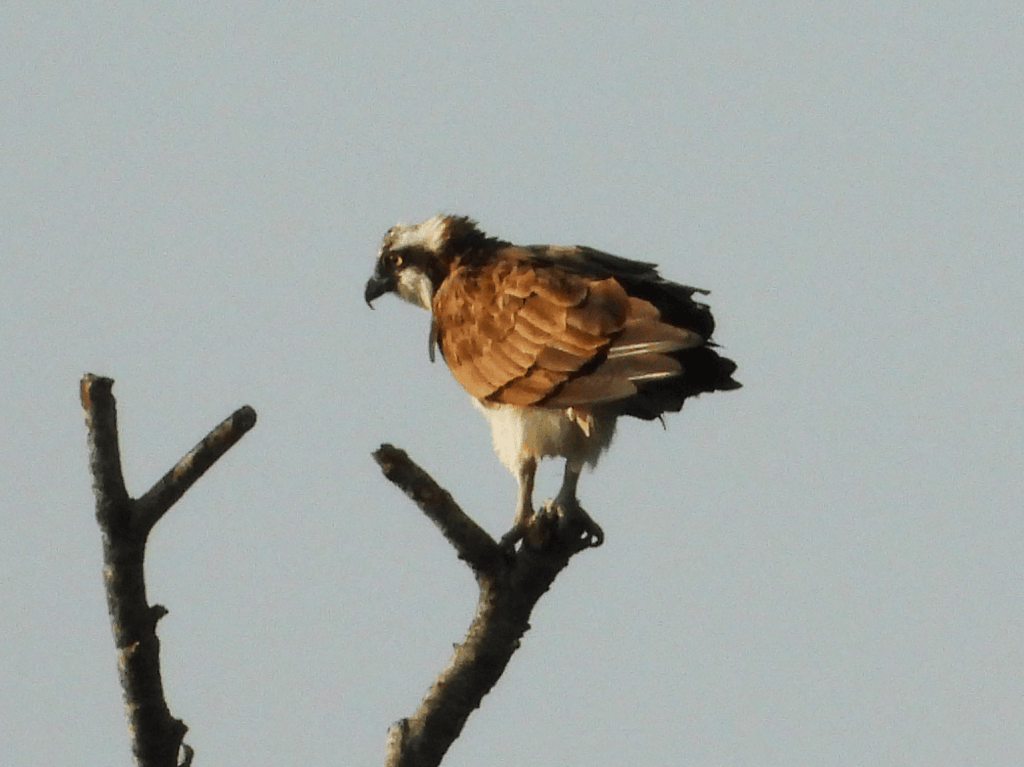
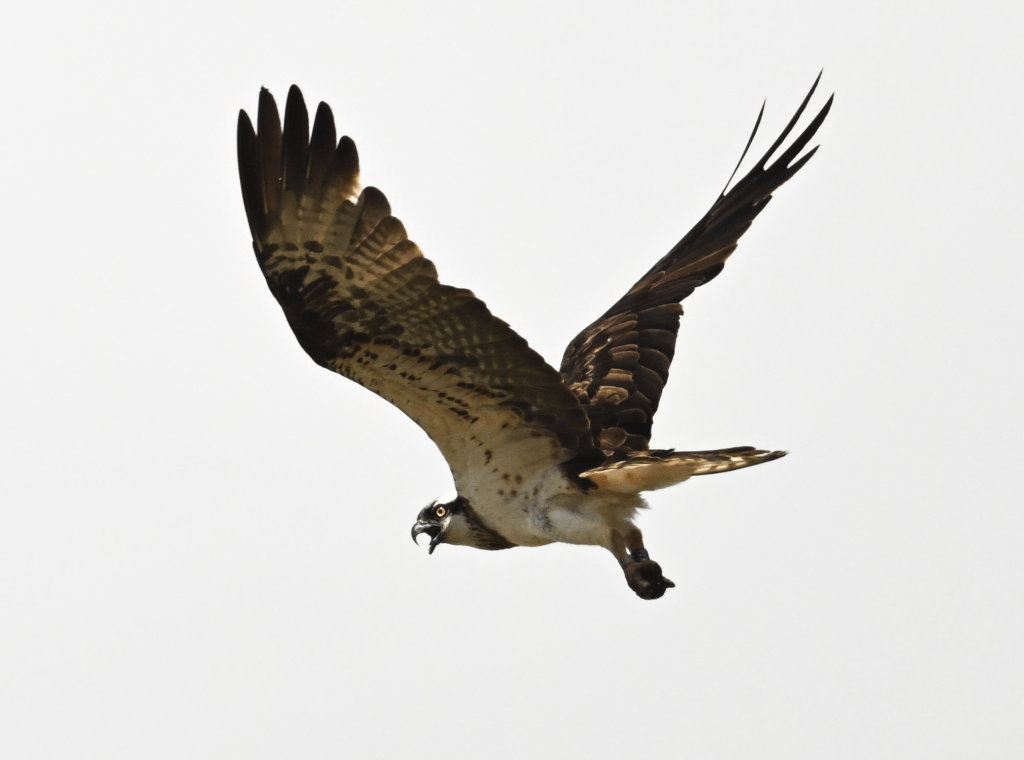
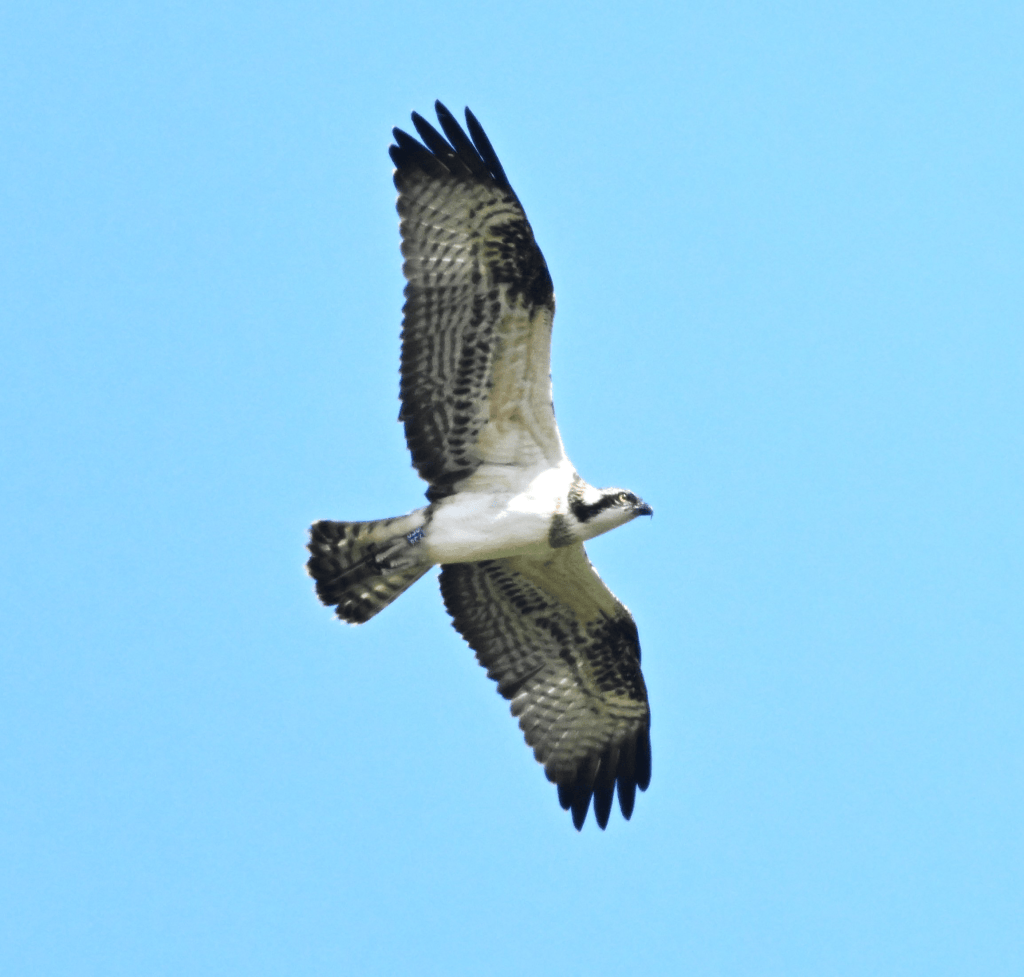
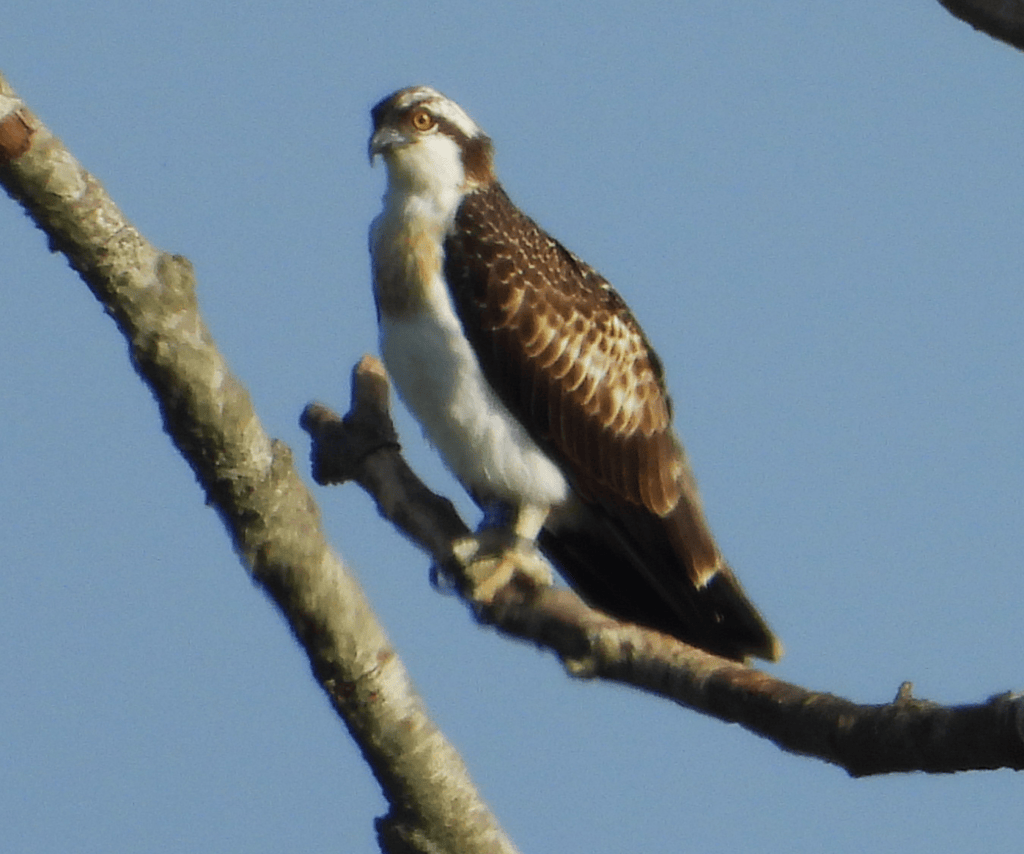
Pictures from the top are
Un-ringed male
Mum KA6
Chick 8S6
Chick 4R6
All from the original nest
Thanks
PHIL COOPER
The Following link is informative about this nest, it also carries an important message about NEST DISTURBANCE.
Osprey chicks fledge despite disturbances
EAST MIDLANDS
Second season for this Nest in the East Midlands (Falls under the Rutland Water Umbrella), known as Site Z. Pair are Blue 3AY ( Hatched Rutland Water 2019 Parents are Blue 03(09) and BTO Ringed Female From Argyll) and Blue 5H1 ( Hatched Poole Harbour, 2022 parents are Blue 022 and Blue CJ7) They successfully raised 3 Chicks for the second year running which were ringed Using Blue 9R7, 9R8 and 9R9.
SOUTH WEST ENGLAND
There have no updates in 2026, with their last blog in November 2025
The west counties are some of the highest visited counties according to reported sightings, Although the majority of sightings appear at the begining and end of each season.
WELSH NESTS

DYFI
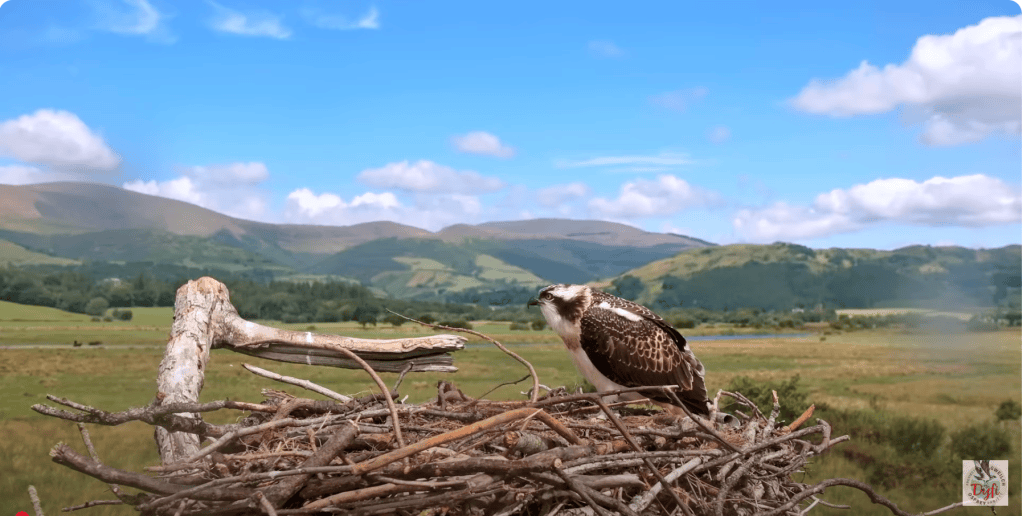
Dyfi 2026-one drama, but otherwise a textbook season
Project: Dyfi Osprey Project
2026 Breeding Pair
Male: Unringed (Idris)
Female: Telyn (Blue 3J, Manton Bay 2013)
Key Dates (more information in the Dyfi observation log-
Telyn Returns 30-Mar Telyn last seen 23-Aug
Blue N0 Arrives 30-Mar Blue N0 last seen (Unknown)
Idris Returns 2-Apr Idris last seen (10-Sep)
Chicks (ringing date ??)
Name/RingnumberGender Date Egg Laid Date Hatched Date Fledged Last Seen
Llinau (Blue6B7)F 14-Apr 23-May 17-Jul (55 days) 5-Sep
Ogwen (Blue6B8)M 17-Apr 24-May 15-Jul (52 days) 21-Aug
Elsi (Blue 6B9) F 20-Apr 26-May 19-Jul (54 days) (09-Sep)
After Idris’ exceptionally early return to the Dyfi nest in 2025, there was a lot of speculation as to whether he would return again before Telyn in 2026. However, it was Telyn who returned first, on 30th March, and there was no sign of Idris. Instead, on the same day, ringed male, Blue N0 hatched at Foulshaw Moss, arrived on the nest, initially with an unringed female. This nine year old male has been seen before early in the season at Dyfi and it’s unclear whether (and if so where) he has a nest. However in the absence of Idris, N0 spotted an opportunity and swiftly began to court Telyn with fish, and Telyn accepted him mating within a day or so.
Whilst ospreys often pair with the same partner, for many years in some cases, their prime instinct when they return at the start of the season is to breed. They will quite happily ignore any sentimental feelings that humans may ascribe to them and they keep their options open by pairing with any available bird of the opposite sex that happens to be passing by! However if the other resident bird returns, then this usually means that there will be a territorial battle. And on 2nd April (well within his normal return window) Idris arrived at the nest, and very quickly asserted his dominance. Thankfully there was no dive-bombing or vicious fighting (as there had been at Glaslyn the previous year for example) and N0 moved on swiftly. He was last seen at the nest on 3rd April although it was thought he was still in the area for a short while, but his whereabouts after that are not known. After gaining quite a few “fans” from his attempts to woo Telyn at the start of the season, it would be nice to think N0 might have paired up with a female and raised chicks of his own this year, but sadly it isn’t known if he did.Telyn and Idris then quickly reasserted their pair bond and from this point the season seemed to be mostly a textbook one. Telyn laid her first egg on 14th April, and whilst, as at Glaslyn, there was some speculation as to whether N0 might have fathered this egg, the 12 day gap between Idris and Telyn getting “reacquainted” and the first egg being laid makes it almost certain that Idris was the father. Viewers and followers of Dyfi also often ask why Telyn doesn’t lay four eggs like her mother, Maya, at Manton Bay often does. The answer is unclear – Idris is an exceptional fish provider (as is Maya’s mate Blue 33(11)) and if food supply is a possible factor, this would almost certainly not be the reason at Dyfi – but she never has laid four in nine seasons of breeding at the Dyfi nest, and the 2026 season proved no exception, with three eggs being laid. As usual Idris’ antics during the incubation period, where he tried to get Telyn off his beloved eggs, caused much mirth amongst viewers, with shoving, wing pulling and standing in the nest cup apparently his favourite ways to dislodge her.
The incubation and hatching stages progressed smoothly and as expected, with all three eggs hatching on 23rd, 24th and 26th May. Idris, as always, stepped up with his signature deliveries of “Dyfi whales” to the nest to feed the three chicks. And then, the season’s only moment of real drama occurred, and in a remarkable coincidence, as at Glaslyn and at Manton Bay (the nests of Telyn’s son and mother respectively) it also involved a fishing hook and line.
On 5th June, a fish was brought in which had a hook embedded in its mouth. Viewers were then horrified when Telyn was seen actually eating the hook and swallowing it. There was much consternation about what would happen next and what the likelihood was of the hook causing her internal damage. Unlike at Manton Bay and Glaslyn, there was no possibility of intervening in this situation, given the issue involved an adult osprey which would be impossible to catch, even if this was desired. So the project made the decision not to do so, and continue to monitor the situation. Of course for viewers it was a very difficult watch. If the hook caused internal damage, it might not be apparent immediately, and for the next few weeks viewers and DOP alike watched with bated breath for any abnormal behaviour on Telyn’s part. However as time went on, it became apparent that Telyn was behaving (and eating) normally and there seemed to be no lasting damage or injury. What happened to the hook, no-one really knows. She could have expelled it, as ospreys often do with sharp fish bones, as a sort of liquid pellet, or it could literally have passed through her without harming her. Or it could even still be inside her – ospreys have very strong stomach acids and it could have been dissolved, or perhaps more plausibly it could have calcified and the sharp part of the hook blunted so it can cause no harm. By the time she migrated, Telyn showed no obvious ill effects from the hook and the only way we will know whether it had no ill effects is for her to return successfully next season. I’m sure everyone will be keeping their fingers very much crossed in March 2027….
Meanwhile the three chicks continued to grow and were ringed on 29th June. This was a few days later than originally scheduled due to the potential stresses to both the birds and the ringer from the exceptional heat at the time. The chicks were determined to be two females and a male, and as is traditional at Dyfi, named after Welsh lakes and rivers: Llinau (Blue 6B7, female), Ogwen (Blue 6B8, male) and Elsi (Blue 6B9, female). Following ringing, the next milestone is fledging, which generally happens when the chicks are around 7-8 weeks old with males tending to fledge at an earlier age than females. And as such, the only male, Ogwen, was the first to fledge on 15th July. He was followed by his older sister Llinau on 17th July. The youngest chick Elsi caused a bit of concern with her fledge however: she was spooked off the nest on 19th July into a forced fledge (always a worry if a bird isn’t quite ready) and did not return to the nest until over 24 hours later. There was much celebration when she did!
With three successful fledges this season, this takes Idris and Telyn’s record to 18 chicks overall. All three continued to develop as expected and the first migration was thought to be the male chick Ogwen, last seen on 21st August. Telyn was last seen on 23rd August, around her usual departure time, and as of the time of writing (5th September), Idris and the two female chicks were still around. Both female chicks stayed until they were over 100 days old, which seems to be a fairly common occurrence on the Dyfi nest since Idris and Telyn became the breeding pair. It is interesting to speculate whether this may be genetic as Telyn also was a late leaver at Manton Bay in 2013.A final note: 2026 has been the most successful season for ringed intruders at the Dyfi nest, with 12 identified in all, including on 24th April, a very famous female, the 23 year-old Morven (White PE), who had been satellite tracked by Roy Dennis at one point; and on 22nd August, a juvenile from a brood of two hatched from a private nest in the Dyfi Valley, Blue 9L8 that the osprey population in the mid-Wales area is very healthy and growing every year: very good news indeed!
(C) CAROLINE WOODLEY
Dyfi nest Intruder list © Dyfi Osprey Project, Observation Log 2026
Information (C) Dyfi Observation Log.
DYFI PHOTO GALLERY
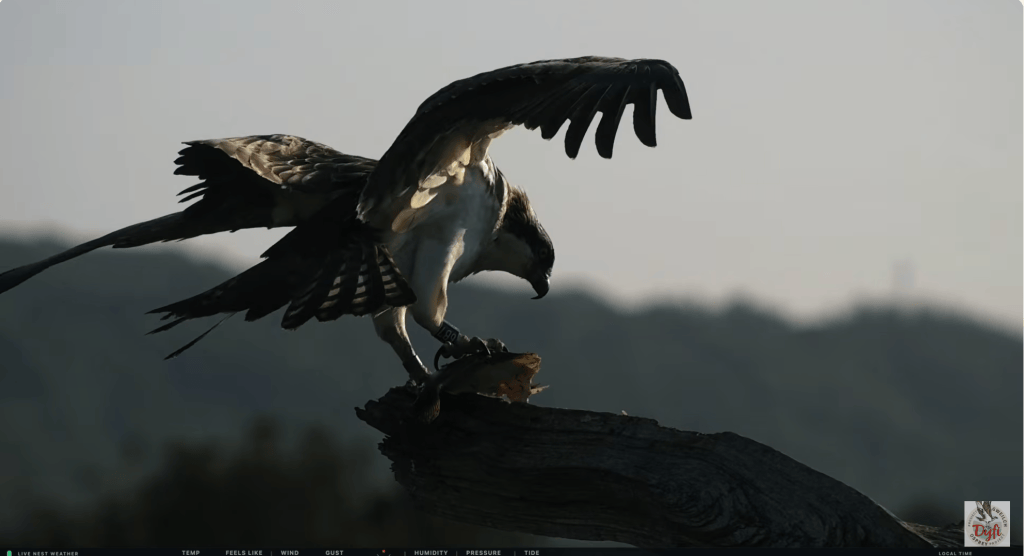
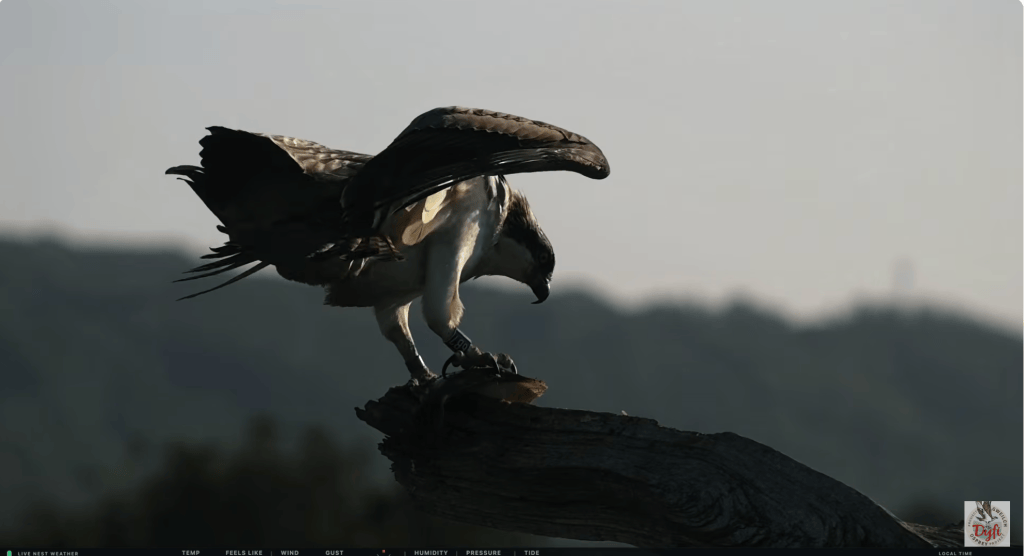
LLINAU
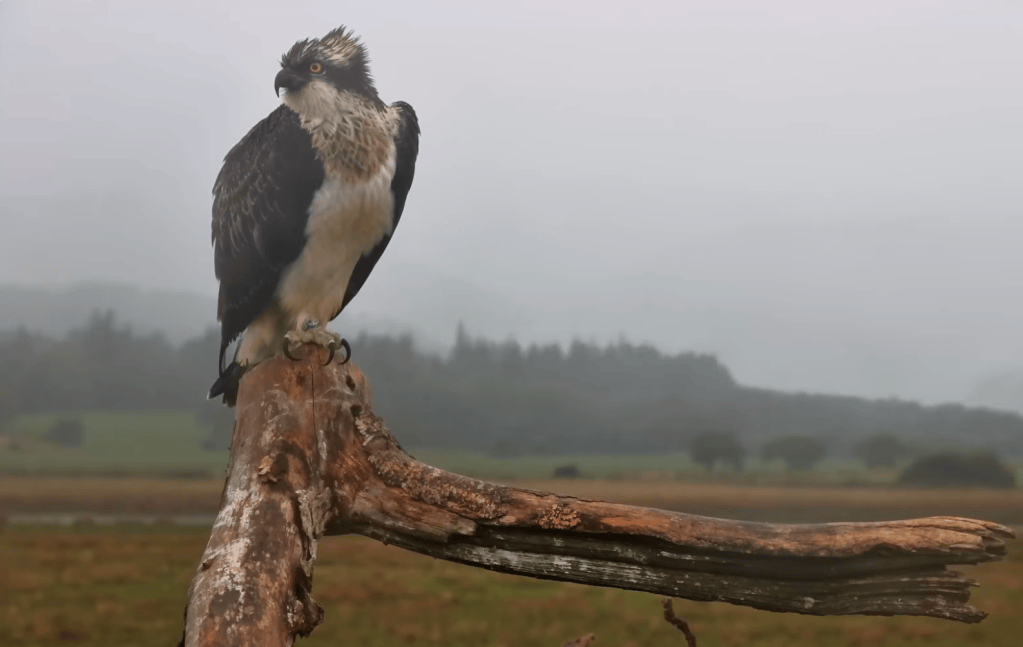
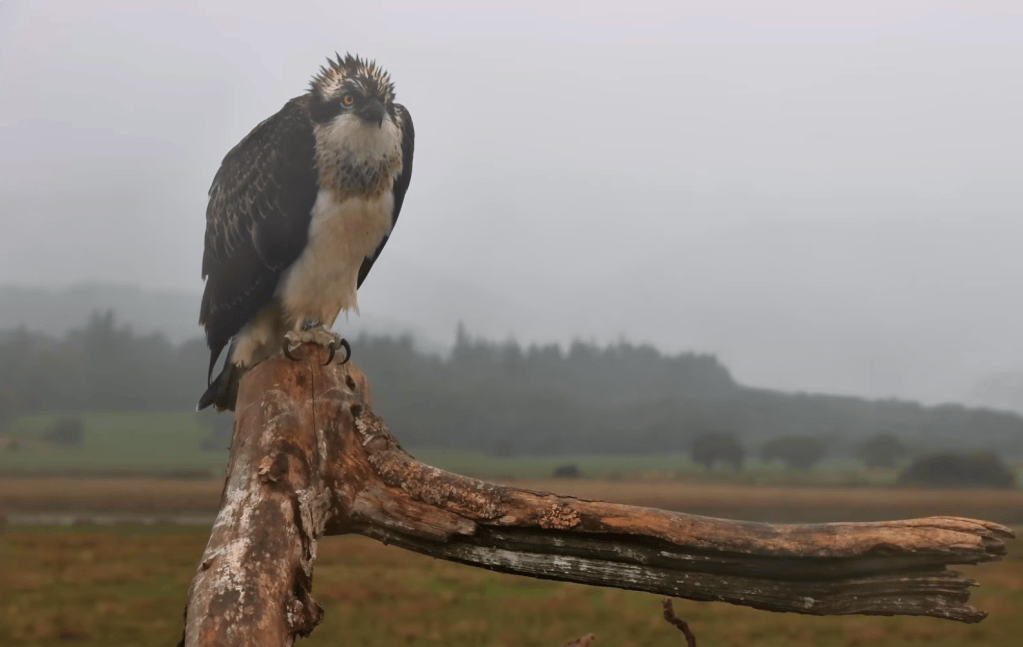
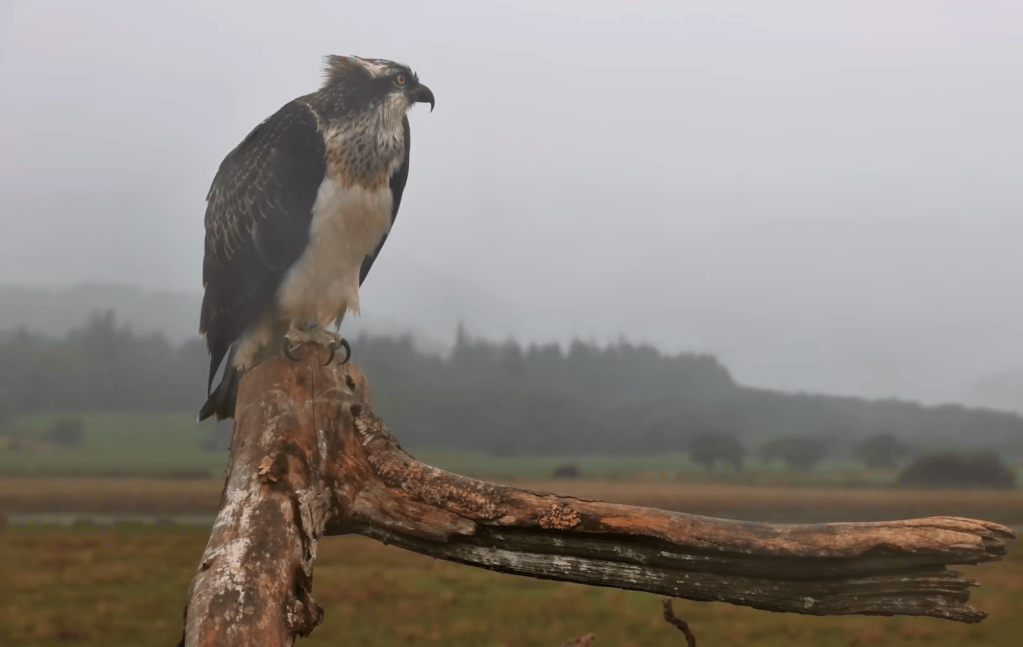
ELSI
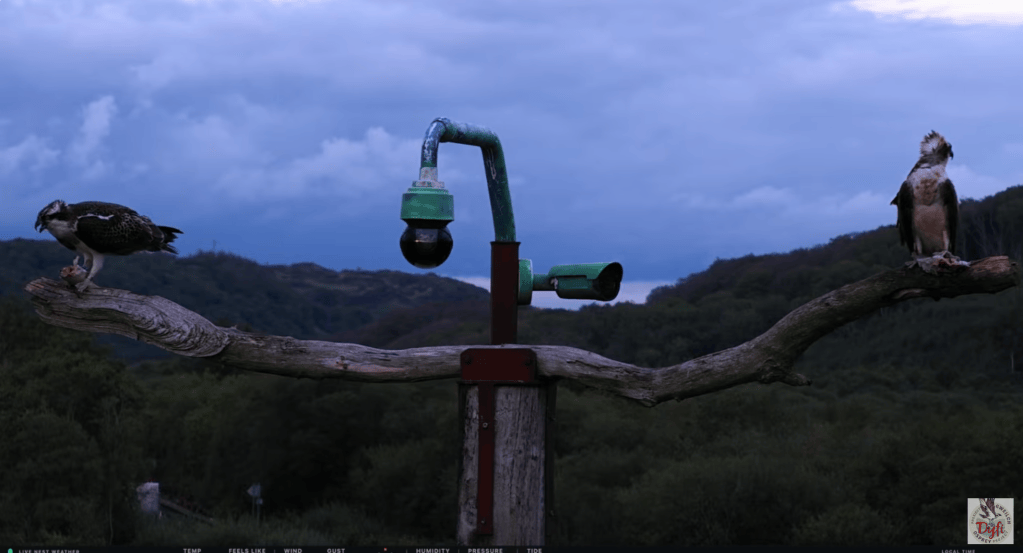
LLINAU and ELSI
CLYWEDOG
Clywedog nest 1
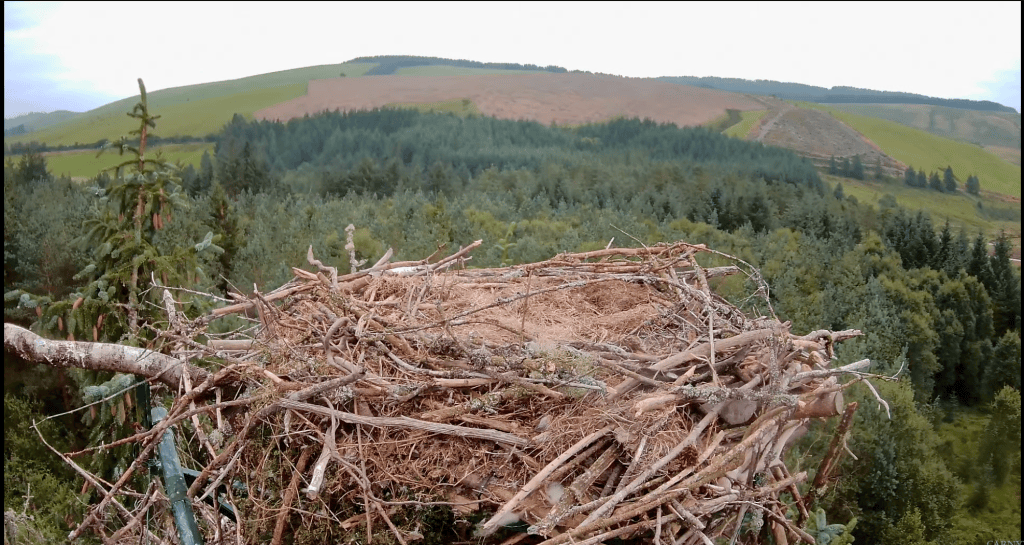
Llyn Clywedog Ospreys 2026
The 2026 breeding season will no doubt be remembered with sadness at the loss of a brood of chicks, but there were successes and moments of joy too.
Nest 1 (Livestreamed)
Resident pair: Unringed male ‘Dylan’ and female Blue 5F ’Seren’ (2012 Rutland)
Unringed Dylan arrived on the nest at 14:04 on 28/3/26 and was joined the following day by 5F Seren at 14:49. It was to be their 7th breeding season together but unfortunately that number did not bring its customary good luck with it.
They produced 3 eggs and, as expected from this experienced pair, incubation went pretty much by the book, so that by 23rd May they had three healthy chicks to rear. However, there was concern when Dylan brought in nesting material with a burst balloon and 2 ribbons attached, posing a threat to both adults and chicks. Fortunately, he removed one ribbon and 5F Seren took the other away the following day. Another close call happened when 5F accidentally knocked one chick clean out of the nest cup as she left the nest, but fortunately it had the strength and determination to work its way back to its siblings over the following 9 minutes.
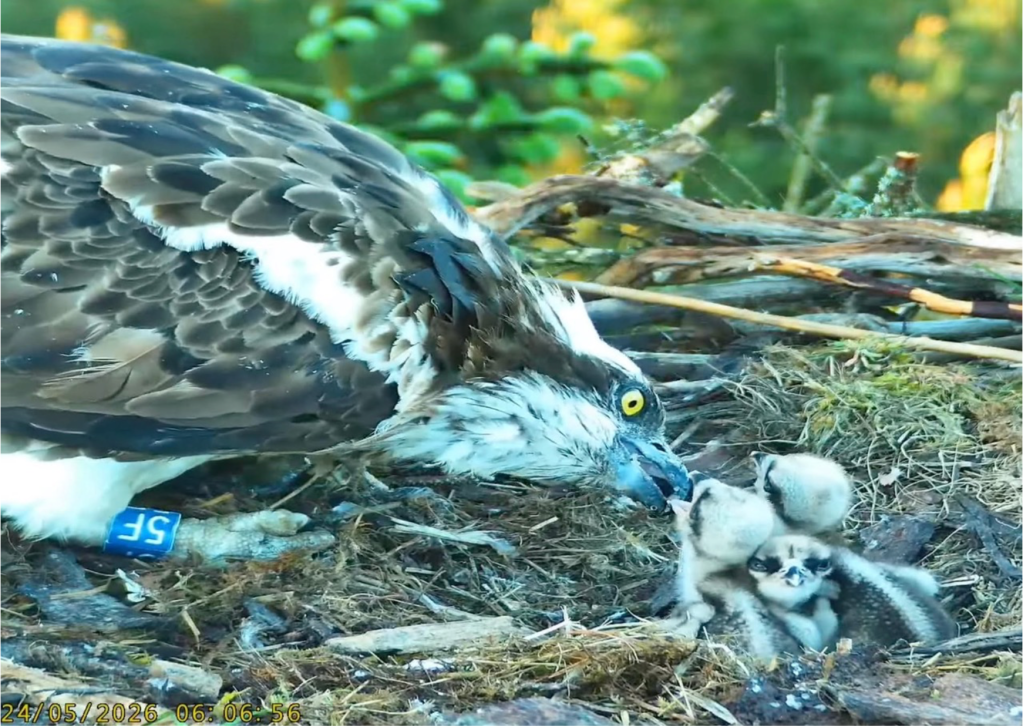
5F feeding chicks – Livestream NRW/Carnyx Wild’
Dylan provisioned the nest with his usual expertise, while 5F Seren took great care of their chicks just as usual. But then something very unusual happened that will forever remain a mystery.
On 3rd June, with the eldest of the chicks just under two and a half weeks old, all three were still totally reliant on their mother for warmth in the stormy weather that was setting in. That evening, 5F was brooding the chicks, when, at 20:58 and with Dylan seemingly still absent, she stood up, took two paces back, turned and flew off. There were no signs of panic, distress or disturbance of any kind. No calls from her or any other osprey. No sound of anything at all except the wind. It looked like any normal exit by a female who needs to take a comfort break and is careful not to tread on her chicks as she leaves. She did not pass the nest within sight of the cameras, so the direction she took was not known, but that was the last that was seen of her. Just under an hour later Dylan arrived on the nest but stayed less than a minute. The night was windy and then became very wet. The worst combination possible for the chicks.
Early next morning, 4th June, Dylan brought fish to the nest to feed the chicks. His male osprey instincts allowed for that but not for brooding them to keep them warm and dry. He came and went several times but at 7:35 they did not respond to his contact calls or sit up.
The area had been scanned even before the first hour of 5F Seren’s absence was up and nothing untoward was spotted. At this point there still seemed a glimmer of hope that she would return, but all options were explored and plans made. Due to the remoteness of the site and the fact that a hired cherrypicker is needed to reach the nest, no rescue attempt could be made until morning. The chicks were finally recovered from the nest but sadly none survived.
As this sad day progressed and no sign of 5F Seren had been found, the mood was incredibly sombre. She is a bird that means a good deal to a lot of people; in Wales, the UK as a whole and in the Gambia, where she is photographed and reported on every winter. But the growing sense of dread and loss turned to massive relief when at 17:30 she landed on the nest perch. Her crop was empty and she looked wet, but she was alive and she was home.
For the rest of the season, Dylan and 5F Seren defended their territory against intruders, shared fish and maintained their bond with each other and their nest. An early migration could not have achieved any of that.
5F was last seen on camera at 19:30 on 2nd September and Dylan at 11:16 the following day.
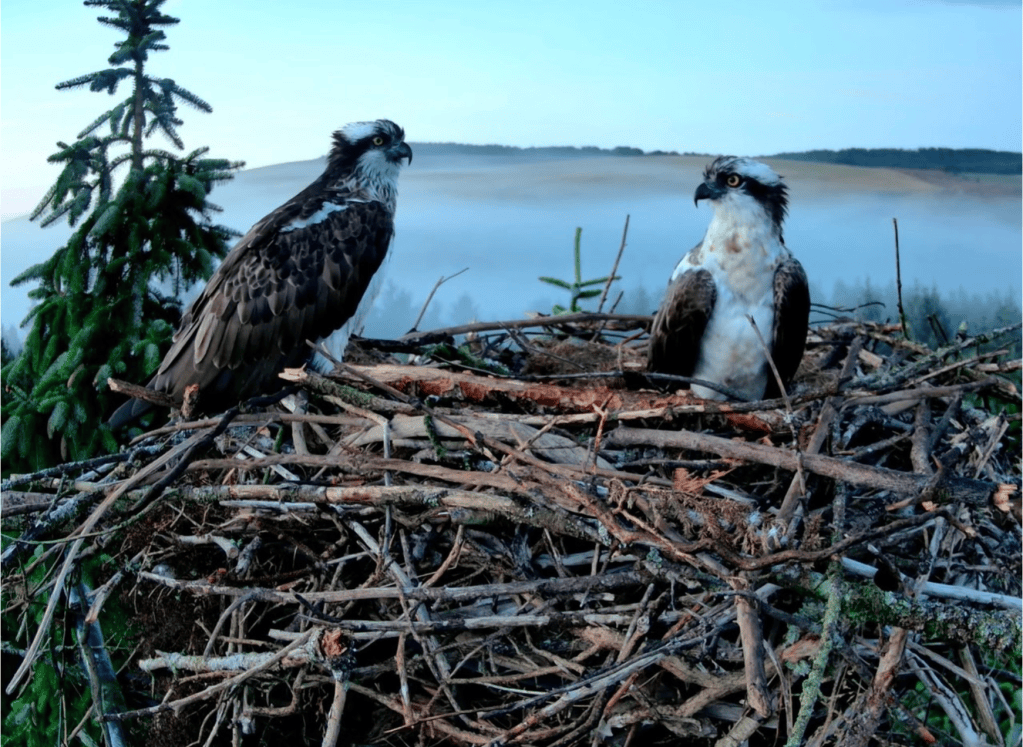
Dylan and 5F – Livestream NRW/Carnyx Wild’
A small but dedicated group record and collate the stats of fish deliveries to nest 1. This years fish stats are not directly comparable with previous years, as the adults would not necessarily bring their catch to the nest following the death of their chicks, but they are interesting nevertheless and reflect the circumstances.
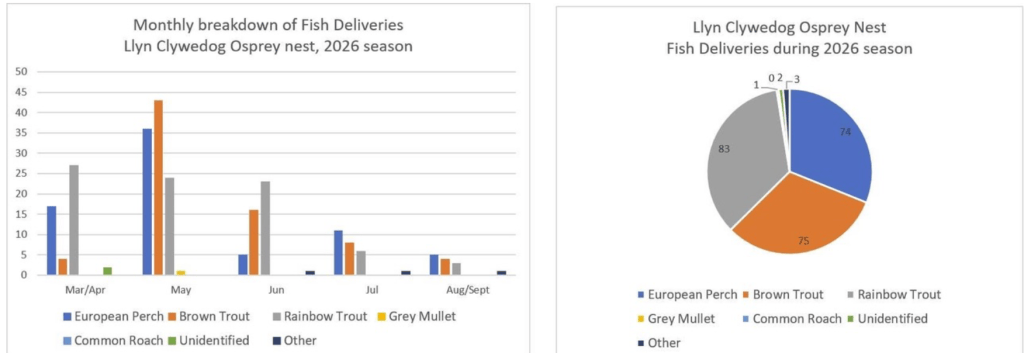
Fish stats’
Nest 2
Resident pair: Unringed male and Female Blue Z5 (2020 BM nest North Wales)
The unringed male and female Z5 returned to Clywedog facing a now familiar challenge. Once again their nest had been destroyed by winter storms. But a new nest platform had been erected not far away and well within their territory, in anticipation of clear felling that is needed at the badly storm damaged area of their previous nests. The question was, would they rebuild in the broken, windblown section, or try their luck on the platform a little further away? By the 2nd week of April it seemed they had made their choice and had been seen together on the platform. Their 3rd new nest in four years! Unfortunately the weather had totalled the nest camera just before the pair returned so monitoring was less straight forward. The new location was not publicised for this reason and it was hoped that any chicks could fledge safely before before the location was more widely known.
On the 14th April John Williams was able to confirm the ringed female was indeed Z5 as suspected, and the unringed male bringing fish to her appeared to be her mate from previous seasons.
They were observed nest building, mating, displaying and chasing intruders. All things that suggested they had settled and most importantly, Z5 was incubating.
It wasn’t until the afternoon of 4th June (the same day that the chicks on Nest 1 had been lost) that Z5 was first seen feeding a chick. This happy news did much to lift spirits.
For quite some time only one chick raised its head above the nest on any one occasion and it wasn’t till the 18th of June that two were seen.
Ringing of the 2 chicks took place on 8th July and was completed in super quick time to beat the growing heat. The verdict – One female and one male.
Only one chick was seen still on the nest on 29th July and by the 31st both had successfully fledged. Both parents were very much in attendance and providing for the youngsters.
Z5 appeared to have migrated by the end of August. The chicks were still in evidence during the first week of September but there was no sign of them by the 10th. On this day, only one adult osprey was seen in the area. It was flying over the water not far from nest 2, but could not be identified.
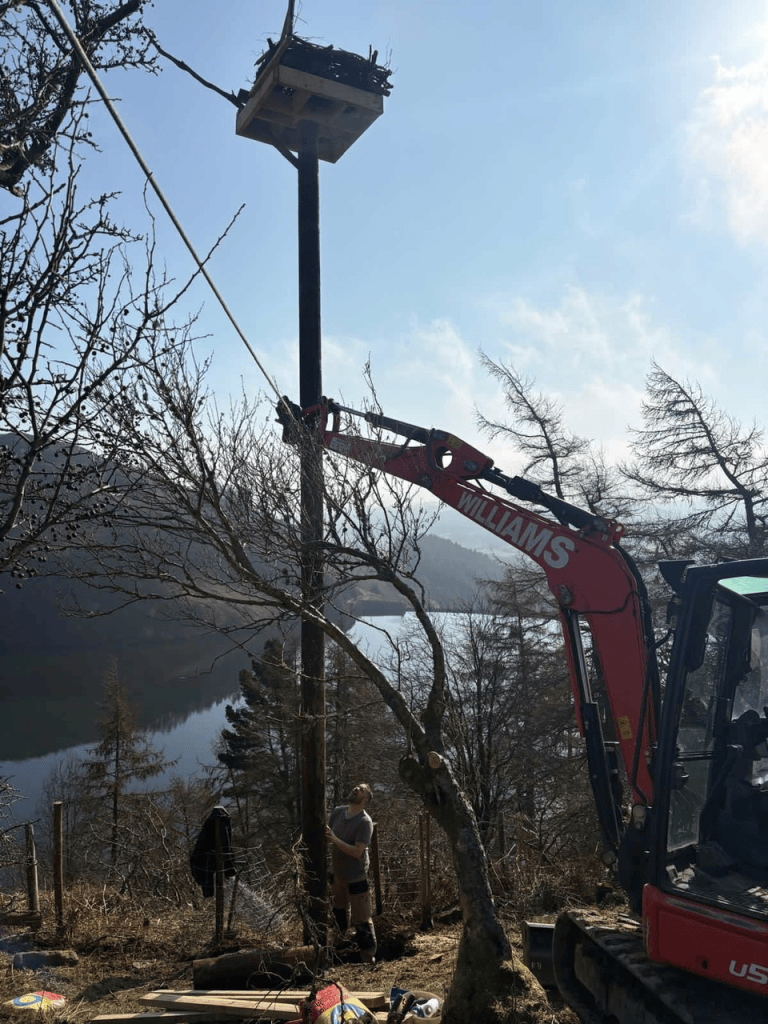
The platform erected in spring 2026‘
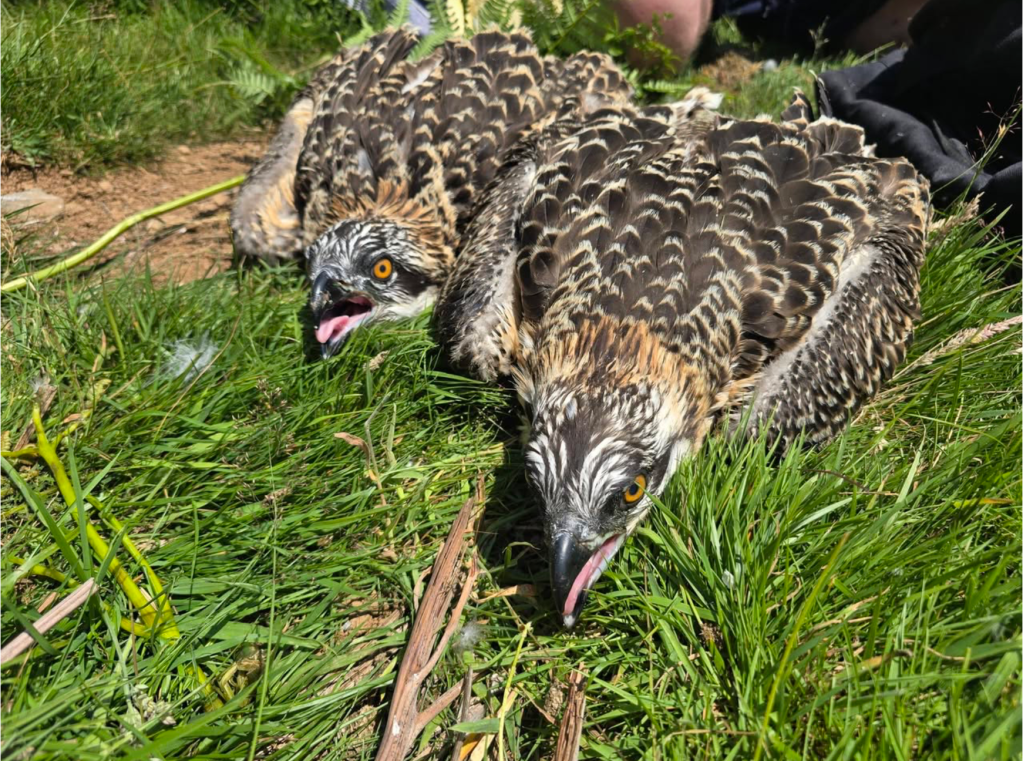
Chicks ringed 8th July – photo John Williams’
Nest 3
Resident pair: Male Blue X6 ‘Owain’ (2022 Llyn Brenig) and Unringed Female
The resident unringed female returned to the nest on 5th April. On that same day she was visited by KA9 (2022 Llyn Brenig), the full brother of her mate X6. The following day X6 returned from migration.
On the 7th April they had another visitor. It was Z5 from Llyn Clywedog nest 2 but this was brief. The 10th April brought an altogether more serious intrusion by an unringed female who mobbed the resident female for over an hour.
The first egg was laid on the 24th April and on the 30th a clutch of 3 could be seen on the nest cam. Male 721 (2022 Tweed Valley) intruded that day.
The nest continued to be monitored and was described as being “blissfully quiet” during the incubation period. But then problems arose with the camera, so that viewing was intermittent at best. Hence it was on 4th June (the same day the chicks were lost at nest 1) when John discovered that the first chick had hatched. The joy at this, together with news of a chick at nest 2 would very quickly be amplified by 5F Seren’s return to nest 1. A day that had started with disaster now seemed to be trying hard to redeem itself.
Chick 2 was first seen on 13th June and was a few days old. The remaining egg did not hatch. The chicks thrived and were ringed on the 8th July. Both were judged to be female.
The camera problems persisted and on 26th July it was noted that chick one had fledged. John was rewarded for his efforts trying to monitor this nest by witnessing the 2nd fledge on 30th July.
At the time of writing, it is unknown whether all birds at nest 3 have migrated.
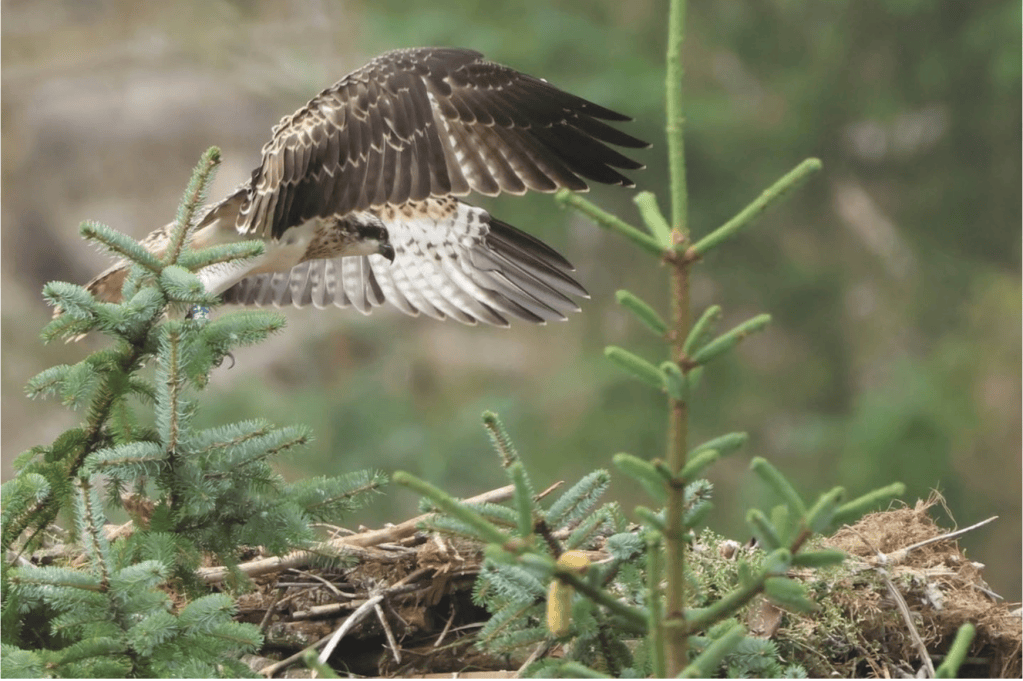
9L4 Fledges from Nest 3 – photo John Williams 30/7/26‘
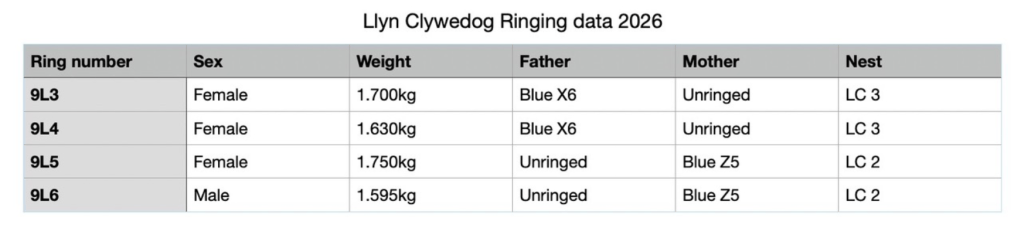
Clywedog 2026 Ringing Data
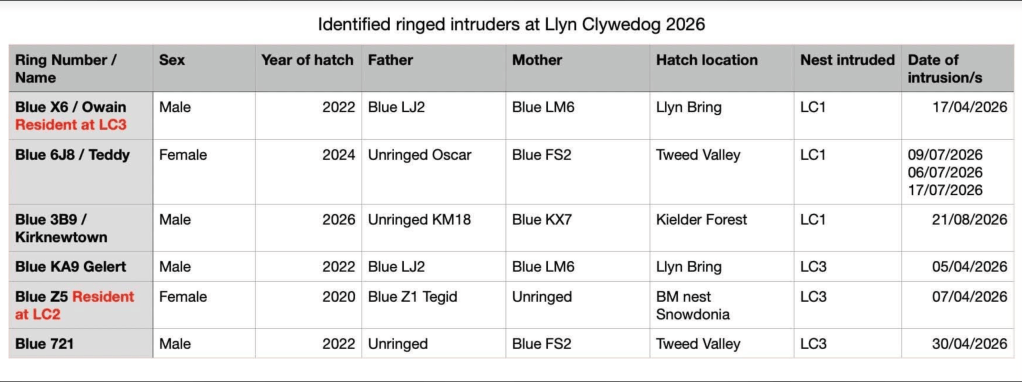
Ringed Intruders at Llyn Clywedog
Looking Forward
A new ‘osprey built’ nest has been located in the area. Breeding has not taken place this year but the signs are good and it is hoped that the new pair will return to breed in 2027. If so, this will be known as Nest 4 in the Clywedog colony.
After a roller coaster of a year, all those who follow the Llyn Clywedog ospreys closely, are now hoping it won’t be too long before hearing that 5F Seren has arrived safely at her usual wintering ground in Gambia.
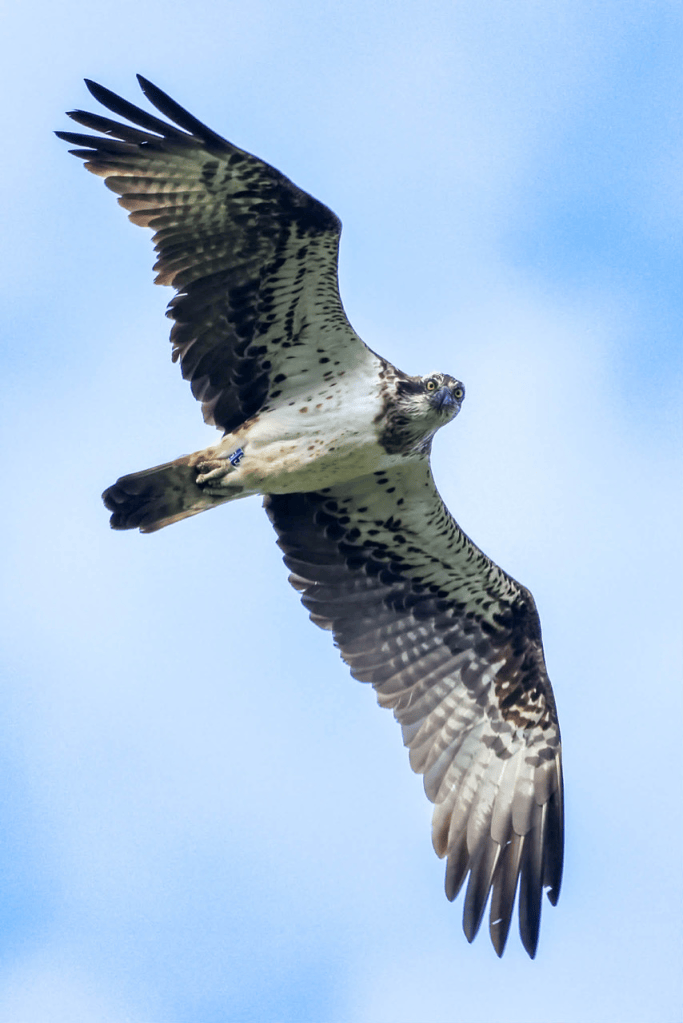
5F Seren – photo John Williams 30/7/26‘
(C) LIZ JONES and JOHN WILLIAMS
Videos Above (C) NRW/LCOP, Viewed from Both available cameras. 03/06/26
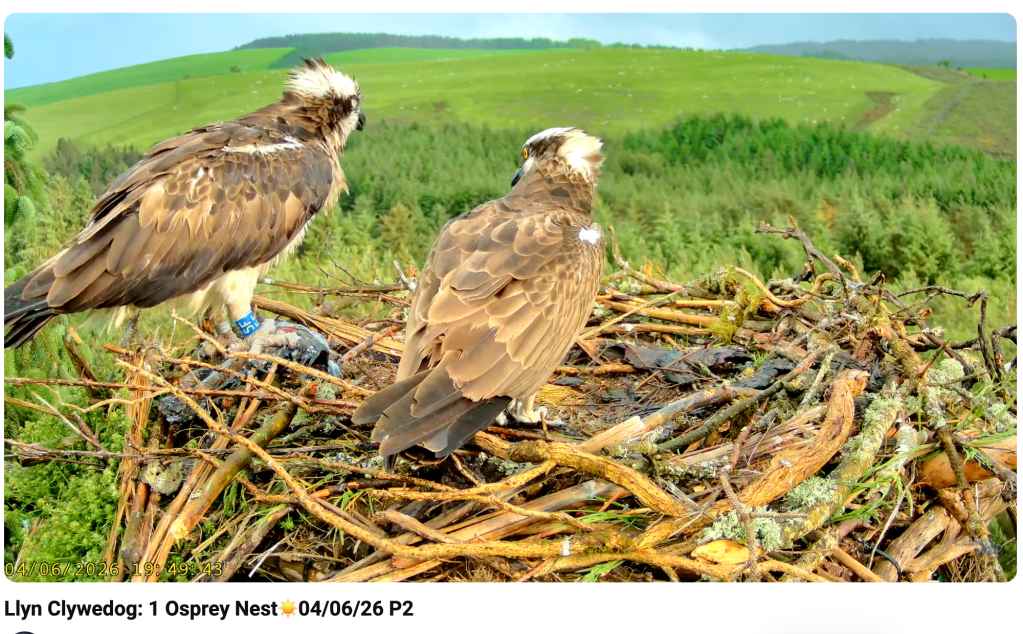
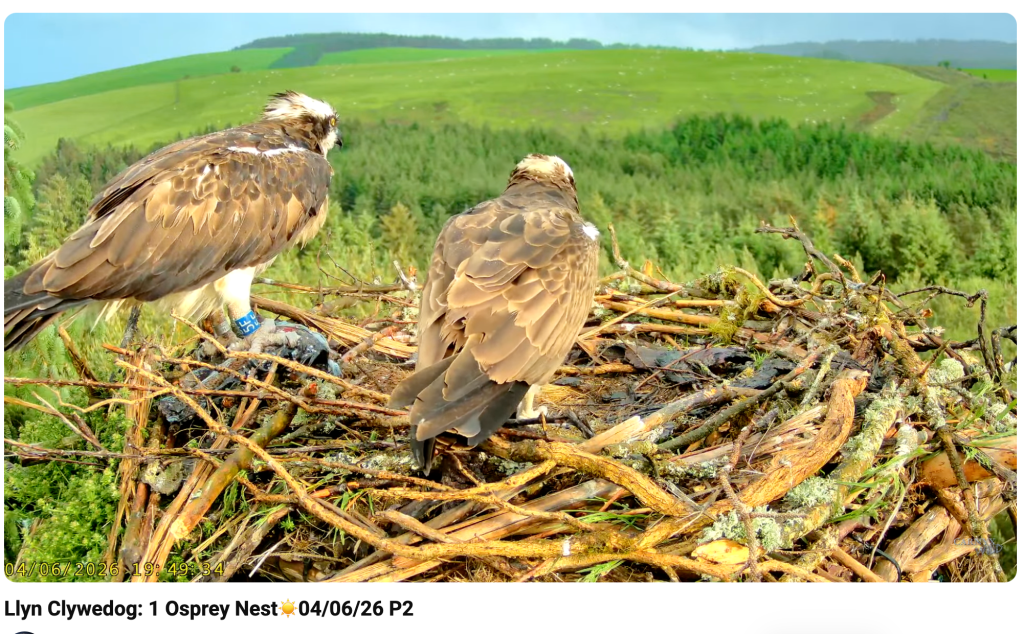
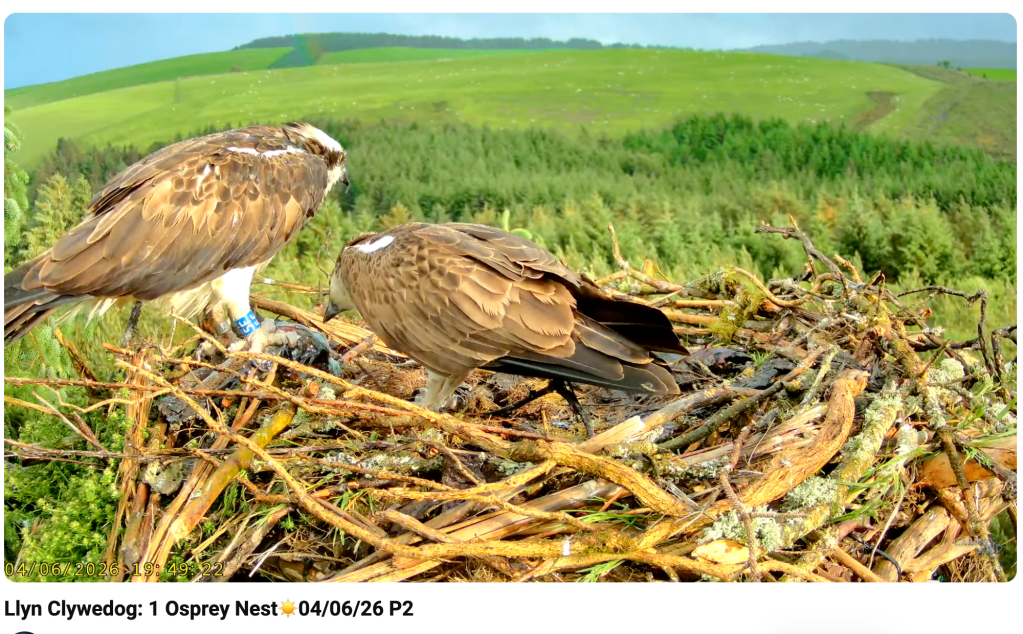
Blue 5F and Unringed Dylan Reunited 04/06/26
GLASLYN
Glaslyn 2026 – a dramatic season ends in success
Project: Bywyd Gwyllt Glaslyn Wildlife
2026 Breeding Pair Male: Teifi (Blue KC6, Dyfi 2020) Female: Unringed (Elen)
Key Dates (further details in Glaslyn Key Dates document) –

Chicks (ringing date: 30-Jun)
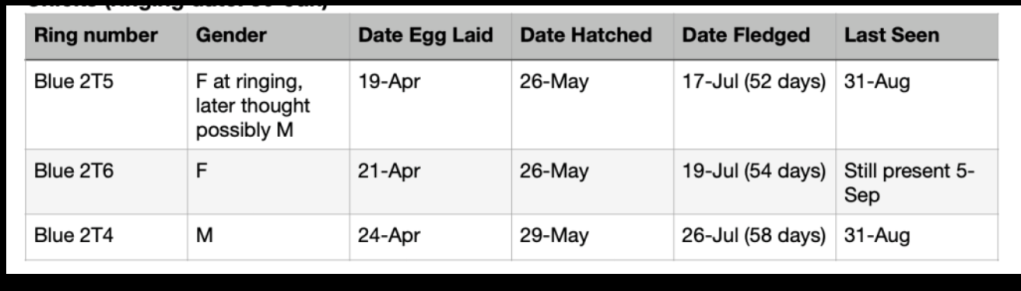
Following the unsuccessful season at Glaslyn in 2025, when the longtime resident male, Aran, was ousted from the nest by Dyfi-hatched Teifi (Blue KC6, 2020), and no chicks were hatched, all eyes were on the Glaslyn nest in 2026 to see what would happen next. A lot of questions were as yet unanswered when Elen arrived at the nest on 20th March. Which male would arrive first? Would Elen stay on the nest? Would Aran re-take his nest or would Teifi prevail? Unfortunately, having arrived early and left on her own, Elen disappeared as she had done in 2024, and was not seen again on the Glaslyn nest in March. Other birds visited the nest briefly, then on 4th April the one bird arrived who everyone was hoping to see – Aran! That Aran was the first male back revived hopes that perhaps he might re-take the nest and breed at Glaslyn again this year, but there was still no sign of Elen. However for a couple of days Aran entertained a Cumbrian hatched female, Blue 7C1, a daughter of 2014 Glaslyn chick Blue 9C, and therefore a granddaughter of Aran’s long time mate, Mrs G, and her first mate 11(98). It seemed like a perfect pairing for the nest, but sadly it wasn’t to be. Just two days later, Aran’s arch-nemesis from 2025, Teifi, touched down on the nest and the much feared reprisal of the 2025 battles looked likely to take place. This year however, the battles were over mercifully quickly, with Teifi claiming the nest and Aran moving on to the nest he was seen at last year, where – in a rather joyous irony – he was again joined by 7C1 (see elsewhere for full details). However before that, 7C1 was one of two females vying for Teifi’s attention. The other was 432/ Eshells, a Kielder-hatched bird whose father, Blue W6, interestingly was hatched in Wales at the FotO BM/ON4 nest. However, initially Teifi dive-bombed them both – it seems he was in full “nest defence mode” after chasing off Aran, and it wasn’t until 432/Eshells seemed to have won a brief battle with 7C1, that Teifi settled with her and brought her fish. As their bond grew over the next few days, it looked very likely that 432/Eshells and Teifi would end up as the breeding pair at Glaslyn in 2026 – but yet again, on 13th April, there was another plot twist in the Glaslyn “soap opera” that very few of us were expecting at this stage: Elen was back! Elen Returns 20-Mar Elen last seen 25-Aug Aran Returns 4-Apr Aran last seen (Unknown) Teifi Returns 6-Apr Teifi last seen Still present 5-Sep
She swiftly set about evicting poor 432/Eshells (who was later seen around the Clywedog area) and reclaiming the nest (and Teifi) for herself. Where had she been? It is thought likely she was touring the other nests in the area and may have spent time with a lone male holding territory, although this has not been confirmed. Elen and Teifi swiftly started to renew the bond they had established in 2025 and Teifi began to share fish with her – a good sign because in 2025 he had shown himself to be extremely inexperienced at providing fish to a female. Speculation about Elen being on a nest with another male was compounded when she laid her first egg only six days after returning to the nest. Even long-standing osprey pairs usually take 10-14 days after returning from migration for the female to be ready to lay an egg, and for a new pairing like this one it often takes longer. So with an egg laid so soon, there was some speculation about whether Teifi was the father. However, as at Dyfi, osprey biology suggests that he almost certainly is, because eggs are usually fertilised about one to two days before laying from sperm from recent matings, which would all have been with Teifi. The next thing that had viewers on tenterhooks was: what would Teifi’s reaction be to the egg? Male ospreys often reject any eggs laid “too soon” after re-establishing their pair bond with a female, and continue to scrape the nest, kicking out any eggs already laid. And at first, when Elen first got up and revealed the egg to him, it looked as though Teifi would do exactly that. But then, incredibly, he stopped scraping the nest and very, very tentatively sat down on the egg. Success! He had accepted it – what a relief! Elen laid two more eggs after that and a full clutch was being incubated for the first time since 2024. Incubation progressed without too much incident and the first hatch occurred in the early hours of 26th May, followed very quickly by the second on the same day and the third a couple of days later. It also became clear that Teifi has inherited some of his dad Idris’ love of incubation – and his tricks to “persuade” the female off the eggs – with wingpulling, shoving Elen off the eggs and sitting beside her all in evidence! For the most part the season then progressed well, with all three chicks growing fast, although there were a few incidents of sibling aggression particularly by the second chick towards the smallest when poor fishing conditions and persistent intrusions limited Teifi’s ability to fish. For a couple of days there was concern that the smallest chick was missing out too much at feeding times, but thankfully things changed, Teifi once more was able to fish enough for all three chicks and eventually the smallest one was able to feed well. And then, just as things started to look better there was yet another plot twist in a season that was turning out to be even more dramatic than expected: a fish was brought in which had a fish hook and line embedded in it. Unfortunately when Elen was feeding the smallest chick, the line got tangled up in its mouth and the chick was already looking distressed when Elen flew off the nest, taking the fishing line with her and almost dragging the chick out of the nest. Thankfully the line snapped and the chick wasn’t taken off the nest with it, but with the line wrapped around its tongue the chick was in peril and a very rapid decision was taken by BGGW to intervene, even though it was fairly late in the evening and the light was beginning to fade. The cameras went off and during that time a tree-climber scaled the tree (a very risky operation indeed for the climber as much as the chicks) and removed as much of the line as they could find. When the cameras came back, the chick was in the nest and looked OK but for a couple of days as it was far from certain that the chick hadn’t been injured and be unable to eat properly. Thankfully, that wasn’t the case and luckily the intrusions and weather improved too, so Teifi was better able to fish. The three chicks all then progressed and although at times there was still some sibling aggression thankfully it eventually died down, as it so often does once the food supply re-stabilises. Teifi in particular has put to rest all the concerns and worries about his ability to provide this season, bringing some huge fish to the nest at times, and raising three healthy chicks, which is quite an achievement in his first breeding season. The chicks were ringed on 30th June, and at ringing were thought most likely two females and a male. However the first to fledge, on 17th July at 52 days, was 2T5 – pretty much the average age for males to fledge at Glaslyn, This raised suspicions that 2T5 might actually be a male, although this may only be possible to confirm if the bird returns as an adult and breeds. 2T5 was followed two days later by 2T6 but the third chick 2T4, did not fledge until 58 days on 26th July. It’s unclear as to why this is. The bird could be a female rather than a male (there is divided opinion on this) or there may be a possibility that the stress of the incident with the fishing line caused this chick to be less confident than the others (albeit that did not seem to be the case later on). Following fledging all three juveniles continued to thrive and were well fed by Teifi and, on occasions, by Elen as well, and during the remainder of July and August honed their flying skills and were seen practicing diving at times. As the end of August approached the sight of the three chicks all lined up on the perch was a grateful reminder of a dramatic, but ultimately successful season, with the Glaslyn nest once more home to a full brood of three healthy chicks. Let’s hope we see them back in 2028.
(C) CAROLINE WOODLEY
Postscript – a personal note
On a personal note, for the writer (Caroline), it has been an absolute joy to be able to watch Teifi take his first steps into parenthood so closely at Glaslyn. Having been, during the Covid lockdowns, one of the first two osprey chicks I watched on the Dyfi live stream as they hatched, grew to fledge and flew off into an uncertain future where sadly most young ospreys don’t make it back as adults, to see Teifi not only return as an adult, but breed on a live-streamed nest and be able to watch his own first little “bobblehead” hatch at Glaslyn this season – just as I watched him hatch too – has been the highlight of my osprey season in 2026. And as an additional bonus it has, uniquely so far in the history of osprey live streams, as far as I’m aware, also been possible to watch Teifi’s grandmother, and Telyn’s mother, Maya, breeding at Manton Bay. It is being able to watch so closely exactly this kind of continuity in osprey families that is so fascinating for me about osprey watching, and is exactly what got me involved so closely in UKOI and ospreys in the first place. Thank you to all the projects and people who make it all possible.
FoTo NESTS
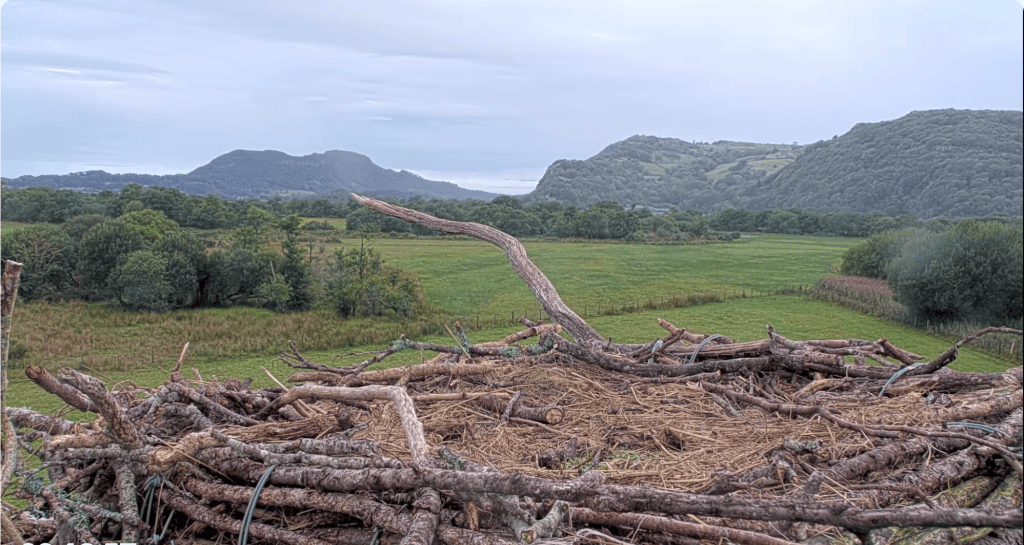
(C) BGGW/FoTo PC NEST
https://www.glaslynwildlife.co.uk/friends-of-the-ospreys-news/
Welsh nests managed by the group ‘Friends of the Ospreys’
All the following nests are managed by ‘Friends of the Ospreys’ (FotO). The group only releases a limited amount of information publicly. The following reports are compiled from this data, from posts published on public social media sites (Facebook, Bluesky, X and YouTube) and from comments on YouTube livestream chats from volunteers, visitors and osprey project staff. The reports below have not been endorsed or verified by Friends of the Ospreys.
Pont Croesor
The Pont Croesor (PC) nest is visible from the visitor centre at Bywyd Gwyllt Glaslyn Wildlife (BGGW), but this year, for the first time, it has been livestreamed on YouTube.
The nest has been occupied since 2021 by the same pairing: Aeron/Z2 (Dyfi 2017) and 014 (Poole Harbour translocation 2018). Up until 2026 they had raised 9 chicks to fledging.
In recent years, both birds have been reported as returning on the same or consecutive days. 2026 proved to be no exception, with Aeron/Z2 first seen back on his nest on the 1st of April at 12.52pm, and 014 returning the following day at 13.33pm. Over the weeks that followed, as well as building up the nest ahead of the arrival of chicks, both birds were kept very busy defending their territory from a string of intruders – some very persistent! The presence of the livestreaming camera, and some sharp-eyed viewers, made it possible to identify a number of ringed birds, many with connections to the Glaslyn Valley and other FotO nests. Of particular note is the number of visits from birds descended from the iconic Mrs G – 2 sons, 3 grandchicks and 1 great-grandchick, and from Mr Rutland, 03(97) – 2 great-grandchicks and 5 great-great-grandchicks.
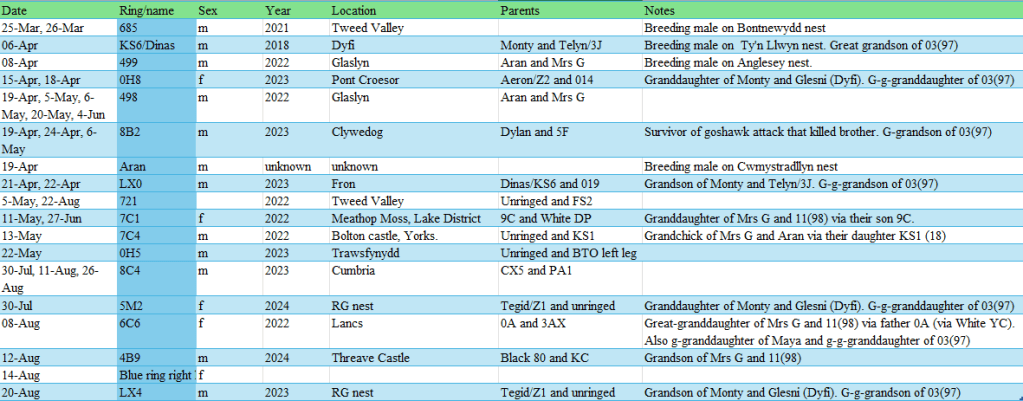
Aeron/Z2 proved to be an excellent fisherman, providing well for his family and often delivering 6 or 7 fish over the course of a day. There was a heavy preponderance of flounders on the menu, but brown trout, sea bass and mullet also featured, and even a river lamprey! This is the first known catch by an osprey in the Glaslyn Valley of this rare and protected species. Two fish were delivered simultaneously on at least 3 occasions, but in mid-August, Aeron/Z2 surpassed himself when he arrived with 3 sea bass for the eagerly waiting beaks. 014 made a small contribution to the fish tally, bringing in her first fish early in the morning of the 12th of July, taking only 2 minutes from leaving the nest to returning with her catch. Her subsequent fish deliveries were also in the early morning.
The first egg was laid on the 18th of April, followed by two more at the usual 3-day intervals. The eggs hatched in order after 37, 36 and 35 days respectively. The flounder-feast diet didn’t have any noticeable effect on the chicks’ development and all 3 had reached a good weight when they were ringed on the 30th of June by Darren Moore of FotO with Darvic rings 0T7, 0T9 and 0T8.
The following weeks were marked by extremely hot and dry weather, with 014 doing her best to provide shelter for the by now almost fully grown juveniles.
Sunday the 19th of July began like just another sunny day on the nest – a flounder for breakfast, some helicoptering, but by the end of the morning the nest was empty, as in a record-breaking feat, all 3 chicks fledged within an hour. 0T7 was the first to go, taking flight at 10.51 and flying over the Visitor Centre, shadowed closely by her mother. Having failed to land on a tree beside 014, she succeeded in perching beside her father on another nearby tree. 0T9 was next. After walking up and down the perch a few times, she finally took off at 11.41. 0T8 didn’t want to be left out and followed suite at 11.50. At 51 days old, he was exactly the same age as his father Aeron/Z2 when he took his maiden flight.
0T8 was the first to return, crash landing back on to the nest at 12.53. 0T7 returned at 14.21, also rather inelegantly. It was then a wait for the return of 0T9, but eventually, at 20.51, she landed on the nest, narrowly avoiding knocking 014 off the perch as she did so. A day of great excitement!

After a quieter couple of months, late July and August saw a pickup in intrusions, for the most part 2 and 3-year-olds scouting out possible future nesting sites. But on the 2nd of August there was an even younger visitor to the nest – 2T5, the osplets’ 3rd cousin from the neighbouring Glaslyn nest. All 4 juveniles were together for a few minutes until 2T5 misjudged her landing, so appearing to divebomb the nest, and was sent packing. She returned for a second visit later that evening, before returning home for supper.
As the season draws to a close, the call of migration gets stronger. 014 was last seen on the 10th of August. After providing an early morning fish to her offspring, she paid a visit to the neighbours on the Glaslyn nest at 11.15, helped herself to a flounder and was off. 0T8 was last seen a week later on the 17th of August at 8.59. He was 80 days old, 3 days younger than his father when he migrated 9 years earlier. 0T9 was last seen on the 20th of August at 14.21, but was likely still around on the 21st, when 2 juveniles were seen chasing a male with a fish. Finally, on the 4th of September at 8.48, Aeron/Z2 brought a flounder to the nest for 0T7. This was the last time he was seen. Five minutes later, at 102 days old, 0T7 departed the nest, bringing another successful season to a close on the Pont Croesor nest.
Cwmystradllyn
This territory was occupied last year by Aran, previously the resident male on the Glaslyn nest, after he was ousted by Teifi/KC6.
He was first seen back this year on the 4th of April at his old nest at Glaslyn. His previous mate, Elen, had been back over two weeks at this point, but was absent when Aran arrived. He was joined on the nest on the 6th of April by 7C1. Born in 2022 at Meathop Moss in Cumbria, she is the daughter of 9C, who hatched on the Glaslyn nest in 2014. She is thus a granddaughter of Mrs G and 11(98). A dark female, she has a glare reminiscent of her grandmother! First seen in Wales in 2024 when she intruded at the Clywedog nest as a 2- year-old, she paired up with Roli/KA5 on the Chris Wood (CW) nest last year and raised one chick. However, with her previous mate not yet returned, she was keeping her options open, scouting out other possible nests/partners. Having been seen at the Chew Valley reservoir in Somerset on the 26th of March, she may well have been in North Wales for over a week already.
The potential union was cut short the following day, the 7th of April, with the return of Teifi/KC6 to his nest. Aran was swiftly dispatched. Wisely, he chose not to engage in a long drawn out nest battle with the younger Teifi, risking both birds losing another potential breeding year.
We soon discovered where he had gone. Thanks to regular updates and photos from a local resident, Kathryn Keir, we have been able to follow events at Cwmystradllyn this year, and she reported that Aran had headed straight back to the site where he had spent most of 2025 and which he had visited on the previous day, the 6th of April.
7C1 remained at the Glaslyn nest for a few more days, but on the 10th of April she was chased away by Teifi. She was seen shortly afterwards at Cwmystradllyn, but there was initial uncertainty as to whether or not she would stay. In the early days she disappeared frequently – possibly torn between a potential new nest with Aran and her old nest. But by the second half of April, things were looking more settled, and she was bonding with Aran.
12 days after they were first observed mating, the birds’ behaviour changed and they were seen to be incubating. It is uncertain how many chicks hatched, but by mid-June it was clear that there was just one. There was a spell of very cold, wet and windy weather in early June, and it may well be that one or more very young chicks perished. The single female chick was ringed in July and fledged on the 26th of that month, making several flights around the nest area on her first day airborne.
7C1 was last seen on the 22nd of August. The chick has not been seen since the morning of the 7th of September. Aran brought in a fish that evening, but with no sign of his daughter, he eventually ate it himself. He was last seen at lunchtime on the 13th of September.
After a miserable 2025, where Aran lost both his nest and his mate, it has been wonderful to see him have a successful season this year, and his many fans across the world are indebted to Kathryn Keir for enabling us to enjoy this next chapter of his life.
Ty’n Llwyn
This is a new platform that was erected over the winter by FotO close to the Glaslyn and Pont Croesor nests. It is visible from the John Parry hide at Glaslyn.
The resident birds Dinas/KS6 (Dyfi 2018) and 019 (Poole Harbour translocation 2019) had been breeding since 2022 at the Fron site, where they raised 10 chicks to fledging. For reasons unknown, they decided to move to this new site this year.
019 was spotted flying over, and later landing on, the Glaslyn nest on the 5th of April. Dinas/KS6 was first seen the next day, the 6th of April, when he landed on the PC nest at 7.31am. 3 eggs were laid and all hatched, but two chicks perished early on – probably due to the very bad weather at the time. The single female chick was ringed on the 15th of July and fledged on the 27th of July.
Dinas was seen still to be present on the 16th of September.
2 offspring of this pairing are known to have been seen back this year:
– 5M4, a female who hatched in 2024 and who intruded at the Dyfi nest on the 5th of May and at Foulshaw Moss on the 31st of August.
– LX0, a male from 2023, who was seen at Pont Croesor in April and at Alyth in Scotland in August.
Ynys Môn/Anglesey
2026 was a landmark year for Ynys Môn with ospreys successfully breeding on the island for the first time in modern recorded history.
The male 499 hatched on the Glaslyn nest in 2022. He is the youngest of Mrs G’s last ever clutch – 3 boys, all of whom have returned to Wales, with 2 now breeding there. 499 was first seen on the 8th of April flying over the PC nest.
The female, 3C2, was one of a brood of 3 born in 2024 at Carrbridge, Inverness, Scotland. She is the first 2-year-old known to have bred in Wales.
After a late start to the season, the pair saw their first chick hatch on the 23rd of June. Two chicks were ringed – 7T6 and 7T7, and by mid-August both had fledged. The two juveniles had left by the 20th of September, and 499 was last seen on an empty nest on the morning of the 21st.
It has been a successful first season for 499 and 3C2, despite significant disruption from photographers trespassing close to the nest.
Chris Wood nest
This nest was occupied in 2025 by Roli/KA5 and 7Cl. They raised one chick together.
Roli returned in the second half of April this year, a couple of weeks later than in 2025, he paired up this year with an unringed female.
Alwen nest
This nest was previously occupied by 416 (2020 Cumbria) and Eshells/432 (2021 Kielder 6). 416 did not return from migration. Eshells/432 was present on the Glaslyn nest early in the season but has not been seen since being chased off by the resident female, Elen. Although Eshells/432 has been since intruding at Llyn Clywedog.
RG nest
The residents of this nest are Tegid/Z1 (Dyfi 2016 – lost Darvic ring), who was first seen this year on the Glaslyn nest on the 7th of April, and an unringed female. They previously bred at a different location, known as the BM nest, and moved to this site in 2023, possibly because of disturbance from forestry activity. They have been together since 2020 and had raised 16 chicks together up until 2026. This is the 16th year of breeding for the unringed female. Having raised 33 chicks to fledging prior to this year, she is the most prolific osprey breeding in Wales at present.
A number of offspring from this nest have been sighted this year:
- 5M2, a female who hatched in 2024 and has been seen for several weeks around the Glaslyn Valley.
- LX4, a male from 2023, seen on the PC nest.
- KC1, a male from 2019, first seen back in 2021, visited the Dyfi nest late April.
- Z5, female 2020, breeding at Clywedog 2 since 2023
- W6, male 2015, breeding since 2020, now at Kielder 1A
North Wales
The pairing of 685 (2021 Tweed Valley) and an unringed female, have been breeding here since 2024. 685 was seen on the PC nest on the 25th of March. He is often sighted fishing at Malltraeth, Anglesey.
ON10 North Wales
The residents of this nest are an unringed male and a female with a BTO ring on her left leg. This female is thought likely to be KS8 (2018 Clywedog, first returned 2020). They have been breeding here since 2023 and up until 2026 had produced 9 chicks.
(C) Florence Flounder.
It is known that Friends of the Ospreys manage several other active nests in North Wales which have been publicly reported on in the past, however no information has been released publicly by them for these nests in 2026, which is their choice. UKOI, does however, really appreciate the work done by Friends of the Osprey, also the streaming of the PC Nest and the information that they have chosen to share. The combined efforts of the Welsh projects must be applauded, collectively they have been very successful .
LLYN BRENIG
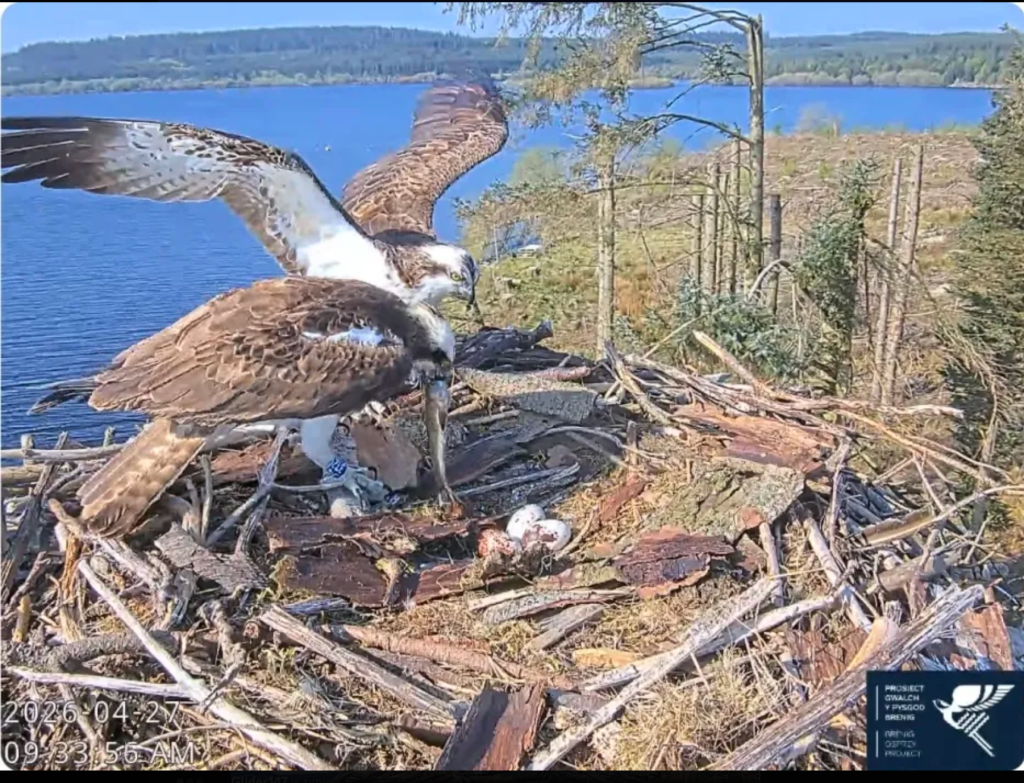
Llyn Brenig 2026 Season Summary
The 2026 osprey season began with news that our female, Blue 372, had been spotted at a lake near Madrid where she stayed for at least six days between 20th and 26th of March. She arrived at Llyn Brenig seven days later, on the 2nd of April. The straight-line distance is 875 miles, although ospreys do not fly in a straight line.
A young, unringed male joined 372 at the nest for a couple of days but seemed inexperienced. Rather than bringing her fish, he tried to take hers, and her surprised reaction was amusing.
Our male ringed blue LJ2 arrived on the 7th of April and quickly drove the young male away. We saw no sign of male Blue 416, who had caused all the trouble the year before or his partner Blue 432. (432 did visit the Glaslyn nest but only stayed a couple of days until the resident female returned)
Unlike the previous two years the start of the season was quiet. LJ2 and 372 quickly began to bond, building their nest together, LJ2 bringing 372 fish and mating.
With LJ2 perched close by, 372 laid her first egg at 7:32 am on 21st April. She laid her second at 5:00 am on 24th April and her third at 2:47 am on 27th April.
What is really fascinating about our pair of Ospreys is that while they have eggs, they do not do what the books say. The books say that female should be incubating the eggs most of the time with male bringing her fish and incubating the eggs when she needs a break. But as I said, this pair do not read books! LJ2 loves to incubate and 372 continues to fish. This is just the way our pair do things; they have done it this way for the last three seasons.
On the 28th of May, our first chick hatched (Bob1) and on the 2nd of June the second chick hatched (Bob2). Unfortunately, the third egg did not hatch. We are unsure whether it was the second or third egg that hatched, they were both within the hatching window. We were incredibly pleased to have two healthy chicks. At this time 372’s maternal instinct kicked in fully and she stopped fishing. After LJ2 had had a good rest for a month undertaking more than 50% of incubation duties, he returned to fishing duties for his family.
372 and LJ2 fiercely defend their nest against intruding ospreys. While 372 remains on the nest to protect their young, LJ2 chases intruders away or returns when one ventures too close. Even crows are unwelcome on the osprey peninsula. LJ2 clearly enjoys chasing them, and 372 has learned this “crow-bashing” behaviour from him and now seems to enjoy it too.
Ospreys are amazing birds and they seem to continue to learn throughout their life. 372 arrived at Llyn Brenig and during her first season she didn’t bash any crows whereas now, three seasons in, she has learnt to do this from LJ2 and is now as good a crow basher as LJ2, also showing us some spectacular flying while she’s doing it.
Bob 1 and Bob 2 were fed well and they grew quickly. The chicks were ringed on 7th July, although Bob 1 appeared larger in the nest weighing revealed that he was the smaller chick. Bob 1, a male named Rhys with ring number 9L1, weighed 1.48 kg. Bob 2, a female named Winni with ring number 9L2, was the heavier chick at 1.69 kg.
At 52 days old, 9L1 made his maiden flight and fledged on 19th July. His sister followed on and fledged on the 29th of July, aged 57 days. Just five days after fledging, the eager 9L1 was seen diving twice in attempts to catch fish. Once both young ospreys had fledged, 372 resumed fishing, mostly at Llyn Brenig, giving volunteers and visitors spectacular views of her in action. She caught some exceptionally large trout and shared them with the family.
We were not surprised when 9L1 Rhys was the first to leave on his migration at 84 days old, on the 20th of August. 9L2 followed suit and was last seen on the 31st of August. LJ2 left on his migration on the 4th of September and 372 was also last seen on the 2nd of September.
We wish all our osprey family a safe migration and hopefully see LJ2 and 372 return to Llyn Brenig next year.
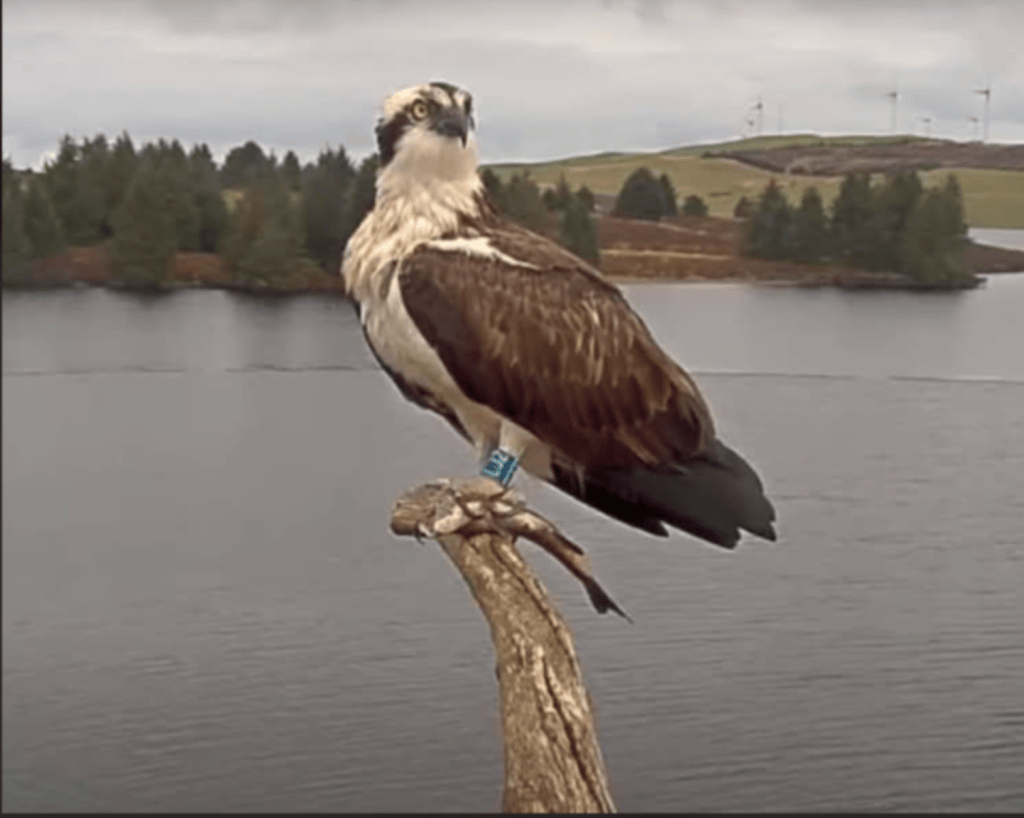
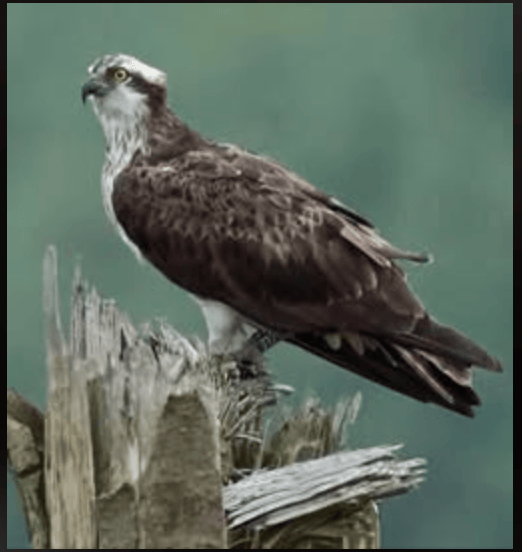
SARAH CALLON
SOME DIFFERENT VIEWS FROM AROUND THE NEST.
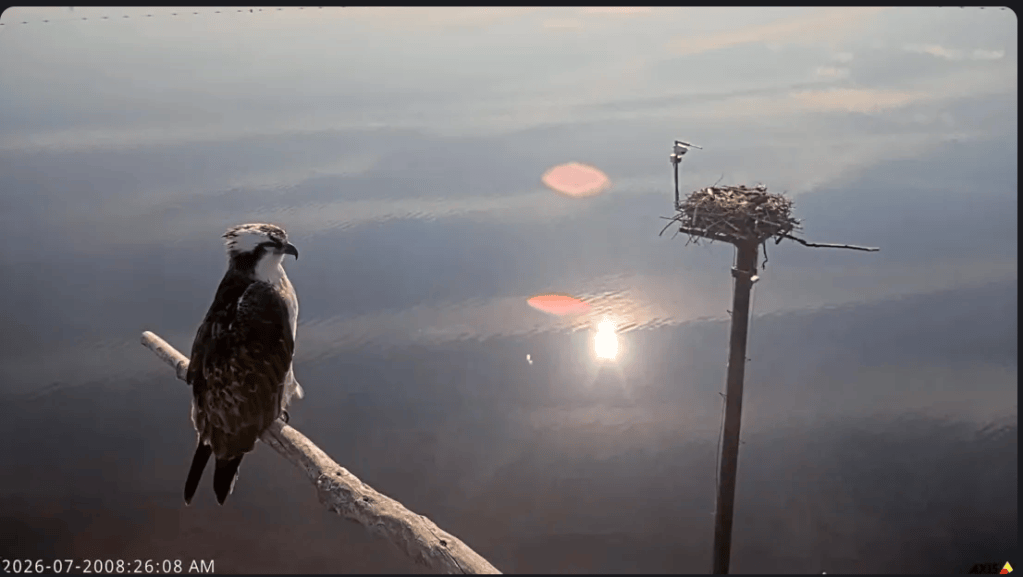
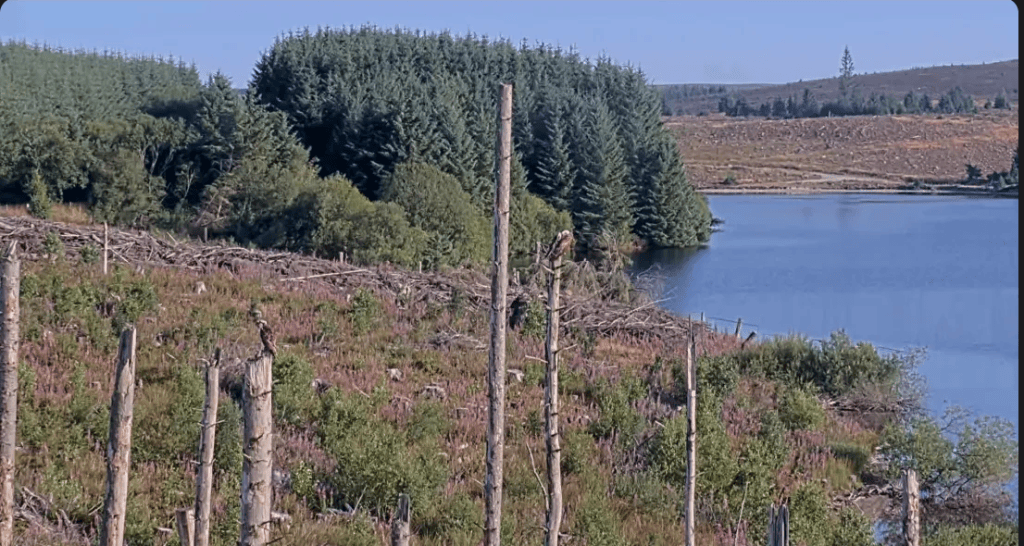
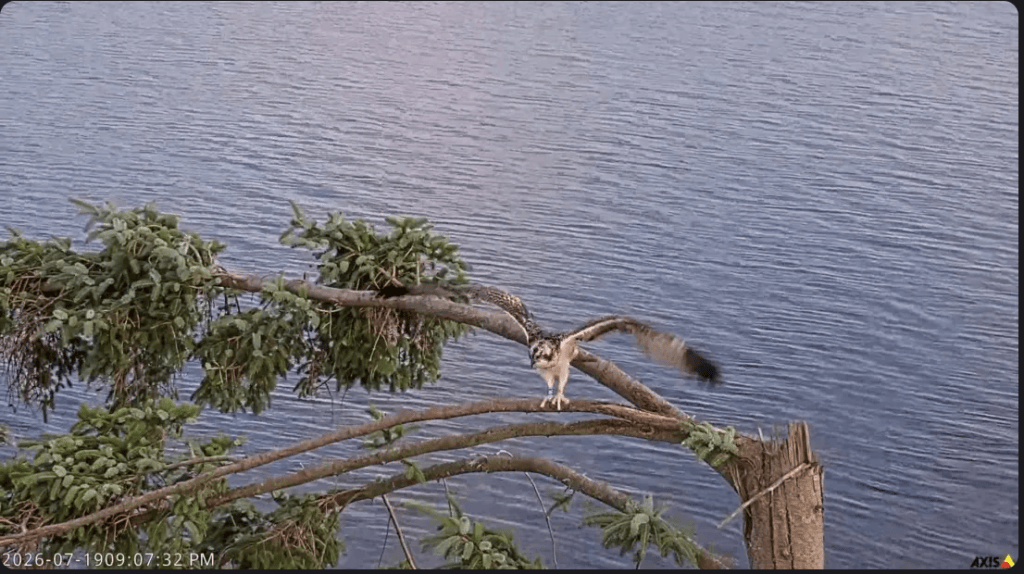
CREDIT:- Brening Osprey Project ( Thanks to Glider for the Screen Captures)
USK VALLEY
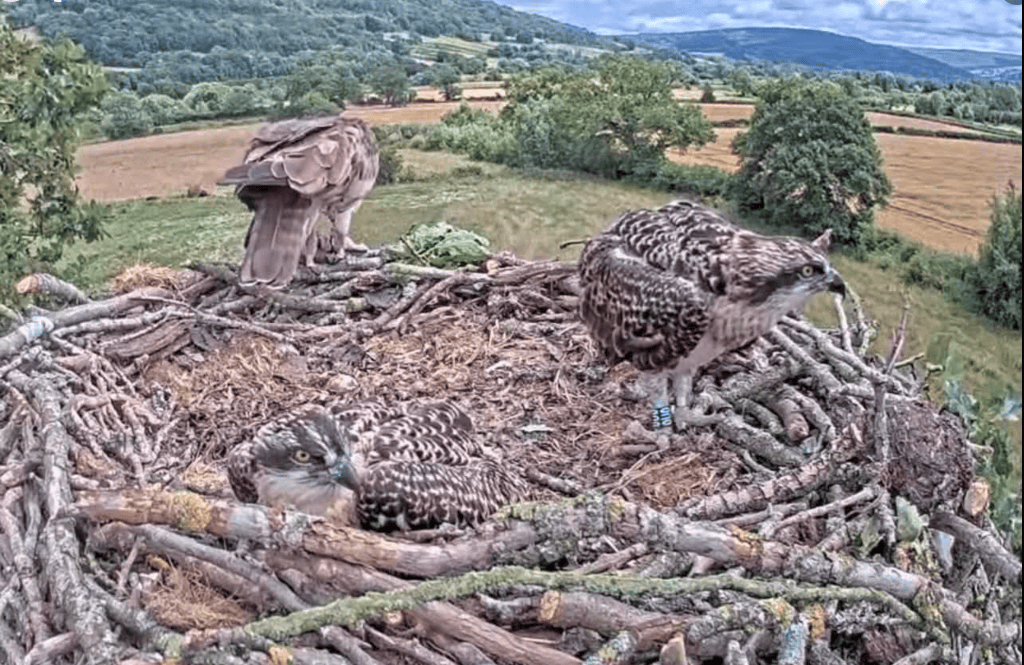
USK VALLEY NEST
LINK TO USK VALLEY OSPREYS
USK VALLEY OSPREYS
Male:- Unringed, named Syfaddan, returned 6/4/2026 @ 14:35 (observed in the field). Last seen xx/9/2026
Female:- Unringed, named Clogwyn, returned 29/3/2026 @ 07:05 (Nest camera). Last seen 1/9/2026.
The second breeding year for this pair who came together in 2024, and fledged their first chick in 2025 – Male, Blue 9K5 – the one egg to hatch from a clutch of 3.
After some emergency nest rebuild work by Wildlife Windows just the week before, the Female arrived back much earlier than last year, by 19 days. She was reunited with her mate when he arrived 8 days later. His arrival was also earlier than last year, by 8 days. They worked well together to build their nest back up through a wet and cold period, and, as was the case last year, they needed to fend off intruding Osprey who started to arrive from early in the season, the first being an unringed female on 5/4. See separate list for nest intrusions – many more intrusions have been observed by UVO Field Volunteers, some of which resulted in the Male being absent for long periods of time.
Unfortunately, a camera outage occurred from 13/4 until the evening of the 17/4 which prevented the Camera Volunteers from formal monitoring. A UVO Field Volunteer undertook observation during daylight hours for this period in an effort to continue recording successful mating attempts. 3 eggs were subsequently laid. The 1st egg was 19/4, the 2nd on 22/4 and the 3rd 25/4.
We saw the Male much more adept this year at taking on incubating duties, with the Female often needing to chivvy him off to let her back on the eggs. With the first hatch on the 28/5 we saw the Female deftly feeding their youngster and, the same as last year, actively excluding the Male from becoming involved. The second hatch was on the 31/5 and whilst this was the first time that the Male got to briefly feed his offspring, he remained regularly & deliberately sidelined from this activity. The chicks were well protected from wet weather in June, and from the extreme temperatures that followed. Some sibling aggression was seen, with the oldest chick often attacking the younger. This went on for a couple of weeks, until the younger chick became more comparable in size towards the end of June. They developed as expected, with both chicks moving sticks and attempting to feed themselves later on in that same month. On the 23/6 one of the two nest cameras suffered a direct hit when the oldest chick defecated. Rain a few days later helped to clear some of it off, and the tree climber for the Llangorse Ringing Team was kind enough to fully clean it on ringing day (4/7). Both chicks are believed to be female. They were exercising their wings by early July, and, by the second week of that month, they were feeding themselves. The remaining egg failed to hatch, ending up on the side of the nest, and was seen to explode during an extremely hot day on 10 July.
Helicoptering started for the oldest chick, 0U0, on 13 July and she fledged on 19 July. Her sister, 0U1, started to helicopter on the 16 July and underwent a forced fledge on the 23 July when 2 military planes flew low up the Valley and over the nest.
The Male provisioned his family well throughout the season, mainly catching brown trout from the River Usk (which runs a few metres from their nest), with the occasional coarse fish from nearby Llangores Lake. From early August the youngsters regularly played ‘tug o war’ with fish, with 0U1 often managing to steal fish from her older sister. The female also started hunting again in the second week of August and, although eating her catch away from the nest, she also started to provide fish for her youngsters. This is in stark contrast to last year when she continued to expect the Male to provide for her and their one chick. The youngsters became ever more protective of their fish, often lunging at the providing parent after taking possession, with 0U1 pushing her father from the nest on one such occasion.
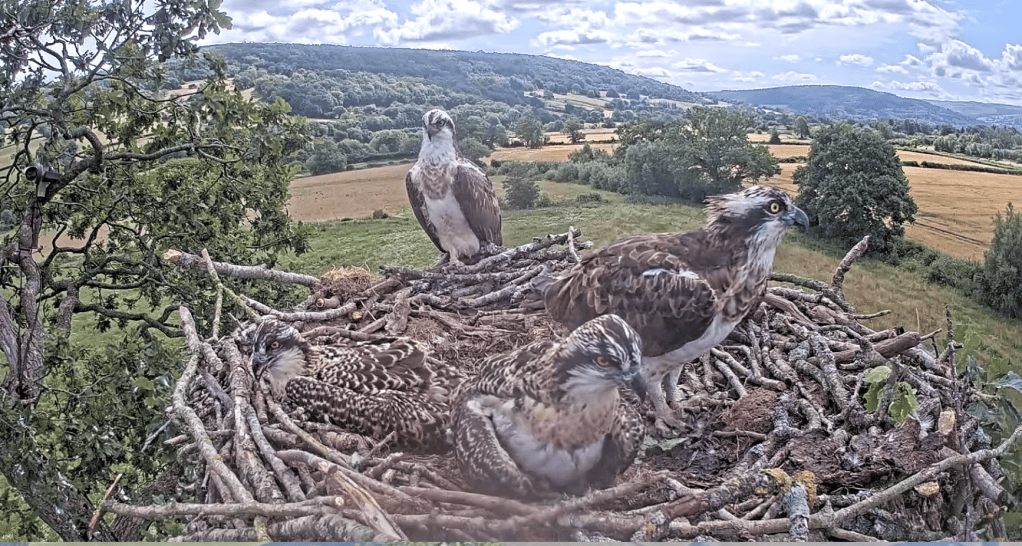
Observations from a UVO Field Volunteer indicated that development continued as expected for the youngsters, with practice diving happening during their last couple of weeks in the Usk Valley.
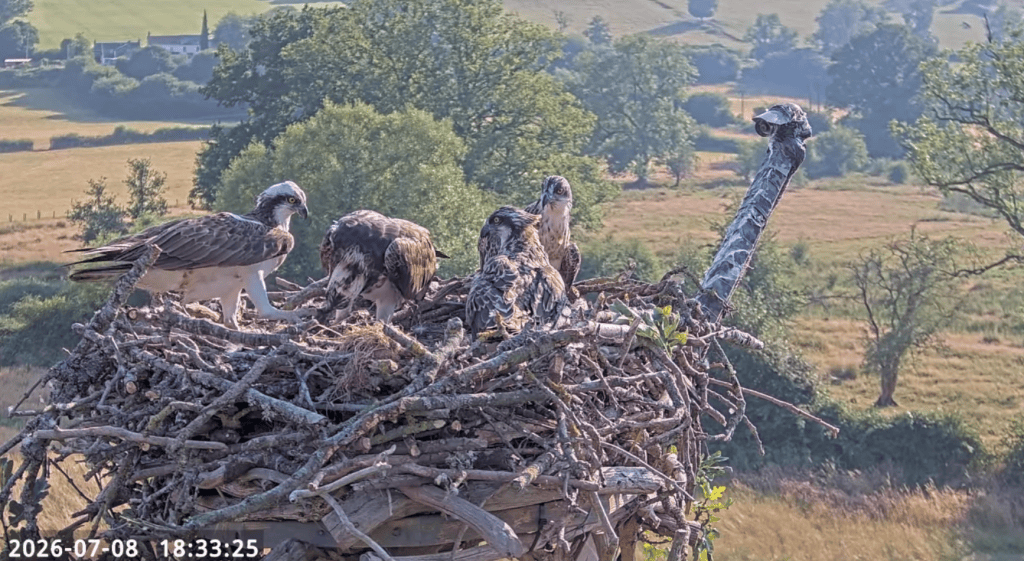
The Female was last seen by a Field Volunteer on the 1/9. 0U1 was last seen on the nest on 5/9, aged 96 days. Her older sister, 0U0, was last seen by a Field Volunteer on 8/9, aged 102 days – yet to be confirmed by UVO.
At the time of writing, the Male is yet to leave.
Not unlike a number of other Osprey nests in the UK, this pair had to contend with human interference in various forms. People beneath the nest – on one occasion resulting in the Female being off her eggs for an hour. Poachers and their torches were also seen during the early hours on one morning. The UVO Chairman, Welsh Govt (the landowner) and Dyfed Powys Police have reviewed security arrangements and it is hoped that extra warning measures will keep people away from the restricted zone around the nest. Rubbish – soft plastics, a long length of fishing line and some baling twine were items brought back in nesting material after the first egg was laid. The male was fortunate to be able to free himself when he found himself dangling from the nest with the baling twine wrapped around a leg. The arrival of a discarded pot plant and bamboo garden stake were less of an issue and, what looked like the wing of a bird of prey, was removed the day after it was brought in. Low flying aircraft also factored again this year.
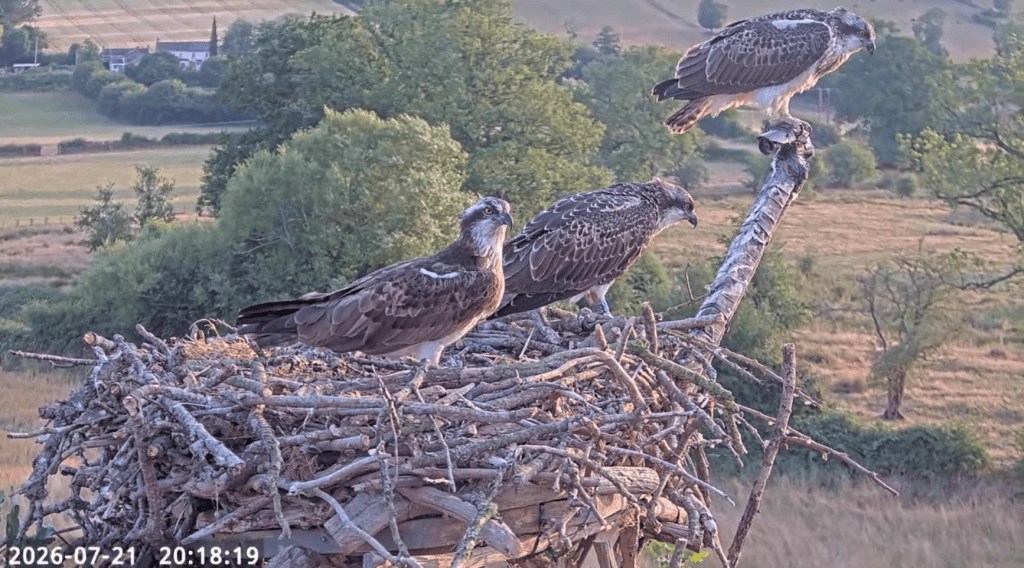
I wish all the birds a safe flight and hope to not just see the adults returning in 2027, but also that we hear news of 0U0 & 0U1 returning as 2 or 3 year olds.
Author : Louise Milne
10 September 2026
RINGED INTRUDERS
USK VALLEY OSPREY/NEWS BLOGS
https://www.uskvalleyospreys.org/news
OTHER WELSH NESTS/NEWS
MID WALES
A nest first used in 2024, The breeding Pair of Blue KA7 (Darvic Lost 2025, Damaged IN 2024) and Blue 469 both returned and have raised 3 chicks, the Chicks were ringed on 18/07/25 by the Llangorse Ringing Team, rings used were Blue 9K6, 9K7 and 9K8.
LLANGORSE RINGING GROUP BLOG
Osprey ringing 2026
The 2026 Osprey “season” has so far been a busy one for a couple of members of the ringing group, with lots of work done on monitoring the expanding local population. In recent weeks, the usual experienced team of ringers attended both sites we have previously reported ringing at. First up was the Usk Valley Ospreys site where the birds can be watched on a 24 hour live stream, this has provided fascinating viewing for many people again this year. The unringed resident pair have returned and have two healthy female chicks which are now fast approaching an expected fledge date, with the live stream showing more and more “helicoptering”! The relevant ringing details were as follows:
Chick 1 (age 37 days) colour ringed 0U0 – wing-measurement of 348mms and weight of 1820g.
Chick 2 (age 34 days) colour ringed 0U1 – wing-measurement of 308 mms and weight of 1750g.
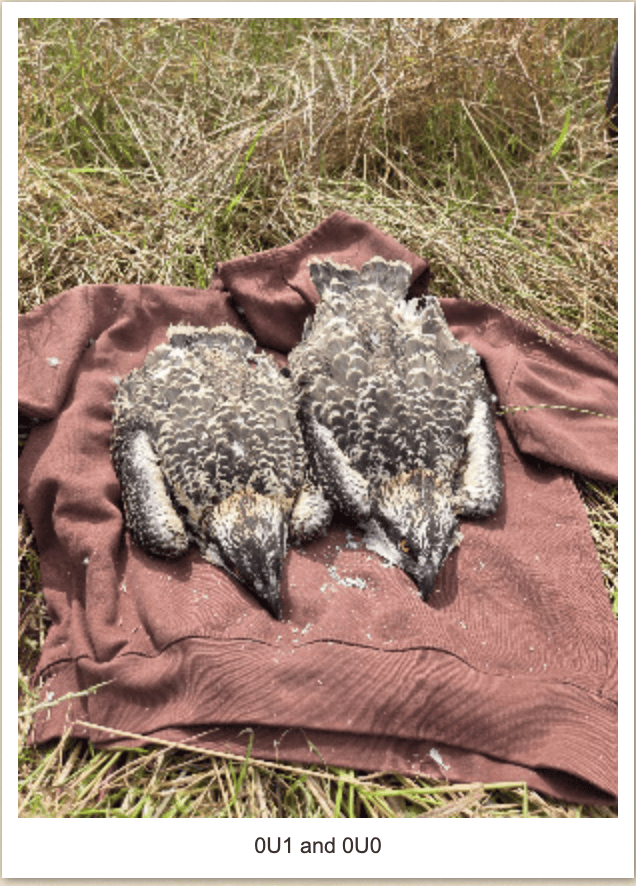
The second site we have reported on in previous years was only a few days behind the UVO nest this year, the same adults are again present at this site. Male KA7 (who has lost his colour ring), he is a 2019 bird from the original nest at the nearest “cluster” of nests to his own site. This is around Clywedog Reservoir where John Williams has done so much wonderful work protecting Ospreys as they colonised the area as they have spread through Wales. Female 469 (2021 bird from a Private Lancashire site) appears a fierce protector of the site against Osprey intruders. The same experienced team again visited and ringed 3 chicks at this productive site. The details for these three chicks C/Rs were:
Chick 1 0U2 – wing 327, weight 1600 – Female,
Chick 2 0U3 – wing 321, weight 1520 – in the “overlap zone”, won’t be sexed when officially submitted, possible Female
Chick 3 0U4 – wing 286, weight 1440 – Male.
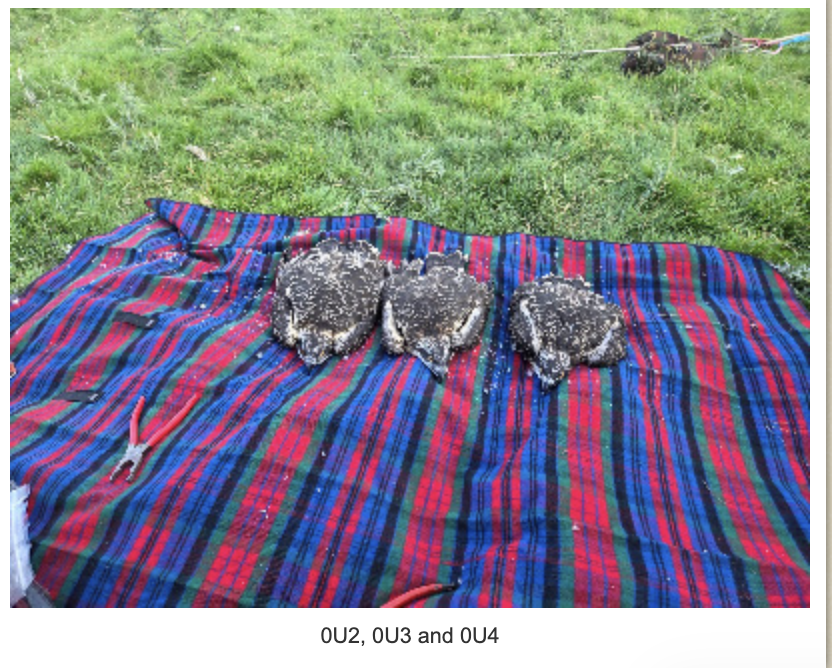
It is important to acknowledge the work that has gone in to protecting the birds at both these sites, the volunteers at Usk Valley Ospreys maintain a 24 hour watch of the nest which, with the additional security measures, provides the best protection possible for this pair. We are thankful to each and every one of these volunteers who give so much of their time.
At the second site there has been significant disturbance in both previous years they have bred. This is primarily because the vulnerable location has been shared on social media by a few individuals. This disturbance has included a “forced fledge” in 2025 when all three chicks were witnessed leaving the nest for the first time, in a panic, together, as a couple of humans approached the nest with camera’s. On this occasion, thankfully enough information was recorded of the individuals in question, which resulted in the police taking formal legal action against the perpetrators. This isn’t the only time the police have had to take legal action at this site. Given a forced fledge can often have dire consequences for the birds we were extremely pleased to have had the sighting of 9K7 on its wintering grounds last winter (as reported here). If you know of the location of this nest, it is extremely important for the continued success of these birds that you don’t share it. It is also very important that if you are viewing the site that you view from a safe distance.
The persistent disturbance led our ringing secretary and schedule 1 licence holder to form a small group of local observers to watch over this nest from 2026 onwards, this has proven very successful with all disturbance events being reported to the relevant authorities quickly so action can be taken. This has led to a large reduction in the amount of disturbance this pair have faced in 2026, although there have still been concerning incidents. We are incredibly proud of this improvement and the work of this small group has been absolutely invaluable in this, so we couldn’t be more grateful to them for the time and effort they have put in, every day, to help us protect these birds.
MONMOUTHSHIRE
This is the second year for this nest, Last year they were unsuccessful when the Chicks were predated after Ringing, This year the same pair raised 3 chicks to Fledging. This pairing of Blue 497 and Blue 2H4 links the Glaslyn and Rutland projects. Ring numbers have not been disclosed publicly
WELSH NESTS/BIRDS 2026
EMYR EVANS DISCUSSES INTRUDERS AT WELSH NESTS
A Crowd in the Skies: The Surge of Welsh Osprey Intruders, (EMYR MWT)
IRELAND
Once again Ireland appear relutant to share information, UKOI understands that two batches of chicks were translocated 10 from Southeastern Norway and 16 from Central Norway. Central Norway we are told have had a very good year. To date we understand 56 Chicks have been translocated to Ireland from Norway, only 2 have been mentioned post Fledging White 21, was photographed in Devon 07/09/25 and second being White 34, See Below.
IRISH RESCUE.
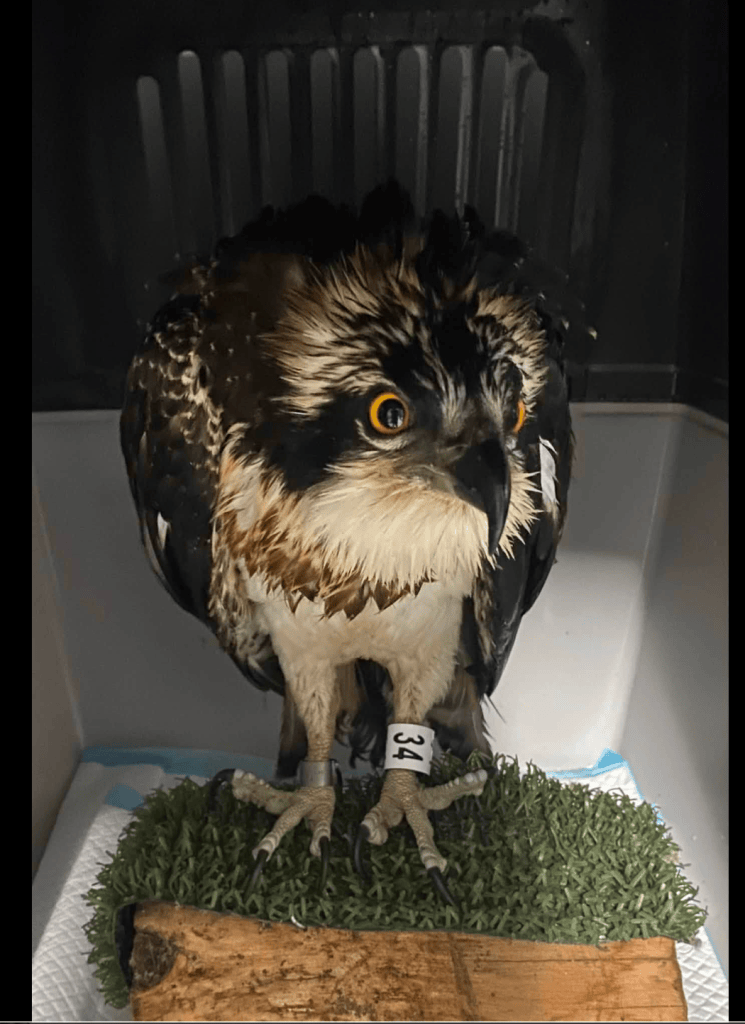
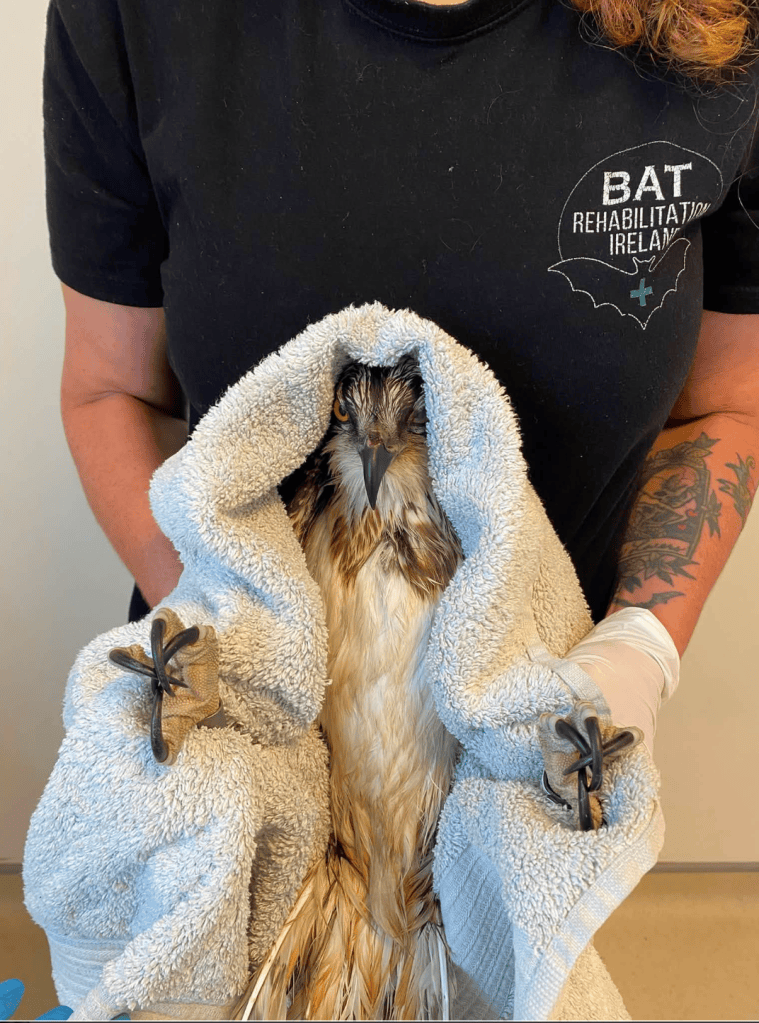
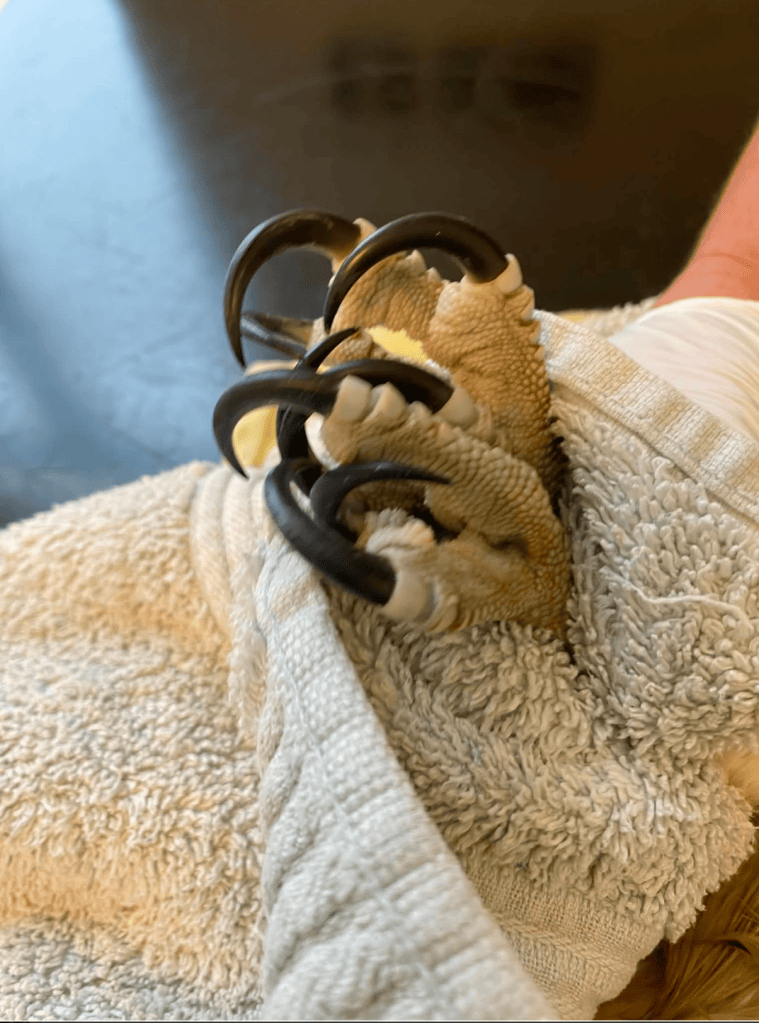
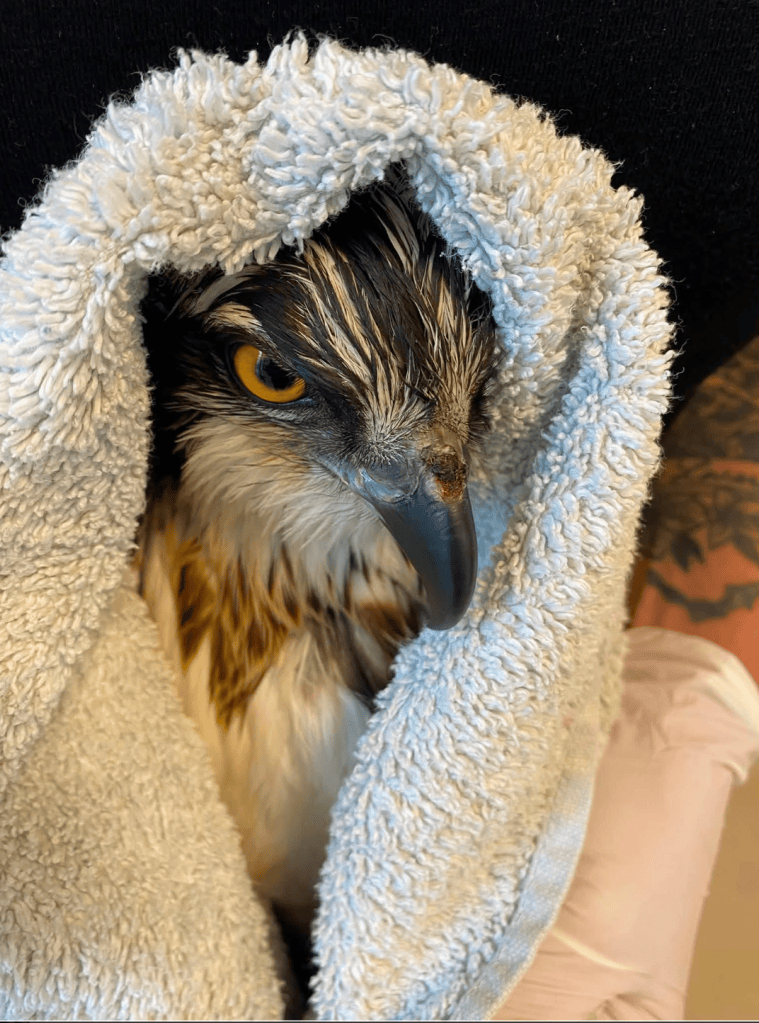

Today brought us a rescue that was very different from anything we have dealt with before.
We received a call from Bev at the Hogsbrickle, who had been contacted by a member of the public after an Osprey had been found grounded and in distress in the Killaloe area.
When we arrived to collect this magnificent bird, it was extremely flat, exhausted and completely soaked through.
We immediately began supportive care and were able to administer subcutaneous fluids and electrolytes before bringing the Osprey to the vets in Castletroy, Limerick. The veterinary team were absolutely fantastic and carried out a thorough assessment.
Thankfully, there were no obvious physical injuries. The bird was suffering from severe exhaustion and needed supportive care and time to recover.
What makes this rescue even more special is that this is one of the Ospreys involved in Ireland’s Osprey Reintroduction Programme. These magnificent birds have been brought over from Norway as part of an important conservation programme aimed at establishing a viable breeding population of Ospreys here in Ireland. The released birds are individually identified and fitted with satellite transmitters so their movements can be monitored. 
All of the relevant bodies have been contacted and are aware of the bird’s situation.
And the best news of all…
This evening, this incredible bird is doing really well.
After the condition we found it in this morning, seeing the difference already is incredibly encouraging, and we are very positive about its chances of making a full recovery.
I have worked with birds of prey for 20 years, but this was my first time ever handling an Osprey.
To have the privilege of being so close to such a magnificent species was something I will never forget. Even with many years of experience handling birds of prey, you cannot help but be struck by the power, beauty and sheer majesty of an Osprey when you are standing beside one.
It really gives you an even greater respect for these incredible animals and for the importance of protecting them.
A huge thank you to the member of the public for rescuing the bird and to the amazing veterinary team at Limerick Veterinary Hospital
Tonight, we are just incredibly grateful that this beautiful bird is safe, receiving the care it needs, and heading in the right direction.
We hope that, before too long, this magnificent Osprey will once again be doing what it was born to do,flying free.
OTHER NEWS ITEMS
Interesting read, showing a small population increase across Scotland. Published April 2026
SCOTTISH RAPTOR MONITORING SCHEME, 2024 REPORT.
TEACHING MATERIALS
Osprey Teaching Scheme
The Osprey Teaching scheme has been written to engage pupils with the natural world around them. The lessons within the scheme aim to put pupils at the centre of the learning and to enthuse them to become healthy, confident individuals, ready to lead fulfilling lives as valued members of society and ethically, informed citizens of the world, and maybe the conservationist of the future…!
Curriculum areas covered across the Osprey Teaching Scheme include: science, technology, maths, literacy, history, art, music and geography. The Osprey Teaching Scheme has been written to support teachers of pupils aged between 9-14 years old and includes Lesson Plans and PowerPoint slides. Each lesson has been written to last between 1-2 hours. There are a total of 13 lessons. The lessons have been written in a chronological order to reflect what pupils would be able to observe over a full osprey season in the UK.
Teachers could teach all 13 lessons in order, or alternatively pick and choose individual lessons to teach. Each Lesson Plan provides learning intentions, suggested curriculum links, assessment ideas, key questions, lesson resources, teacher and pupil activity ideas.
The Osprey Teaching Scheme has been written by me, Dr Andrea Mapplebeck, with support from my colleague and friend, Dr John Walker. I am a science educator who is passionate about learning and wildlife. After having worked in education for over 3 decades I wanted to support other teachers to enthuse their pupils about the world around them. I decided to start by focusing on ospreys as they are my favourite bird and offer so many wonderful inspiring learning opportunities! Lessons have been used by teachers in the UK and abroad, if you have any feedback, questions or examples of pupils work to share, then please do get in touch with me on email at info@andreacm.co.uk
(C) ANDREA MAPPLEBECK
SIGHTINGS
Overall reported sightings are up this year, we asked Birguides about their policy of reporting sightings in Scotland, This is the reply we received:-
“Thanks for your email. As you surmise, we do not routinely report Ospreys in Scotland owing to their status as a fairly widespread summer breeder. Likewise, we don’t report the species in or around breeding areas in England or Wales either, and aim to only report migrant birds”.
Below is the link to the sightings page on the Website.
In line with an increase in reported sightings this year, sightings of 2 year olds returning for the first time is also up on the last couple of years.
Below is the link to 2 Year old Returners on the Website.
SUMMING UP
Two sides of one coin:-
HEADS
Generally speaking a very good season, particularly in England and Wales, Figures for Wales have been quoted as 25 Nests producing 47 Chicks, phenomenal when you think that the first nest in Wales was only 22 years ago. Equally the first nest south of the border in England was at the turn of the centuary, there are now 40+ Nests nest which this year produced a minimum of 60 chicks. Kielder Forest has had a much better season than of late and at least 3 new nests in the Lake district. Rutland continues to flourish and a 3rd nest in the Midlands. UKOI has records of over 140 ringed birds this season. Over 30 first time returning 2 Year Olds have been reported, which bodes well for the future. Similarly reported last year Maya and Black 80 have both increased their tally again this year putting both into the mid forties. Yellow 30(05) has bred again this year, is she the oldest breeding bird we know, although White PE Morven is known to have returned we do not know if she breeds.
TAILS
The majority of the downs this season appear to be north of the border in Scotland, although some predation in Wales and the tragic situation at Llyn Clywedog does impact on the season in that area. At two nests, Loch Garten and Alyth the resident Males went missing in May resulting in the loss of both nests. We have to wonder if the extreme hot weather impacts productivity. With many nests producing only one or two chicks. The list below shows the known losses across the estate.
THE FINAL WORD ( A BIT OF A GRUMBLE)
LIVESTREAM CHAT
There has been an issue at one of the RSPB nests this year with the unmoderated livestream chat. There have been accusations of bullying and harassment, on occassions the chat was unpleasent and exclusive rather than inclusive, this behaviour did spread to another forum, which resulted in suspension of an individual. However, this problem is not restricted to any one nest, it can quickly invade any unmoderated chat. We would hope/ask that projects can see their way to moderate chat next year. Across several of the nests/Livestream Chats there seems to be a small group of people who appear to act as experts attached to the project, when in fact they are simply chatters with some experience but no official position with the project. Chat should be a place where anyone can ask questions, express opinions without being made to feel stupid or small, We would ask that our members challenge negativity and bullying behaviour without becoming embroiled in arguement and also encourage the asking of questions and the enthusiasm of new followers.
Social Media.
2026 has had its tragic moments, Male Birds going missing at Scottish Nests, Eggs predated by corvids, Eggs evicted from nests by new males, Eggs failing to hatch and then the tragic loss of all three chicks at Llyn Clywedog. All of which in our view are not as sad as some of the reactions projects have had to put up with. Ill informed people criticising decisions made and actions taken. All the people either working at or volunteering at the projects, put in way above and beyond and should be supported, praised and congratulated by those of us who take advantage of their work and watch Ospreys from the comfort of our homes. But no, some of us choose to criticise, complain and behave in an offensive way, UKOI cannot and never will condone this type of behaviour, We ask all our members to support projects, challenge negative behaviour and comments. We would ask our members to lead by example on how to respond to these types of incidents. Show patience, Be polite and do not inundate Projects with questions, they will issue updates as and when they have time. Questions at the time of an incident can be misconstrued as criticism, where as asked a later time will be seen as seeking knowledge/understanding of the incident,
A BRIEF REVIEW OF UKOI
UKOI is not an individual it is a community of like minded people, it continues to go from strength to strength. UKOI grew out of the sad loss of Pete Dee who created and ran United Kingdom Ospreys a site that underpins UKOI. The website has now passed the 500K page views, and the Facebook Group has OVER 2.2K members. UKOI now has a growing presence on Bluesky, with many more people sharing information and photographs with us.
Caroline Woodleys https://ospreyinfo.azurewebsites.net/ospreys. Is an integral part of the UKOI family, a extremely easy to use database, there is also a CountDown Clock.
We are really excited about Plans for 2027 with STRONGER Links to another Website, WATCH THIS SPACE!!!!!!!!!
WINTER PLANS/PROJECTS
LAST SEEN DATES
It was recently pointed out, that we do not have a record of last seen dates for monitored birds, so that task is underway. Anyone who has a record of last seen dates for known birds at monitored Nests going back to 2020 or beyond, it would be extremey helpful if could let us have them.
NEWS ARTICLES/HISTORY
We will continue to collect old and new news articles, historical documents, anything that helps complete the jigsaw. Some years there appears to be far less news articles than in other years.
SPECIAL PAIRS
There are some pairings, that have stood the test of time, we will be adding a section of pairings that have either lasted past 9 years together or produced over 18 chicks to fledging, these figures may change as we discover the pairs that qualify for listing. Any special pairings that spring to mind please let us know.
DISCUSSION, DEBATE AND CONVERSATION
We are hoping to arrange some online talks, with different people. Send out some questionaires and find out things that might be of interest. So if you have any ideas, suggestions to help fill the next few months let us know.
Any information regarding Arrival/Last seen dates you can share withus would be appreciated, Any links to news articles past or present that we have missed again would be appreciated and finally suggestions for special pairs who fit the criteria mentioned above.
CREDITS(The End)
We would like to take this opportunity to thank all those who have contributed throughout the season and to this summary.
Credit and Thanks to ➖
| NEST | CONTRIBUTOR |
| ALYTH | RUTH BOUGHTON & LIVIA ARMSTRONG |
| BLYTHFIELD | PHIL COOPER |
| BRENIG | SARAH CALLON |
| BOLTON CASTLE | SAM MASHFORD |
| BORDER OSPREYS | ROSIE SHIELDS BLOGS |
| DYFI | CAROLINE WOODLEY |
| GLASLYN | CAROLINE WOODLEY |
| FOTO | FLORENCE FLOUNDER |
| LLYN CLYWEDOG | LIZ JONES |
| LOCH DOON | JACQUILINE REILLY |
| LOCH ARKAIG | MARY CHEADLE |
| MANTON BAY | ROSE RAINSFORD |
| POOLE HARBOUR | ALISON COPLAND |
| PROOF READING | CAROLINE WOODLEY & MARY CHEADLE |
| RANWORTH BROAD | SAM WALSHE |
| SCOTTISH NESTS | JEFF KEAR, PROJECT UPDATES |
| TWEED VALEY | COMBINED WEEKLY UPDATES DIANE BENNETT |
| USK VALLEY | LOUISE MILNE & RACHEL MILNE |
Content.
The accuracy of reports credited to individuals is their responsibility, UKOI has not fact checked those reports. We have asked that all information is gained from public sources and that any media used is used with permission of the owner. All reports are intended to promote Projects, conservation and inform through sharing information.
Finally we would like to recognise all the individual projects, without their tireless work, UKOI would have nothing to report or share. Please if you are able to contribute to one or more of the projects either financially or with your time, PLEASE DO.
Promoting individual Projects and Osprey Conservation in general is one of the many ways we can support them, sharing knowledge with others increases awareness and understanding.
All information is gained from public sources as are the Photographs, (we have permission to use those photographs not from open sources) and verified to best of our ability, if you come across any errors please let us know, either by commenting on this blog or via the email address below, you can also contact us through the Facebook Group below.
UKOsprey Information/FaceBook Group.


2 responses to “2026 SEASON”
Thank you so much for all the detailed information that has been collated and presented. Great work.
LikeLike
fantastic effort everyone, only my second year of watching these fabulous birds. There were highs and lows, and I am learning to cope with the lows, albeit not to many thankfully. Thanks you all ,🫶
LikeLike